

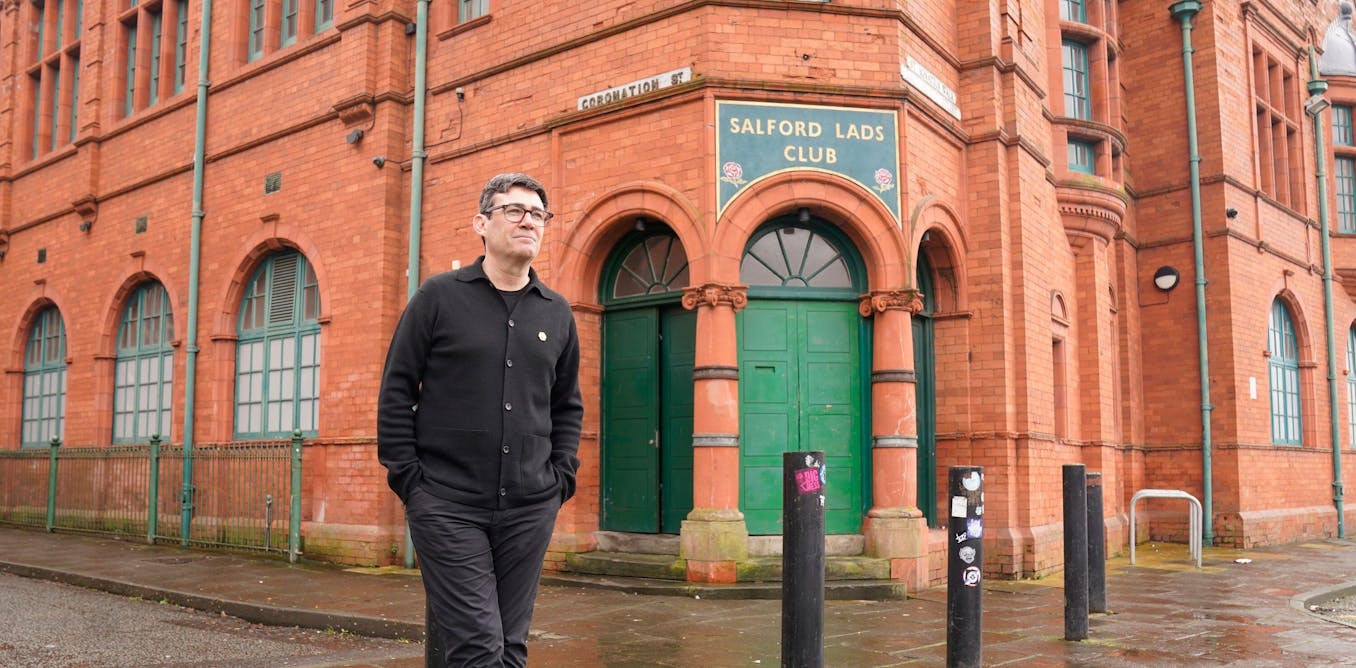
Alamy/PA Images
Manchester has always been an English city that tells its story through culture. Its reputation was not built solely through a global crucible of industry, commerce or politics but through music, football, television, art and a tradition of creative self-invention.
The northern English city of Manchester has played a critical role in the development of Andy Burnham’s political and social outlook. This series considers what some have dubbed Manchesterism and what it might mean for the future of the UK.
Few cities have translated local culture into international influence quite like Manchester. It is the city that gave the world Joy Division, The Smiths, New Order, Oasis and The Stone Roses; where Factory Records and The Haçienda redefined independent music and club culture; where punk, post-punk, rave and Britpop became part of a distinctive civic identity.
But Manchester’s creative influence extends far beyond music, encompassing internationally recognised comedy, theatre, television, literature, visual art and festivals. It is a city whose cultural output has consistently shaped how Britain is imagined around the world.
Flickr/Dunk, CC BY
Manchester is no longer simply a place on the map; it has become a globally recognised cultural brand built on creativity, reinvention and an unwavering confidence in its own identity.
That identity is important because culture in Manchester has never been decorative. It has long functioned as civic infrastructure; shaping how the city understands itself, how it responds to moments of crisis and renewal, and how it presents itself to the world.
Music, in particular, has provided a shared language through which successive generations have expressed ideas about class, community, resilience and belonging.
It is against this backdrop that Andy Burnham’s mayoralty should be understood as he becomes the UK’s prime minister.
For much of the modern era in British politics, culture has been treated as an optional extra: valuable for tourism, regeneration or economic growth, but rarely considered central to how places function.
Burnham took a noticeably different approach.
Culture and ‘Manchesterism’
Throughout his time as mayor of Greater Manchester, culture was increasingly positioned not as a luxury but as part of the region’s strategic infrastructure. Culture matters because it creates economic value, but also because it creates civic value: fostering belonging, confidence and the conditions in which communities flourish.
Alamy/ David Lichtneker
Part of that perspective appears rooted in Burnham’s own relationship with music. Unlike politicians who occasionally deploy popular music as an electoral prop, Burnham’s engagement with Manchester’s musical culture feels authentic and longstanding (despite the fact that he is originally from Merseyside, and supports Everton).
He has become one of the clearest exponents of a distinctly contemporary “Manchesterism”. No longer simply shorthand for swagger, musical heritage or post-industrial resilience; Manchesterism has evolved into a civic philosophy that combines cultural confidence with social purpose. It treats culture not as decoration but as infrastructure: something that underpins economic renewal, public wellbeing and collective identity.
Now he has moved onto the national stage, the question is not simply whether he will take Manchester’s policies with him. It is whether this evolving form of Manchesterism can itself become a national political language.
His greatest political innovation may not be a single transport scheme or cultural initiative, but the demonstration that investment in music, creativity, local identity and civic pride can sit at the heart of modern government rather than at its margins.
As Manchester continues to reinvent itself as an internationally recognised cultural city, Burnham’s politics appear to be evolving alongside it. The relationship has never been one-way.
He has helped shape the city’s contemporary identity, just as the city has shaped his political imagination. Now, as he enters national leadership, it may be this distinctive model of culturally informed civic leadership – born in Manchester but increasingly relevant far beyond it – that proves his most enduring legacy.
Indie music and Manchester icons
Burnham’s social media posts and running playlists reveal an affection for the independent music that has shaped both the city and his own generation.
The playlists move comfortably between Manchester icons and other British acts, such as The La’s, suggesting someone whose soundtrack has been formed as much by post-industrial Britain as by Westminster.
Musical taste is rarely just about entertainment. It often reflects values.
The music Burnham returns to is characterised by independence, community, experimentation and a certain scepticism towards established power.
From The Smiths to The Stone Roses, these are artists who emerged from a city that repeatedly reinvented itself after industrial decline. Their music speaks of resilience, ambition and some sense of civic pride without sentimentality. Those themes have become remarkably consistent features of Burnham’s political language.
His connection to Manchester’s music scene therefore feels less like political performance than political formation.
His administration’s creation of the night time economy adviser, establishment of the Greater Manchester Music Commission, advocacy for grassroots music venues, and sustained backing for major cultural institutions all reflect an appreciation that cultural ecosystems are interconnected.
This Is The Place
But perhaps nowhere was Burnham’s understanding of culture more visible than in the aftermath of the Manchester Arena attack in 2017.
At a moment of profound grief, one of the defining public responses was not a government statement or policy announcement but Tony Walsh’s poem, This Is The Place.
Performed before thousands gathered in Albert Square, it articulated a version of Manchester rooted in solidarity, creativity and resilience.
The moment resonated because it demonstrated that culture was not simply reflecting Manchester’s identity; it was actively producing it.
What has frequently been missing from politics is an understanding that people experience places emotionally as well as economically. Burnham’s contribution has been to recognise that identity itself matters.
People do not simply inhabit cities. They develop attachments to them. They inherit stories about them. Music venues, festivals, football clubs, libraries, theatres and public spaces all contribute to those attachments. Culture becomes one of the ways communities imagine themselves.
As Burnham enters 10 Downing street, the more interesting question is whether this contemporary form of Manchesterism will travel with him. The city’s distinctive blend of cultural confidence, civic identity and creative ambition has become more than a local political style. It offers a model of how culture can shape economic development, public life and place-making.
If that vision gains national traction, Burnham’s most significant legacy will not simply be the projects he championed in Greater Manchester, but the argument that culture is not an optional extra to be supported once economic priorities have been met. It is a fundamental part of how resilient, innovative and internationally recognised places are made.
Manchester understood that long before politics did.
