

What tariffs has Trump introduced and why?

Getty Images
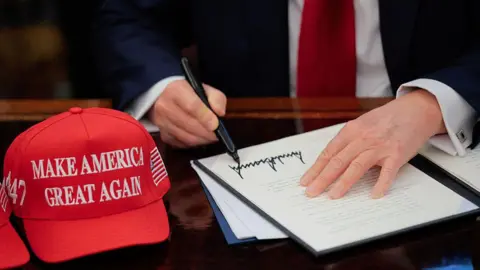
Tariffs have been one of US President Donald Trump’s favourite economic tools since he returned to the White House.
He argues these import taxes boost US manufacturing and create jobs. But critics say they have put up prices for American consumers and disrupted and damaged the global economy.
What are tariffs and how do they work?
Tariffs are taxes on imported goods.
Typically, the charge is a percentage of a good’s value.
For example, a 10% tariff on a $10 product would mean a $1 tax on top – taking the total cost to $11.
The tax is paid to the government by companies bringing in the foreign products.
These firms may pass some or all of the extra cost on to their customers, which in this case means American consumers and other US businesses.
Companies may also decide to import fewer goods.
Why is Trump using tariffs?
Trump argues tariffs increase the amount of tax raised by the government, encourage consumers to buy American-made goods and boost investment in the US from foreign companies.
Parts of the US were hollowed out economically when free trade deals resulted in industrial jobs heading overseas.
Trump also wants to reduce the US trade deficit – the gap between the value of goods it buys from other countries and those it sells to them.
The president argues that countries which sell more products to the US than they buy from it are cheating the US and that tariffs correct this imbalance.
What did the Supreme Court say about Trump’s tariffs?
In February 2026, the US Supreme Court said that Trump had exceeded his authority when he used emergency powers to introduce tariffs on specific countries without approval from Congress.
That ruling affected all tariffs Trump brought in under the International Emergency Economic Powers Act (IEEPA).
That includes the first tariffs Trump announced in early 2025 which targeted Mexico, Canada and China.
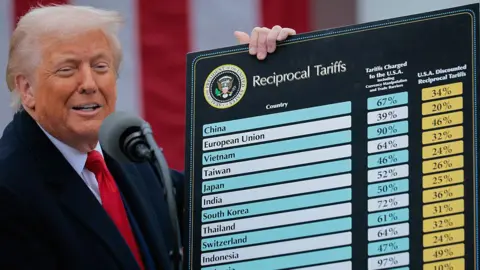
The ruling also covers those announced on Trump’s so-called “Liberation Day” in April 2025, when the president set out tariff rates of up to 50% for dozens countries, including Cambodia, Vietnam and Malaysia.
Tens of billions of dollars have since been refunded to companies that paid them.
Getty Images
Has that ruling killed Trump’s tariff policy?
No. The White House has been looking at alternative ways.
After the Supreme Court ruling, Trump used different legislation – Section 122 of the Trade Act of 1974 – to impose a temporary 10% tariff on all global imports.
And in recent weeks, he has used Section 301 of the Trade Act of 1974 to justify imposing tariffs on a range of countries.
These include Brazil, from which certain goods being brought into the US will be subject to a 25% tax. US officials claimed that Brazilian policies have harmed US trade.
Trump has also announced a 50% tariff on a wide range of goods imported from Canada, in retaliation for what he called “unequal treatment” of US cars, dairy and alcohol.
Which tariffs apply to the UK?
The UK had already negotiated 10% tariffs with the US on most goods in June 2025.
In 2024, it exported about £58bn of goods to the US – mainly cars, machinery and pharmaceuticals.
Under the terms of the 2025 deal, the 10% rate applied to the first 100,000 UK vehicles exported every year – roughly the number sold in 2024. Additional cars face the standard 25% tariff.
UK steel exports to the US are also subject to 25% duty, compared to the 50% rate which applies to steel and aluminium products from the rest of the world.

Reuters
Have prices gone up for US consumers?
Many firms said they would pass on the cost of tariffs to US customers, including Target, Walmart and Adidas.
Some products have become more expensive – including toys, appliances and furniture as well as certain foodstuffs.
The cost of some goods manufactured in the US using imported components has also gone up.
In October 2025, a study by Goldman Sachs estimated that about 55% of the tariff charges were passed on to US consumers.
And in April, a Federal Reserve study said Trump’s sweeping 2025 tariffs had caused a surge in inflation this year.
The White House has always maintained that it will take time for the tariffs to pay off, pointing to promises by firms and countries to make big investments in the US.
Despite the new barriers to trade, US imports actually increased by 4% in 2025.
How have tariffs affected the global economy?
Trump was accused of throwing the global economy into turmoil when he announced the first tariffs of his second presidential term in early 2025.
Share prices around the world fell sharply, as did the value of the dollar.
Although the US currency and global financial markets have since largely recovered, the ongoing uncertainty around Trump’s tariff policy has continued to destabilise international trade.
Some US allies have looked to alternative markets, causing what some economists describe as a “re-wiring” of global trade.
In January 2026, the International Monetary Fund (IMF) said the tariffs had “definitely [slowed] down global activity”, and warned further trade tensions could threaten economic growth.
Since then the Iran war has restricted the global supply of oil and fertiliser, pushing up prices.
And a new round of US tariffs could be on the horizon.
United States
Donald Trump
Canada
Mexico
China
Steel industry
Global trade
Trump tariffs
Car industry
International Business
European Union
