

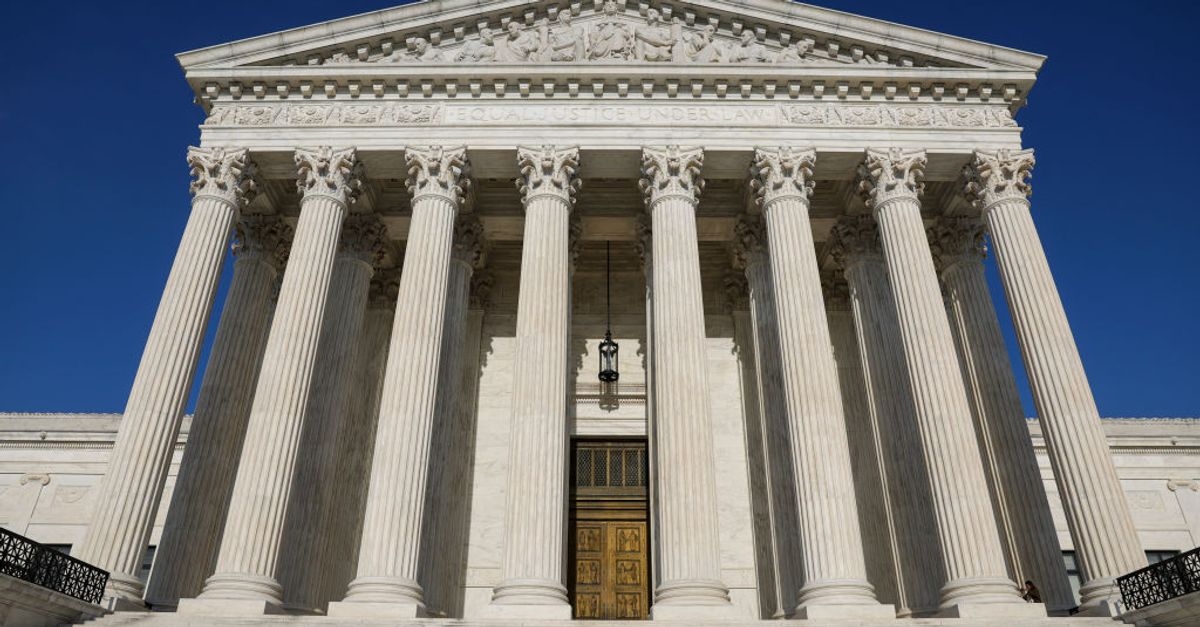

Just over two weeks after the Supreme Court cleared the way for Alabama to use a congressional map that a lower court had blocked as racially discriminatory, Alabama returned to the court. In a filing on Wednesday morning, the state asked the justices to pause a new ruling by a panel of federal judges that once again barred the state from using the map on the ground that the map “intentionally discriminated based on race in violation of the Constitution” and therefore could not stand even after the Supreme Court’s decision in Louisiana v. Callais. That decision, issued late last month, made it more difficult for plaintiffs to prevail on a claim that a map violates a key provision of the Voting Rights Act.
Unless the lower court’s decision is put on hold, Alabama Solicitor General A. Barrett Bowdre told the justices, both “Alabama and the public face irreparable harm … because they will be unable to use the State’s ‘duly enacted plans’ for the 2026 election. Worse still, voters will be forced to vote under a court-drawn racially gerrymandered map that does not meet Alabama’s legitimate districting goals.”
Wednesday’s filing was the latest chapter in a dispute that began in 2021, when the state enacted a new congressional map. A group of Black voters and civil rights organizations went to federal court to challenge the map. They contended that the new map violated Section 2 of the Voting Rights Act, which bars racial discrimination in voting, because it spread Black voters in southern Alabama across three congressional districts, leaving them a minority in each.
The lower court agreed that the 2021 map likely violated Section 2, and it prohibited the state from using the map. In 2023, the Supreme Court upheld that decision, prompting Alabama to draw a new map. That map also drew a challenge in federal court, leading to a ruling that the 2023 map also likely violated Section 2. The lower court once again barred Alabama from using its map, and the Supreme Court declined to put that order on hold.
A court-appointed special master eventually created a new map, which the lower court ordered the state to use in future elections. That court ruled last year after a trial that the 2023 map did indeed violate the VRA. It concluded that the map was “an intentional effort to dilute Black Alabamians’ voting strength and evade the unambiguous requirements of court orders standing in the way.”
Alabama appealed the lower court’s ruling to the Supreme Court, which on May 11 – one week before the state’s primary election was originally scheduled to take place – sent the case back to the lower court for another look in light of its decision in Callais. It did so in an unsigned, one-paragraph order, in which the justices did not provide any additional explanation for their decision. In the interim, the Alabama Legislature passed a law allowing “a special primary election for affected Congressional districts” if a federal court permits the state to restore the 2023 map.
Justice Sonia Sotomayor dissented from the court’s order, in an opinion joined by Justices Elena Kagan and Ketanji Brown Jackson. Sotomayor argued that there was “no reason” for the court to send the case back to the lower court because that court had also concluded that “Alabama violated the Fourteenth Amendment by intentionally diluting the votes of Black voters in Alabama. That constitutional finding of intentional discrimination is independent of,” she wrote, “and unaffected by, any of the legal issues discussed in Callais.”
When the case returned to the lower court, the panel of three judges – which included one Clinton appointee and two Trump appointees – again barred the state from using the 2023 map and instead instructed Alabama to use the map created by the special master. The panel wrote that “we cannot see our way clear to requiring Alabamians to cast their votes in the 2026 elections under a districting plan tainted by intentional race-based discrimination. And under the unusual circumstances of this case,” the judges wrote, “we conclude that a limited order requiring the Secretary” of State “to continue using this Court’s race-blind map will not disrupt Alabama’s elections.” Finally, the judges explained that they did not “lightly intrude in state affairs,” but there was “no doubt that Alabama’s legislatively enacted plan … intentionally discriminated based on race in violation of the Constitution. Our re-examination in light of Callais yields the same conclusion.”
In its filing on Wednesday, Alabama urged the court to freeze the lower court’s ruling and allow it to use the 2023 map in the upcoming elections. That map, Bowdre wrote, “addressed this Court’s concerns about the State’s prioritization of core retention” – the principle of trying to have districts resemble their earlier iterations as closely as possible – “at the cost of splitting the Black Belt region,” an area in central Alabama originally named for its rich, dark soil but now named for its large Black population, the descendants of formerly enslaved people. The 2023 map, Bowdre said, divided the Black Belt “as little as possible, while also keeping together the Gulf Coast as the State had done for 50 years.”
“Callais,” Bowdre continued, “vindicates Alabama’s position on the lawfulness of the 2023 Plan, yet the district court decided in one week that Callais changed nothing.” The district court, Bowdre stressed, did not require the challengers to offer alternative maps that would achieve Alabama’s goals while still maintaining two majority-Black districts, as the Supreme Court suggested it should have, and “[i]t did not matter to the district court that drawing an additional race-based district came at the cost of sacrificing communities of interest and pairing incumbents.”
“Worse,” Bowdre concluded, the district court’s conclusion that the state intentionally violated the Constitution rests on the idea “that Alabama intentionally discriminated by refusing to intentionally discriminate.”
Alabama asked the Supreme Court to put the lower court’s ruling on hold temporarily while it considers the state’s request – an order known as an administrative stay – and it asked the justices to act by 10 a.m. on Monday, June 1. In the alternative, it suggested, the court could go ahead and either reverse the lower court’s ruling now or take up the dispute and hear oral argument in the fall.

