

The experts behind rhino conservation in Asia
When people picture rhino conservation, they often envisage rangers on patrol or rhinos being translocated on trucks or even by helicopter. Less visible, but just as vital, is the network of scientists, field practitioners, policy experts, and institutional partners who make the decisions behind conservation actions. For Asia’s three rhino species, the IUCN SSC Asian Rhino Specialist Group, or AsRSG, forms an important part of that network.
The AsRSG is one of more than a hundred specialist groups convened under the Inter<a href="https://absafricatv.com/mauritius-to-launch-national-crime-agency/” title=”Mauritius to launch National Crime Agency”>national Union for Conservation of Nature (IUCN) Species Survival Commission (or SSC), the world’s largest network of conservation experts. The Group’s mandate is simple to state and hard to deliver: to inform, guide and catalyse conservation action for all three Asian rhino species. Made up of leading experts from rhino range states and beyond who volunteer their support, the Group brings together key people with the knowledge and expertise to conserve Asia’s rhinos.
What the Asian Rhino Specialist Group does
The AsRSG’s work behind the scenes might appear less dramatic than the action on the ground but is just as important. Members meet regularly to assess the status of each species’ populations, flag emerging threats and develop conservation strategies and recommendations for the sites that matter most.
Some of these efforts take place in partnership with the AsRSG’s African counterpart – the African Rhino Specialist Group (AfRSG). Together with TRAFFIC, the two Groups are mandated to compile the joint “African and Asian Rhinoceroses – Status, Conservation and Trade” report for the CITES Secretariat, the standard reference on rhino population trends, poaching rates, and the illegal horn trade. The AsRSG is also responsible for producing IUCN Red List assessments of the Asian rhino species conservation status. Many of the Group’s findings are published through Pachyderm, the peer-reviewed journal that has documented African and Asian rhino science for decades.
Three asian rhino species, three very different stories
Perhaps the clearest illustration of why this coordination matters is how differently the three Asian rhino species are currently faring.
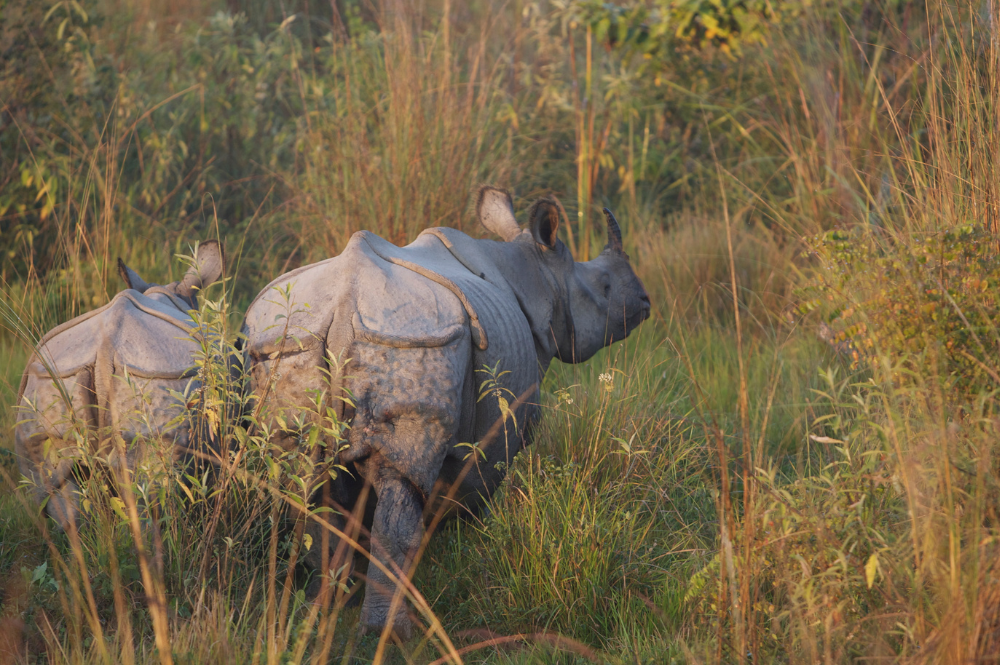
The Greater one-horned rhino (Rhinoceros unicornis) is one of conservation’s genuine good-news stories. From being reduced to perhaps a few hundred animals a century ago, the population has grown to more than 4,000 at the most recent estimate, with roughly 80% found in India, and the remainder in Nepal. In the 2008 Red List assessment, the species was downlisted from Endangered to Vulnerable. This recovery reflects decades of habitat restoration, community engagement, wildlife corridors, translocations and a marked drop in poaching – a case study the AsRSG points to when arguing that sustained, well-targeted, and properly supported protection efforts pay off.
The two remaining Asian rhino species are recognised as Critically Endangered by the IUCN Red List process and tell a more urgent story. The Javan rhino (Rhinoceros sondaicus), is only found in Ujung Kulon National Park in Indonesia, and numbers around 50 individuals in the latest AsRSG estimates. Poaching gangs killed multiple animals between 2019 and 2023. Several calves have been born recently, offering some cause for hope and indicating the need for sustained investment and action in Ujung Kulon National Park. The Sumatran rhino (Dicerorhinus sumatrensis), the most evolutionarily distinct of all living rhinos, is in a similarly precarious state, with an estimated 34 to 47 individuals surviving in fragmented populations across Sumatra and Kalimantan, and in the Sumatran Rhino Sanctuary in Way Kambas National Park.
Given the overlap in the science, the expertise and the geographies, the AsRSG has a cross-cutting mandate – managing the continued recovery for the Greater one-horned rhino while treating the Javan and Sumatran populations with the urgency of species on the brink.
Leadership behind asian rhino conservation
The AsRSG was established in 1984. Its founding Chair, Mohd Khan bin Momin Khan, led the group for two decades (1984–2004), followed by Dr Tirthaman Maskey (2005–2006), and Dr Nico van Strien (2006–2007). For nearly two decades from 2007, nearly two decades, the AsRSG was chaired by Dr. Bibhab Kumar Talukdar, CEO and Secretary General of the Assam-based conservation organisation Aaranyak, who led the Group to the end of the 2021-2025 IUCN period. Talukdar’s tenure spanned much of the Greater one-horned rhino’s remarkable recovery in India and Nepal, and his contribution to Asian rhino science was recognised with the IUCN SSC’s Harry Messel Award for Conservation Leadership in 2024 and, this year, a Fellowship of the Linnean Society of London.
The current four-year period has seen the introduction of new leadership under Dr Christy Williams, an experienced large mammal biologist whose background spans Asian rhino, elephant, sea turtle, and Asiatic lion conservation across Asia, alongside long-running work on the illegal ivory and rhino horn trades, as well as human–wildlife conflict. Christy brings decades of experience and renewed enthusiasm to take the Group into the next term. Christy is supported by a Deputy Chair, Dr Bhaskar Choudhury, Vice Chairs for South Asia, Dr Naresh Subedi, and SE Asia, Mrs Kurnia Khairani, and Dr Deba Dutta as the Red List Authority Coordinator. The AsRSG operates through seven standing sub-committees: three organised around species-level conservation, and four around functional areas essential to the Group’s effectiveness.
Why cross-border coordination matters for Asian rhino conservation
Rhinos don’t recognise national borders, and neither do the threats they face. That’s why the AsRSG has long pushed for coordinated action among range states. In 2013, at the first Asian Rhino Range State Meeting, Bhutan, India, Indonesia, Malaysia, and Nepal signed the Bandar Lampung Declaration, jointly pledging to grow their rhino populations by at least 3% a year, an early example of the kind of multi-government commitment the Group works to secure. Prior to stepping down, the AsRSG’s Chair, Dr Talukdar, took the same message to the international stage, speaking at CITES conferences to make the case that specialist groups’ scientific data should sit at the heart of how the international community tracks – and holds itself accountable for – rhino conservation outcomes. Most recently, the new Chair, met the Hon. Minister of Forestry for Indonesia, Raja Juli Antoni, in Jakarta in May 2026. Dr Williams delivered the AsRSG briefing note on Sumatran and Javan rhino recovery, focusing on conservation-led leadership, conservation breeding, assisted reproductive technology, and second-habitat planning for the Javan rhino, as well as innovative financing.
The quiet engine of Asian rhino conservation
It’s easy to overlook a body like the AsRSG precisely because its work is unglamorous: population surveys, technical reports, quiet advocacy with governments and in CITES corridors. But every anti-poaching unit, every translocation, every habitat corridor funded by conservation NGOs and governments across Asia relies, at some point, on the evidence base the AsRSG and its members painstakingly assemble. As the Greater one-horned rhino’s recovery shows, an evidence-led approach can genuinely turn a species’ fortunes around. The challenge now is applying the same expertise, urgency, and cross-border cooperation to give the Javan and Sumatran rhino the chance to write a similar story.

