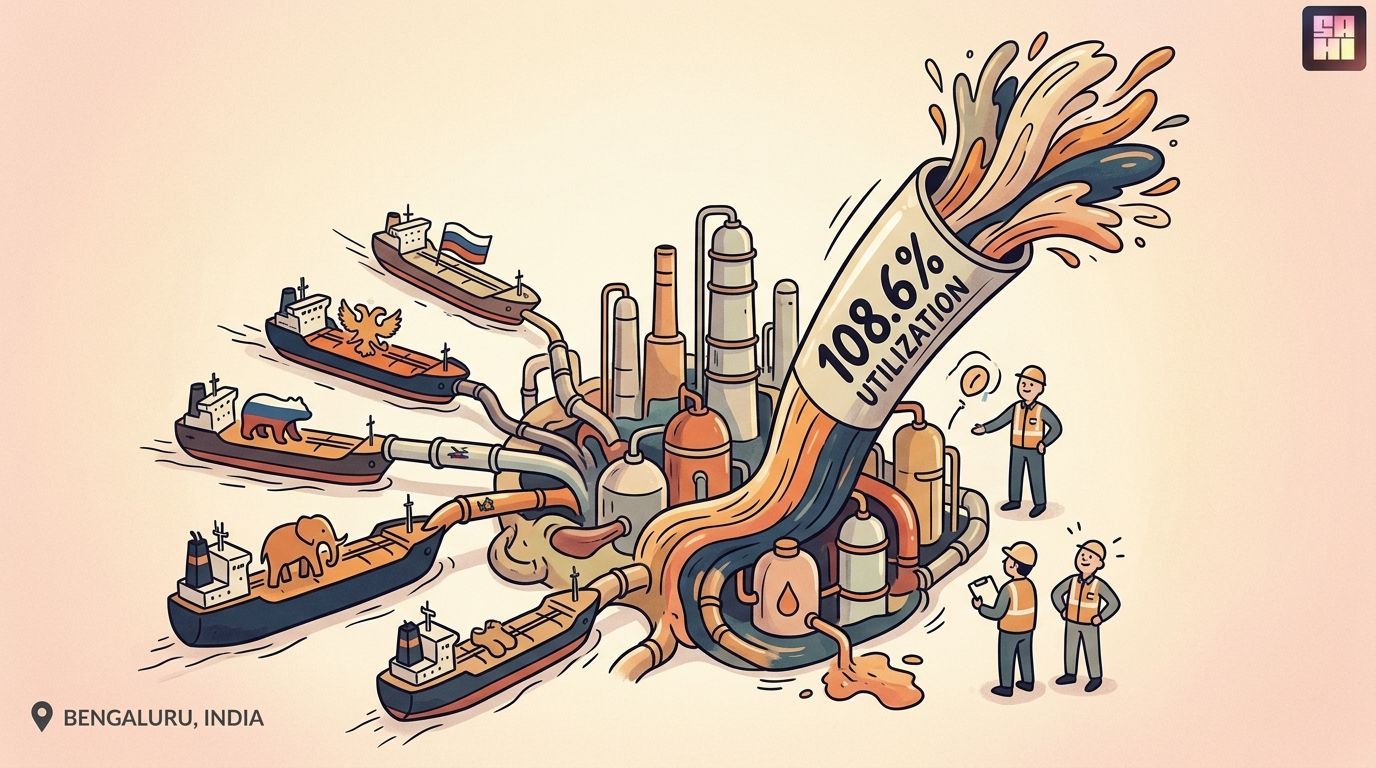
Market snapshot: Chennai Petroleum is adjusting its raw material procurement strategy by raising oil imports from Russia and West Africa to mitigate ongoing logistical issues in the Middle East. Concurrently, management has outlined a robust operational road map, projecting refinery capacity utilization to improve sequentially from 102.9% in FY27 to 108.6% by FY29.
Data Snapshot
- The company expects refinery capacity utilization to hit 102.9% in FY27, rising to 106.7% in FY28 and 108.6% in FY29.
- Chennai Petroleum reported a standalone net profit of ₹1,016.67 crore in Q1 FY27, representing a dramatic turnaround from a standalone net loss of ₹56.62 crore in Q1 FY26.
- Revenue from operations for Q1 FY27 surged by 57.14% year-on-year to ₹29,358.75 crore from ₹18,683.36 crore in Q1 FY26.
- Average Gross Refining Margin for Q1 FY27 came in at $8.78 per barrel, up from $3.22 per barrel in the corresponding quarter of the previous fiscal.
What’s Changed
- Chennai Petroleum’s projected FY27 capacity utilization of 102.9% marks a structural moderation from the exceptional 112% capacity utilization achieved during peak cycles in FY26.
- The crude supply mix is moving toward higher-yield West African lube crudes and stable Russian supplies, reducing systemic dependence on Middle East waterways.
Key Takeaways
- Operational Resilience: Shifting import channels to Russia and West Africa actively shields the refiner from regional geopolitical choke points.
- Sequential Run-Rate Growth: Refinery utilization is modeled to rise incrementally from 102.9% in FY27 to 108.6% in FY29, pointing to robust domestic demand.
- Strong Financial Position: A standalone Q1 FY27 profit of ₹1,016.67 crore establishes a highly stable capital foundation to absorb volatile transition expenses.
SAHI Perspective
Chennai Petroleum’s pivot away from Middle Eastern supply disruptions highlights the operational flexibility essential for modern refiners. Sourcing from alternative regions such as West Africa and Russia provides a dual advantage: securing feedstock supply and optimizing crude costs. Although the projected FY27 utilization run-rate of 102.9% is a step down from the absolute peak of 112% achieved in FY26, the sequential ramp-up targets through FY29 represent a more realistic and highly sustainable long-term operating model.
Market Implications
Diversifying crudepolitical flare-ups. A reliable crude supply will enable Chennai Petroleum to consistently meet strong domestic demand for diesel and a and bolstering equity sentiment
Trading Signals
Supported by a major standalone profit recovery of ₹1,016.67 crore in Q1 FY27 and enhanced operational flexibility, the near-to-medium-term thesis remains constructive despite global sourcing re-alignments.
Overweight: Oil Marketing & Refining
- Movement of global Gross Refining Margins (GRM)
- Discount levels available on Russian crude imports
- Execution progress of the Cauvery Basin grassroots refinery JV
Time Horizon: Medium-term (3-12 months)
Industry Context
Refiners in India are displaying significant agility, balancing volatile Middle Eastern supply constraints with opportunisticallyacity, domestic refining margins are expected to stay supported by steady product demand
Key Risks to Watch
- Potential narrowing of discounts on Russian crude imports, which would directly impact feedstock economics.
- Volatility in product crack spreads compressing overall refining margins.
- Any project commissioning delays in the joint-venture expansion at Nagapattinam.
Recent Developments
Chennai Petroleum was officially upgraded to ‘Navratna’ Central Public Sector Enterprise status on June 19, 2026, granting the board enhanced financial autonomy. The company also declared a final dividend of ₹54 per share for FY26, with the record date having concluded on August 7, 2026.
Closing Insight
High Performance Trading with SAHI.