

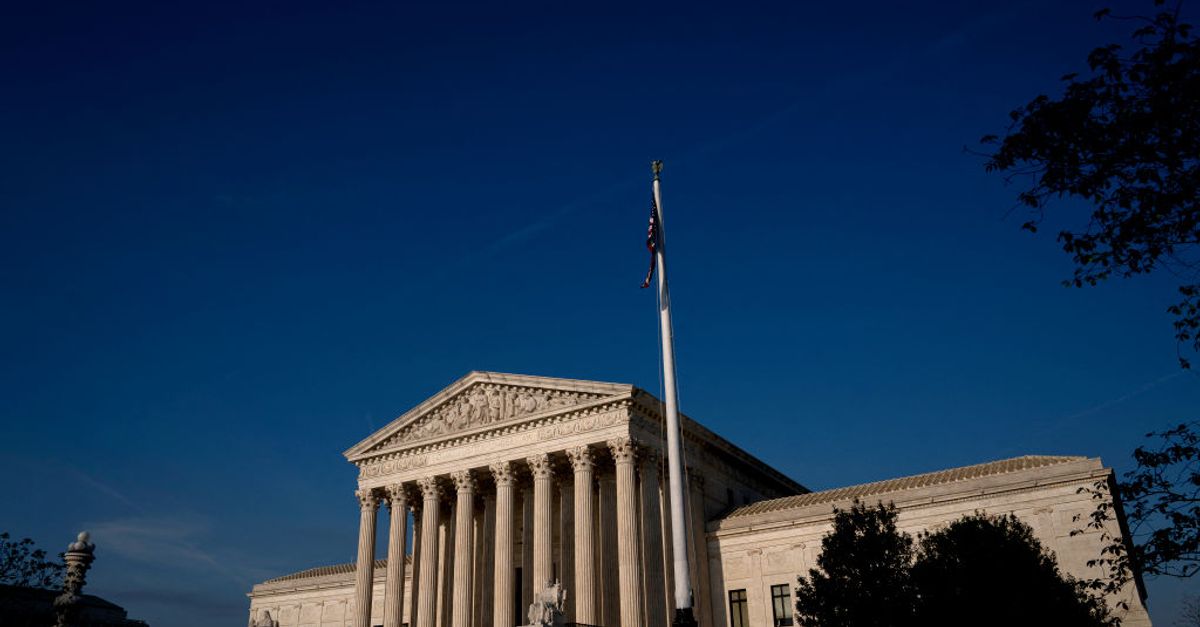

The Supreme Court on Tuesday morning reversed a ruling by a federal appeals court that had revived a dispute over a policy governing speaking engagements by immigration judges. In a list of orders from the justices’ private conference last week, the court also declined to serve as the court of first review for Florida’s contention that California and Washington are allowing undocumented immigrants to obtain commercial driver’s licenses.
The justices did not add any new cases to their docket for the 2026-27 term. They will meet again for another conference on Thursday, May 28.
The dispute over speaking engagements at the center of Margolin v. National Association of Immigration Judges began several years ago, when the National Association of Immigration Judges went to federal court in Alexandria, Virginia, to challenge the policy, which requires immigration judges to obtain permission before making any “official” speeches – such as presentations at immigration conferences and pro bono training. Immigration judges are not required to obtain clearance for speeches that they make in their personal capacity, such as speaking before community groups on topics that are not directly related to immigration. The group contended that the policy violates the First Amendment by (among other things) prohibiting “judges from sharing their private views on immigration law or policy issues, or about the agency that employs them.”
U.S. District Judge Leonie Brinkema granted the government’s motion to throw out the case. She pointed to the Civil Service Reform Act, a federal law enacted in the wake of the Watergate scandal that sets up a scheme to review federal employees’ claims that they have been subject to prohibited conduct, such as discrimination or retaliation. When it passed the CSRA, she wrote, Congress intended to take away district courts’ power to consider claims like the NAIJ’s.
The U.S. Court of Appeals for the 4th Circuit sent the case back to the district court. Although it agreed with Brinkema’s conclusion that, under the CSRA, district courts normally would not have the power to review claims like the NAIJ’s, it questioned whether the two entities where the CSRA would normally channel the NAIJ’s claim – the Office of Special Counsel and the Merit Systems Protection Board – are still working as Congress intended. Specifically, the court of appeals observed, when it issued its opinion in June 2025, the MSPB did not have enough members to take action, which would prevent it from acting on petitions for review. Moreover, the 4th Circuit wrote, although Congress intended the MSPB and the Office of Special Counsel to be independent, the Trump administration now argues that the president can remove both the Special Counsel and members of the MSPB for any reason.
The court of appeals therefore instructed the district court to determine “whether the CSRA continues to provide a functional adjudicatory scheme.” By a vote of 9-6, the full 4th Circuit on Nov. 20 rejected the government’s request to reconsider the case.
The Trump administration came to the Supreme Court in December, asking the justices to temporarily pause the lower court’s ruling while it appealed. In a brief, unsigned order, the court declined to do so.
The Trump administration soon returned to the Supreme Court, calling the case a “clear candidate for summary reversal” – that is, overturning the lower court’s decision without additional briefing or oral argument – “twice over.” The 4th Circuit, U.S. Solicitor General D. John Sauer argued, wrongly relied on an argument that the NAIJ had not made (and, he said, had in fact affirmatively waived). Moreover, Sauer said, the Supreme Court “has already held that the CSRA channels federal personnel claims to the MSPB.”
In Tuesday’s five-page, unsigned order, the justices granted the government’s request to reverse the 4th Circuit’s decision since that decision was based on an argument that the parties had not made. “Federal courts are not ‘roving commissions,’” the opinion explained, “licensed to ‘“sally forth each day looking for wrongs to right.”’ The Court of Appeals lost sight of those principles here.”
Justice Clarence Thomas, joined by Justice Amy Coney Barrett, wrote a concurring opinion in which he explained that he believed “the Fourth Circuit’s decision was also wrong on the merits.” “Neither the President’s view that he can remove federal officials, nor his having done so, change the meaning of the statute or the binding nature of this Court’s interpretation of it,” Thomas argued.
When the Trump administration appealed to the Supreme Court, the NAIJ filed its own brief, known as a cross-petition. If the court were to grant the Trump administration’s appeal, the group said, it should also weigh in on whether federal employees can file challenges to restraints on their speech directly in district court before the restraints are enforced against them. The justices denied that cross-petition on Tuesday without comment.
Elsewhere in Tuesday’s order list, the court turned down a request from Florida to file an original action – that is, a lawsuit effectively treating the Supreme Court as a trial court – against California and Washington. Such cases are rare and normally involve disputes between states over issues like water rights or boundaries.
This case involves immigration. Florida contended that the two states have not complied with federal safety regulations governing commercial driver’s licenses for (among other vehicles) 18-wheelers – and, in particular, have allowed undocumented immigrants “without proper training or the ability to read road signs” to obtain such licenses.
California urged the justices to deny Florida’s motion to file a complaint. It countered that Florida’s claims are “patently meritless”: “California law requires DMV to verify legal presence and test for English proficiency, and DMV in fact does so.” The case also does not meet the high bar required to bring a case directly in the Supreme Court, California argued: Florida cannot, for example, show that the dispute can only be resolved in the Supreme Court.
Washington called the lawsuit “a political stunt, not a real claim,” and it told the justices that Florida is guilty of the same conduct of which it now accuses California and Washington. Florida also does not have a legal right to sue, known as standing, Washington contended, because it had not shown either that Washington’s actions had harmed it or that its lawsuit could redress the problems it targets.
Thomas, joined by Justice Samuel Alito, dissented from the decision not to allow Florida’s lawsuit to go forward, writing “we cannot refuse to hear suits between States.” But even if the court has discretion to decide whether to hear such states, Thomas continued, it still should have granted Florida’s motion, because of the seriousness of the issue and because Florida has nowhere else to turn.
The justices also denied several noteworthy petitions for review, including:
- Meta Platforms v. Vermont, which stemmed from Vermont’s lawsuit alleging that Meta intentionally designed Instagram to be addictive to teens. The question presented at this stage, however, related to whether Meta could be sued in Vermont based on its “business model” – specifically, selling online advertising space to others – even if the claims involved in the lawsuit do not involve that advertising.
- U.S. Conference of Catholic Bishops v. O’Connell, which arose from a lawsuit brought by a parishioner who contends that he was misled by the description of how money collected in an annual offering in the Catholic Church known as Peter’s Pence would be used. As the case came to the court, the bishops had asked the justices to weigh in on issues related to church autonomy over its affairs. Justice Ketanji Brown Jackson did not participate in the case.
- New York Football Giants v. Flores, which began when former Miami Dolphins head coach Brian Flores filed a racial discrimination lawsuit against the NFL, the Miami Dolphins, the New York Giants, and the Denver Broncos. As the case came to the court, the NFL and the teams had asked the justices to decide whether an agreement to arbitrate disputes can be enforced if it designates the NFL commissioner as the arbitrator and allows him to develop the procedures for the arbitration. Justice Brett Kavanaugh indicated that he would have granted the petition for review.
The justices did not act on a petition by Harvard law professor Alan Dershowitz, who alleges that CNN defamed him by “deliberately and systematically misrepresenting his Senate floor statement” when he was serving as a lawyer for President Donald Trump during Trump’s first impeachment. Dershowitz is asking the court to overturn or modify the standard outlined in the 1964 case of New York Times v. Sullivan, in which the justices ruled that a plaintiff in a defamation case can only recover if he can show that the allegedly defamatory statement was made with “actual malice” – “that is, with knowledge that it was false or with reckless disregard of whether it was false or not.” The court will consider Dershowitz’s petition again at their conference on Thursday.

