



Get free access to the most comprehensive World Cup coverage in The Athletic app
Rewatching Yoane Wissa’s equalizer against Portugal in the Democratic Republic of the Congo’s opening match of this World Cup, the whole sequence looks like choreography
Not only the articulated curve of Congolese full-back Arthur Masuaku’s inswinging cross, nor Wissa’s box-step shimmy to peel away from the pack of Portuguese defenders as he leapt into the air to redirect the ball past the goalkeeper with his head. It was what happened next, the manifestation of a team united in its belief that tenacity need not come at the expense of style
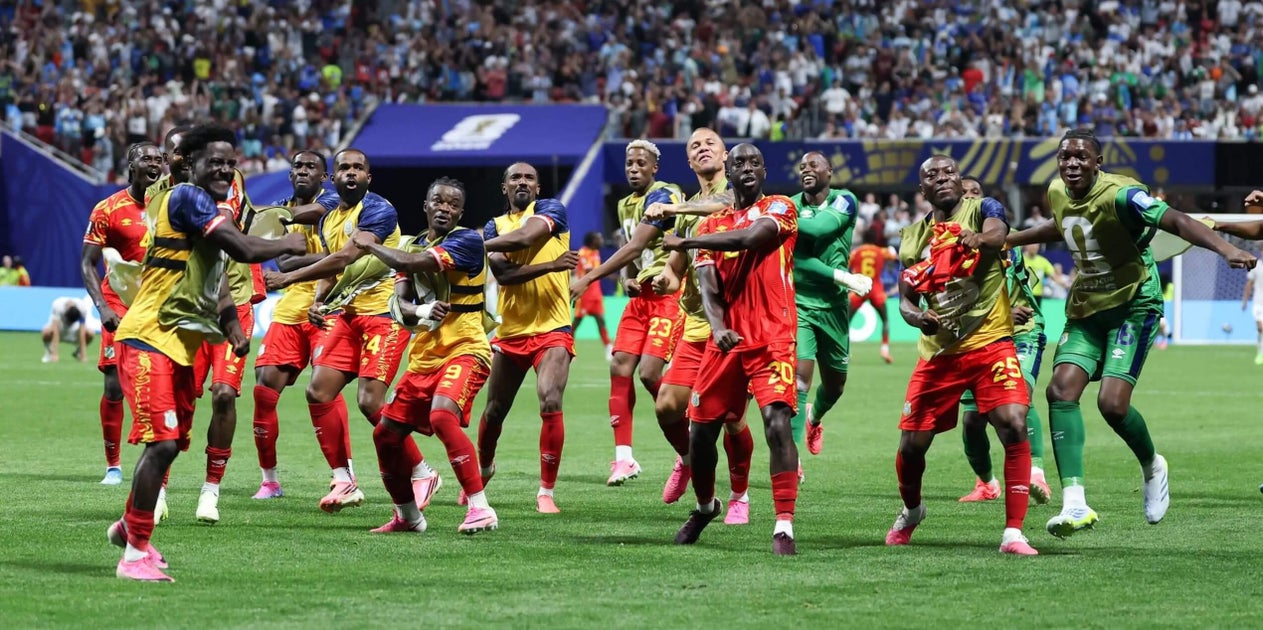
Wissa whizzed over to the bench as his teammates followed behind, arms outstretched like an artistic director cueing the music for a rehearsal — and surely, this was a familiar move
Once gathered, everybody, including some non-Congolese members of the coaching staff, reeled one arm back and lashed it past the other in a dance move known as fimbu
Fimbu translates to ‘the whip’ in Lingala, one of DRC’s four national languages, and this was as much of a display of national pride, and a callback to the country’s soccer glory days, as it was a goal celebration
Yoane Wissa scores DR Congo’s first-ever World Cup goal! 🇨🇩⚽
It makes it 1-1 against Portugal in a historic moment for the nation. pic.twitter.com/Q7B6FcT3tn
— Match of the Day (@BBCMOTD) June 17, 2026
In 2015, Congolese singer and songwriter Félix Wazekwa released “Leopards Fimbu na Fimbu”, and it became entwined with the team’s victory at the 2016 African Nations Championship (CHAN), the now-defunct tournament that formerly alternated with the Confederation of African Football’s premier tournament: the Africa Cup of Nations
Wazekwa has released multiple music videos for the song over the years, but the 2016 version is almost eight minutes long. It features dance steps that go far beyond the whipping motion of the fimbu and get increasingly elaborate as the song carries on, all performed flashmob-style on streets and in train stations
Clips of Congolese players hitting the fimbu are interspersed throughout the video, bringing even more context to what happened on June 17 when, in their first World Cup finals match since 1974 (then playing as Zaire), DRC held a favored Portugal side to a 1-1 draw that was received like a win on multiple fronts
Fimbu may not have gone viral at this World Cup (yet) by modern definition of the term but it is contagious, and Zlatan Ibrahimović appears to have caught it. The Sweden soccer icon and Fox Sports studio analyst did the dance on air Saturday night, inviting his compatriots Thierry Henry and Alexi Lalas to join him. It may not be the last time the dance appears on a World Cup screen, either, as DRC takes on England on Wednesday in the round of 32
It’s time to wake up America.@Ibra_officialpic.twitter.com/LCFWWb2EEo
— FOX Sports (@FOXSports) June 28, 2026
Soccer isn’t just a sport in many parts of the world. It is also the antidote to the social, economic and political forces that threaten to pin a player to the ground. Had a good day? Go play soccer. Bad day? Soccer. Racked with inexplicable yearning? Better throw on a jersey and head to the nearest patch of grass (or dirt, or beach, or concrete)
The game is also dance. Nowhere is this more evident than across Africa and in other parts of the world with ties to that continent. They don’t wait until they’ve scored goals to make that known, either, because dance in soccer is also how these teams announce themselves and take up space. The latter is especially resonant considering the ways that the institution of soccer in the Global North has policed, dismissed or disrespected their product
What You Should Read Next

DR Congo fans are ready to bring fimbu – aka ‘the whip’ – to the world stage
As part of a special World Cup series, The Athletic is speaking to fans of all 48 competing nations to capture their unique football culture

Even Brazil, a country with the most Afro-descendent people outside the continent itself, a nation that has won the World Cup five times, is not immune. Or perhaps it is just that Brazil forward Vinicius Junior, a dark-skinned Afro-Brazilian, has been made into a scapegoat for all the thinly veiled racism that masquerades as hand-wringing every time the Real Madrid superstar dares to embody other parts of his culture on the pitch with a samba step or TikTok dance
Fair enough that his equalizer against Morocco in both teams’ opening game of this World Cup wasn’t exactly the time for dancing. Brazil had conceded first and were (and still are) under immense pressure to reestablish themselves as the global soccer superpower fitting of their joga bonito ethos
Yet after scoring the third goal in a comfortable eventual 3-0 win for his team against Haiti just before halftime, the 25-year-old allowed himself a demure swivel of his hips before the crowd. By Brazil’s third and final group-stage match against Scotland, Vinicius Jr. was back to steppin’. If he scores again at this tournament, in the last 16 against one of Ivory Coast and Norway or beyond, we might just get a full-out samba. He’s been building up to it
Vinicius Junior dances next to the corner flag after scoring in Brazil’s group-stage win over Scotland (Craig Williamson/SNS Group via Getty Images)
At the previous World Cup four years ago, retired player and coach turned pundit Roy Keane criticised Brazil for dancing in their 4-1 win against South Korea in the round of 16
“I can’t believe what I’m watching,” he said on UK broadcaster ITV, adding that he found Brazil to be “disrespecting the opposition”
Writing off these gestures as arrogance is a failure to understand how vital that form of self-expression is for some soccer players
Referencing that 2022 World Cup moment in a recent interview withThe Athletic, Golden Globe-winning Brazilian actor Wagner Moura also rejected claims of gamesmanship
“No, this is cool, man,” he said. “Dance… dance, dude.”
What You Should Read Next
Why I Love The Beautiful Game: Wagner Moura wants Brazil’s ‘sixth star’ and Vinicius Jr to keep dancing
You know Wagner Moura for his starring roles in Narcos and The Secret Agent. What you might not know is quite how much he loves football
Ghana has spanned the traditional and the contemporary in its World Cup dancing, from organizing a call-and-response musical circle in the team hotel with the country’s record goalscorer Asamoah Gyan, who has also popped up in the dressing room, to spreading the viral Kakalika dance. An Afrobeats song by Ghanaian duo DopeNation goes by the same name and has become the Black Stars’ 2026 World Cup jam
View this post on Instagram
One of Canada’s official songs has actually gone viral in the past: “Charger” by the French group Triangle des Bermudes. It was a fitting selection for the aux cord after the tournament co-host made it to the round of 16 at a men’s World Cup for the first time in their nation’s history and showcased the way music and the dances they conjure can fasten ties across the diaspora
TEAM CANADA’S LOCKER ROOM AFTER THE WIN OVER SOUTH AFRICA 😭😭
Ismaël Koné: BRRRRRR-AHHH 😂🤣🤣 pic.twitter.com/DWWmSm1Xck
— Omer Osman (@OmerOsman200) June 28, 2026
Apart from punching its ticket to the knockout stage on its World Cup finals debut, Cape Verde has scarcely stopped dancing since qualifying for the tournament last October
A lot of the dancing on display at this World Cup is even more prevalent at the biennial Africa Cup of Nations, where cultural expression is nearly as important as winning games. With 10 African teams at this World Cup — more than have ever participated before, thanks to the expansion from a field of 32 to 48 — and with nine of them still standing, there is huge potential to shift the narrative of soccer on the continent and its diaspora
Dance and soccer is not a matter of either/or for these players. It has always been ‘both/and’
History tells us there will always be pushback, Eurocentric notions of propriety imposed upon the sport and the Black bodies that play it. But the dance will outlast it
World Cup Tracker
Groups and standingsBracket forecast
Tournament schedule, scores and results
Forecasts for all 48 teams





