



Women’s T20 World Cup, 2026
Familiar flaws return for South Africa in semifinal exit
Aayush Puthran
Women’s T20 World Cup, 2026
Familiar flaws return for South Africa in semifinal exit
byAayush Puthran•
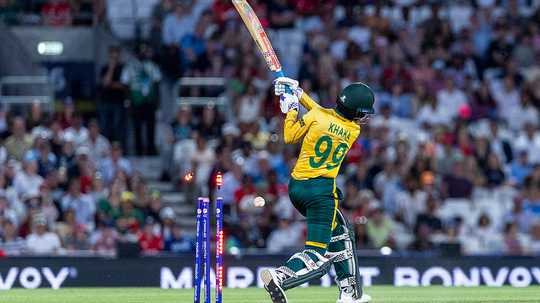
South Africa comfortably fell short by 40 runs.© Getty
South Africa comfortably fell short by 40 runs.©Getty
Tazmin Brits may have finished as the top run-getter for South Africa, and finished as the tournament’s second highest scorer, but this tour has felt ‘a bit different’ for her
“I don’t know if it’s because I sat out of the first two games,” she wondered. “It’s almost like I sat on the sidelines, looking through a window
“I will have to go and do some introspection,” she told herself on the day South Africa’s campaign in the 2026 T20 World Cup came to an end. Much like it had been since her return to the team, her performance with the bat stood out in the semifinal clash against England, but the batting unit failed to chase down a par-total
The batting unit’s underwhelming show has been, in a way, the story of South Africa’s World Cup campaign. Brits, who had top-scored with a painstaking 45-ball 51 in the semis, made an honest confession in trying to explain what didn’t click for them
“Maybe, not having a plan?” she said candidly
“A lot of times we go out there and think we can play without having a look at what the wicket is doing. Or maybe not wanting to change our game. A lot of times players prefer staying in their comfort space. Sometimes, you need more. It’s just maybe about sitting down and watching things a bit better, and not be so…” Brits pointed out before being interrupted
Unlike the first semifinal, the second one promised to be a battle of equals – even if it was between a team struggling to find its rhythm and another rediscovering its lost dominance. For more than half-way through the contest on Thursday, it even played out to that promise, see-sawing all the way through
For a while, at 23 for 3, troubled by swing and pace, England were looking for ways to get past South Africa’s new-ball bowlers. For a while, when Nat Sciver-Brunt and Heather Knight were commanding the direction of the ball, it seemed like England might go past the 180-run mark
In the end, their march halted at 169 – a par total at the venue, and one that promised to make an exciting chase for the experienced batting line-up of South Africa
With three balls remaining in the fifth over, and South Africa at 43 for no loss, the game was set for an exciting finish. But their innings nosedived from thereon
While the playing surface at The Oval is merciful towards batters, the game was taking place on a surface which had already hosted two matches in less than a week. As a result, some of the balls were stopping a bit. The trick after the powerplay lied in varying the pace, as all the bowlers had identified
Brits admitted that it wasn’t as difficult to bat on, and there was more value for the batters as the innings progressed. But South Africa made one error – not learn from the experience and skill displayed by Sciver-Brunt and Knight earlier in the evening
Pushed on the backfoot, the duo comfortably kept nudging the balls towards the leg side, where for most parts three fielders were placed in the deep. Singles and twos were comfortable, and if the gap was precise and shot hit hard enough, the odd boundary followed. They absorbed the pressure, and then threw it back at the South Africans
The South African bowlers became a bit predictable with their lines, allowing for a partnership to flourish, which in a way, proved to dictate the terms of the contest eventually. Moreover, unlike the other pacers who found success bowling the good length areas, Nadine de Klerk went fuller more often, and paid the price for it
England had learnt their lessons, but the South Africans didn’t. Even as South Africa’s head coach, he was comfortable with the performance of the bowlers since they had restricted England to a par score, they probably allowed England to get away when the momentum was in their favour
Moreover, South African batters didn’t borrow the template from England’s experienced duo. “Maybe we tried to pre-meditate and hit too hard, myself included,” Brits looked back. “Maybe (we should have) hit the gap a bit better.”
She denied Freya Kemp’s slower balls troubling her, but added, “I set up for those slower balls, but I just couldn’t pick them up.”
As South Africa struggled to find the gaps, courtesy some fine fielding and disciplined bowling, and chewed up dot balls and allowed the required rate to creep up, the pressure mounted and the batters only made life difficult for themselves. Repeatedly, the players tried to step out and hit hard, but with the ball coming on slowly, they struggled with timing it well, and kept getting caught
Wickets kept falling at regular intervals and South Africa couldn’t forge the kind of partnership that would have allowed them to ease into the run-chase. In their bid to hit big, they failed to smoke a single six. The innings unraveled very quickly after the powerplay, and by the end of it, the eventual result had become too predictable
In a way, it was also fitting. For a campaign that never quite took off, ended in the semifinals, with the two unbeaten – and unarguably the most clinical teams – reaching the final
For South Africa, it was yet another campaign ending in the knockouts. Their quest for the elusive title continues, but it’s a heartbreak that has become a recurring feature – now, playing out almost every year
There was no one shedding tears, no one inconsolably down on their knees – the kind of images that have played out in some of the previous World Cup knockouts for South Africa. Maybe, they were aware who really were the deserving winners long before the contest came to its actual end. When asked if the players were in pain following the loss, Mandla Mashimbyi played it cool
“What pain? You just lose and you learn. And we’ve learned a lot in this World Cup, and we’re going to make sure that we go back to the drawing board and make sure that we put things in place that’s going to make us even more dangerous, even better as a team.”
Mashimbyi wasn’t there to nitpick problems; he had turned up to protect his players after the loss – not wanting to dig deep into everything that didn’t work for the team, as much to show everything that did for them to reach as far as they did. “Without trying to take anything for granted, I think if you get to the semis, you must have done something right. And I think we did do something right, maybe not to the best way in terms of how we wanted to do it. But at the end of the day, you want to get World Cup wins, and we did get that.”
He turned to a more philosophical line instead to describe the loss. “Maybe England today were a little bit. They wanted [the win] a little bit more today.”
Brits, on the other hand, offered a more honest assessment. “We have to find a way. Either the powerplay works very well and we let it go. Or in batting, there are one or two partnerships, but no one carries on to get to those 80s and 100s. We have to find a way to make sure it clicks better.”
Mashimbyi is also practical. “We know where our gaps are, and that’s the only thing we can do really,” he noted. “We can’t change the results. It’s about the work that we put in going forward and make sure that when we get an opportunity to play the World Cup again or at the ICC Trophy tournament, we are sitting at the same table as other teams.”
South Africa will certainly get a chance to play more World Cups and ICC tournaments – and now even the Olympics. But even after so many years, many players from their golden generation are without a world title to show – Laura Wolvaardt, Sune Luus, Dane van Niekerk, Marizanne Kapp, Chloe Tryon, Shabnim Ismail, Ayabonga Khaka – each of them has been around for at least a decade, possessing strong individual talents, but very little collective glory to flaunt
Moreover, with more than half the squad members above the age of 30, and many of them battling recurring injuries, time may not be the best friend for their cricketing aspirations
“We didn’t really click, and it’s scary. We managed to reach the semifinals, and a lot of times the finals without actually clicking. It’s scary to think, if we have to click,” said Brits, who is one among the older people in the team
A late bloomer, at 35, she believes her drive towards the sport will continue until that promise for the World Cup remains in sight. It’s a big tease. For now, she is scoring runs but the team isn’t winning – and maybe that’s why this tournament probably feels ‘a bit different’ for her
© Cricbuzz
TAGS
South Africa Women
ICC Women’s T20 World Cup 2026
ICC Women’s T20 World Cup 2026, 2nd Semi-Final
RELATED STORIES

Familiar flaws return for South Africa in semifinal exit
All-round England cruise to fifth Women’s T20 World Cup final
Being the jaffa called Sinalo Jafta
Favourites, rebels, and a fascinating World Cup semifinal
Danni Wyatt-Hodge: The question of self-worth, evolution and a WC dream
England’s perfect run meets familiar semifinal nemesis





