

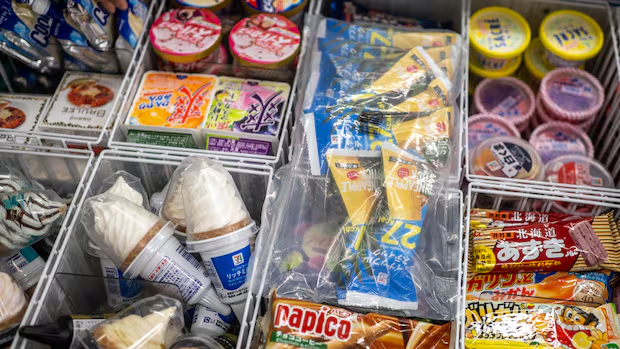
Allegations of a cartel. Multiple investigations. A national scandal.
We are, of course, talking about ice cream.
As Canadians continue to get their slice of the bread price-fixing settlement this summer, Japan is being rocked by its own alleged price-fixing scandal. Japanese government fair trade watchdog officials have conducted on-site inspections of six major ice cream makers on suspicion of price-fixing, with Japanese media calling it a price cartel.
CBC News has reached out to Japan’s Fair Trade Commission (JFTC) and not yet heard back. But according to the Associated Press, the reports accuse top managers at the companies of colluding with each other over several years to co-ordinate raising ice cream prices.
“We take seriously the fact that there was an on-site inspection, and we promise to co-operate fully with the Japan Fair Trade Commission investigation,” Tokyo-based Meiji Co. said in a posted statement Tuesday, written in Japanese.
The company explained that it had an on-site inspection on suspicion of violating the anti-monopoly act, but didn’t say when it happened.

Five other companies, Morinaga Milk Industry Co., Morinaga & Co., Lotte Co., Ezaki Glico Co. and Akagi Nyugo Co., issued similar statements on their corporate websites.
“We sincerely apologize to our customers, business partners, and to all those it may concern for any inconvenience and concern this may have caused,” Akagi Nyugo added in its statement.
On social media, some customers expressed their displeasure.
“Setting the other five companies aside, it was disappointing to see Akagi on the list. I thought they were on the side of the general public,” one person commented on an Akagi Nyugo Instagram post.
“In this weather? Diabolical!” someone commented on a post by the Straits Times, a nod to Japan’s current challenges with extreme heat.

Temperatures in Japan have reached a breaking point, and the language is shifting to keep up. The Japan Meteorological Agency has introduced a new term for days exceeding 40 C: kokushobi, or “cruelly hot day.” In a culture with a deep relationship between seasons and language, CBC News’s Johanna Wagstaffe explores how the arrival of this word is a sobering signal of climate change.
Why ice cream?
As the Associated Press notes, Japanese antitrust officials periodically conduct high-profile investigations to protect fair competition.
And this isn’t the first time ice cream-makers have been included. The fair trade commission website has an example of an unnamed “major” ice cream maker refusing to distribute products to retailers unless they agreed to a certain suggested price, for instance.
“As a result of an investigation by the Japan Fair Trade Commission, it was determined that the company’s practices constituted ‘resale price maintenance,’ an unfair trade practice, and were in violation of the Antimonopoly Act,” the JFTC notes.
But, according to Japanese newspaper the Yomiuri Shimbun, this is the first time the JFTC has investigated an alleged cartel in the ice cream industry. The newspaper reports the JFTC believes that because of the cartel, consumers “might have been obliged to purchase products at higher prices than they otherwise would have paid.”
And this comes at a time when the country’s food prices, including ice cream, are already rising, notes Yahoo Japan.
Meanwhile, ice cream sales in Japan hit a record 663.1 billion yen ($5.8 billion Cdn) in 2025, according the Japan Ice Cream Association. That’s a 102 per cent increase from the previous year’s sales, the association says, and the sixth consecutive year that sales have reached a new record high.
The sales figures, “are largely due to the increased demand brought on by intense summer heat, the effect of price revisions, as well as the continuous efforts of the entire industry ” the ice cream association said in its report.
Japan experienced its hottest summer on record in 2025. In April, the Japan Meteorological Agency announced a new name for days where the temperature is above 40 C: kokushobi, or “cruelly hot days.”

Are price-fixing scandals more common?
Perhaps, like many Canadians, you’ve been following the country’s bread price-fixing scandal. Loblaw and its parent company George Weston Ltd. agreed in 2024 to pay $500 million to settle the class-action lawsuit, and Canadians who submitted a claim started getting their payouts this spring.
You may also recall an alleged “potato cartel” accused of conspiring to raise the prices of frozen fries and tater tots in the U.S.
And just this week, Canada’s Competition Bureau announced it will examine how competition along the food supply chain affects grocery prices for Canadian consumers. That report will be published next spring.
But just because we’re hearing more on the topic doesn’t mean alleged price-fixing is becoming more common, William Huggins, an assistant professor in finance and business economics at McMaster University in Hamilton, Ont., told CBC News.
He says he suspects these recent scandals may be “spreading awareness about something that was always happening.”
Food prices in Japan increased 6.8 per cent from 2024 to 2025, according to the county’s statistical agency. By comparison, grocery prices in Canada increased 3.5 per cent in 2025, notes Statistics Canada. In addition, the Japan Times reports major food producers planned to raise prices for 1,078 items in June, citing increased costs for packaging and fuel due to the war in the Middle East.
All this means it’s not just consumers, but also officials and watchdogs, who may be looking more closely at price hikes, Michael von Massow, a food agriculture professor at Ontario’s University of Guelph, told CBC News.
“We’re paying more attention,” he said.


