

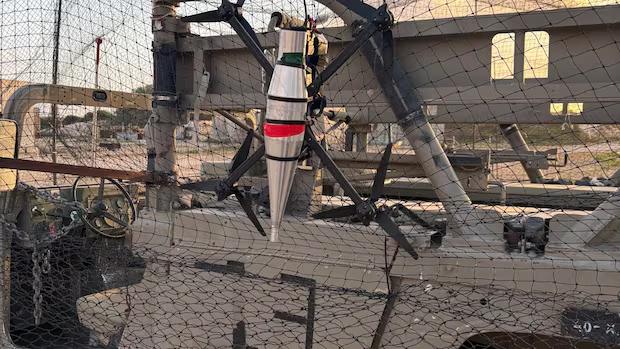
On the battlefields of southern Lebanon, the world’s most advanced air defence network is being bested by small drones that can be bought online, duct-taped with explosives and flown directly into Israeli military vehicles.
Hezbollah, the Lebanon-based militia that was once feared for its powerful arsenal of rockets and missiles, has pivoted to using drones, both out of necessity and shrewd adaptation.
Many of its top leaders have been killed and its inventory of missiles and launchers is believed to be severely depleted because of Israeli attacks.
The change in tactics has had consequences for IDF troops occupying southern Lebanon.
Eleven Israeli soldiers have been killed since the U.S.-sponsored ceasefire was agreed to on April 16, and of those CBC News has found references to four deaths that were the result of drones.
One of the more recent casualties was 19-year-old Sgt. Nehoray Leizer, who was killed on May 24 when the armoured personnel carrier he was driving was hit by a drone. Another soldier was seriously injured.
Last Wednesday, the IDF announced 10 soldiers were wounded in two drone attacks, one seriously.

“It creates quite a serious tactical problem for the Israelis,” said Robert Tollast, a land warfare specialist with the London-based Royal United Services Institute, a military think-tank.
“The longer they [Hezbollah] can persist with this threat, then it starts to have strategic implications. As more Israeli soldiers are killed and wounded … the effects will add up.”
In response to the surge in drone strikes, Israeli Prime Minister Benjamin Netanyahu on Monday said he ordered the IDF to increase the intensity of its attacks against the militant group.
In another indication of the pressure Israel’s government is feeling, far-right Finance Minister Bezalel Smotrich urged the widespread bombing of the Lebanese capital in response.
“For every explosive drone, 10 buildings should fall in Beirut,” he posted.

Lessons from Ukraine
Hezbollah appears to have been watching developments in Ukraine closely.
The battlefields of that country’s eastern front are characterized by the rapid advancement of drone warfare, with both Ukraine and Russia rushing to innovate and deploy increasingly sophisticated UAVs, or unmanned aerial vehicles.
One of the key breakthroughs has been the use of kilometres-long spools of fibre optic cable to tether drones to their operators and remove the possibility that radio transmissions could be blocked.

The cable also gives the operator a high-quality view of the landscape and potential targets below.
“Fibre optic is almost ideal if you are a good [drone] pilot and you’ve planned the route … you could potentially attack soldiers on the other side of a hill, and you’re not going to lose that radio signal,” said Tollast.
While Ukraine and Russia now mass-produce and fly thousands of drones every day, Hezbollah appears to be relying on more conventional methods of obtaining them, such as ordering them on e-commerce sites such as AliExpress.
The Alhurra media site reported Lebanese customs had no restrictions on importing spools of fibre optic wire.
Eluding Israeli air defences
Israel’s military has penetrated up to a dozen kilometres into southern Lebanon, demolishing buildings and attacking what it calls “terrorist infrastructure” in an effort to neutralize Hezbollah’s ability to launch rockets into northern Israel.
That’s left its troops vulnerable to drones that can fly low and avoid Israeli air defences.

“It’s very difficult to detect these quadcopters. They don’t leave much of a signature,” said Yaakov Lappin, an Israel-based military and strategic affairs analyst and research fellow with the Alma Research and Education Center.
“They’re basically a nightmare for any radar detections.”
Hezbollah social media and TV channels are filled with short videos showing purported attacks on Israel troops and military equipment.
CBC’s visual verification team has examined more than half a dozen videos posted on official Hezbollah sites and determined the first-person view (FPV) videos are likely authentic and not the product of AI.
One video published on Wednesday showed what appeared to be a Hezbollah quadcopter hitting a multimillion-dollar Israeli anti-missile system positioned behind a fortified wall. It’s unclear what, if anything, was actually damaged.
In one of the most dramatic incidents on April 26, at least one Hezbollah drone attacked a group of Israeli soldiers performing a medical evacuation after an earlier drone strike killed one soldier and injured six others. CBC was able to verify two videos showing this incident.
Lappin says Hezbollah also uses its drones as roadside bombs by landing them near where Israeli soldiers might be heading and then waiting for an opportunity to launch again.

“They call it ‘perching,’ where they sort of go to sleep and they can be reactivated again,” Lappin said. “They’re not going to be physically detected until someone physically sees them.”
Delayed reaction
Earlier this month, Netanyahu said he had initiated a “counter-drone project” but warned that developing effective counter-measures will “take time.” On Monday, he said he had authorized more intensive strikes on Lebanon in response to the surge of drone attacks.
“The IDF had warnings about this and it’s been late,” said Lappin about the drone threat.
Subsequently, the IDF said it has installed roughly 58,000 square metres of mesh netting to protect its vehicles and troops, with more coming.
Other potential drone counter-measures include using AI-enhanced gun sights called “smart shooters” that soldiers can fire at drones from the ground with a high degree of accuracy.
Some Israeli tanks are also equipped with “active protective systems” that use small radars to detect incoming objects, such as anti-tank missiles, and then fire counter-measures at them just before they’re about to hit.
The IDF “weren’t expecting this fibre optic threat to come to their doorstep so quickly,” said Tollast, the RUSI expert. “[Hezbollah’s] drone operators seem to have picked this up relatively quickly.”
Tollast believes the Israelis will be able to adapt quickly. “But it’s a question of changing training, changing doctrine and I don’t think that’s going to happen overnight.”

‘Psychological terror’
It’s not just the drones’ damage to vehicles and physical threat to troops that’s worrying the IDF — it’s also their ability to panic soldiers and civilians, says Lappin.
“It [creates] a psychological terror, because the IDF soldiers know that there’s a race against time to come up with solutions and until those solutions are in place, they’re going to feel exposed,” he said.
Hezbollah’s drone innovations have implications far beyond the battlefields of southern Lebanon and northern Israel.
“We are going to be entering a situation where basically any adversary, non-state terrorists, some of them supported by nefarious actors, are going to be able to deliver air threats pretty much anywhere in the world,” said Lappin.
“This is like a poor man’s air force and therefore … a wake-up call for everybody, the whole of the West. This threat is very, very accessible.”

