

[ad_1]
On a scorching summer day, sweat wells down Sivuyile Vundle’s face as he sits in his wheelchair, navigating the crowded streets of Ngcobo in the Eastern Cape. Getting anywhere when using a wheelchair is a tough task, so 42-year-old Vundle relies on his cousin, Ludwe, to push him around.

On this day, the pair made their way to Masonwabe Clinic to collect Vundle’s high blood pressure medication. They woke up at 5 o’clock that morning to catch public transport, which comes in the form of a bakkie. This isn’t a straightforward journey. Some taxi operators are impatient because Vundle takes longer to get into a taxi and needs assistance.
“Some of them often just pass me. I’ve got no choice but to be patient until I get transport because I need my medication,” Vundle says, wiping the sweat from his face with a handkerchief.
Vundle has to make this trip at least once a month to collect his medication. It is a daunting task, but he has no choice.
“Living with a disability is not an easy life at all, especially for us rural dwellers. Navigating potholed rural roads is difficult. I wish the government could prioritise us by ensuring that we get free transport to the clinic and hospital,” Vundle says.
Exacerbating his situation is the fact that the clinic is about 40 kilometres away and Vundle has to spend about R400 on transport fares every time he needs healthcare.
“Every time I come to the clinic, I have to pay double for transport for myself and my cousin,” he tells Health-e News.
The urban-rural divide
Having lived in Cape Town from 2016 until 2020, Vundle says there is a huge gap in terms of care for people living with disabilities between the two provinces.
“I have to admit that things are much better in the Western Cape. People living with disabilities there are provided with ‘Dial-A- Ride’ transport by the Department of Health when they need to visit healthcare facilities. Plus, clinics are nearby, and one doesn’t need to travel long distances for health services,” he says.
Vundle’s frustrations are shared by 51-year-old wheelchair-bound Simphiwe Gwaza from Tsolo.
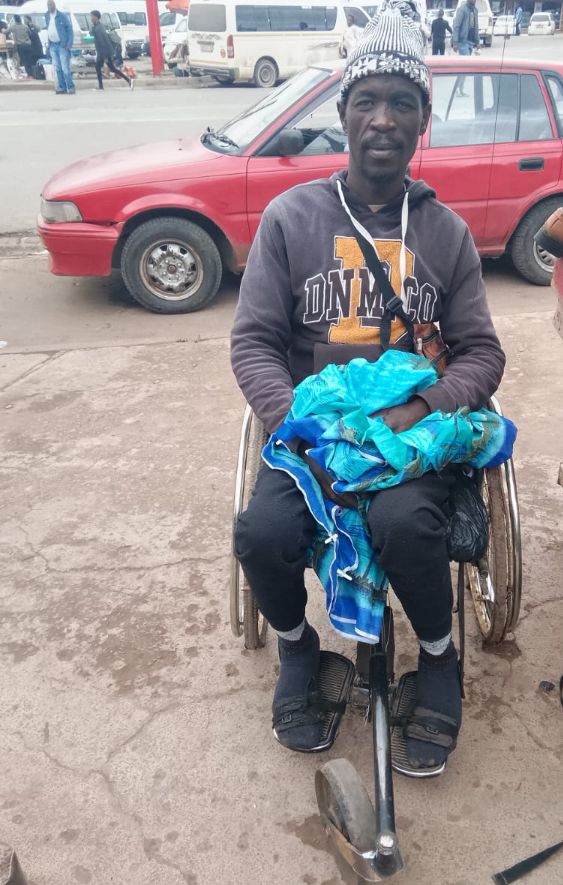
“Being unable to perform the smallest tasks by myself is painful. But the worst challenge for me is visiting the local clinic or hospital whenever I get sick,” he says, shaking his head. “As you can see, I am using this old wheelchair with worn-out tyres, and it is a struggle to move around.”
A marginalised community
Nosintu Mcimeli is the founder of the Abanebhongo Persons with Disabilities Organisation based in Ngqamakwe in the Eastern Cape. She tells Health-e News that inclusion and health care facility accessibility remain a major problem for persons living with disabilities.
“It is still tough, especially here in deep rural villages, because even leaving the house to relieve yourself is a struggle. Many of us (persons with disability) are bedridden as they are badly physically disabled,” she says.
“Mobility assistance is lacking. The worst thing is that the people who usually help them get to a clinic live far away. Imagine a person living with disability living alone and suffering a heart attack, and they can’t even get out of bed to get to the wheelchair and go look for help?”
Mcimeli says even though healthcare is free, persons living with disability have to dig deep into their already stressed disability grants to hire special cars as there are no vehicles and spaces in the bakkies sometimes used as public transport.
The government, she says, has turned a blind eye to the plight of persons living with disability.
Gwaza agrees with Mcimeli. “People with disabilities have the same rights as everyone else and we are demanding equal treatment from our government. It cannot be that it is only in big cities like Cape Town and Johannesburg where the rights of people living with disabilities are respected,” he says. “In the rural areas we are treated like nobodies and are facing discrimination daily.”
Possible solutions
Gwaza says it would help if the government introduced transport for people with disabilities from their homes whenever they need medical attention.
“I really don’t think that’s too much to ask for. Our government has all these resources. But I sometimes feel they just don’t have our interests at heart. We as people living with disabilities are a forgotten community,” Gwaza says. “Yes, they do provide disability grants but the money goes towards many other needs such as food, clothing and transport. All we are asking for is being assisted in getting to healthcare facilities.”
Subscribe to our newsletter
Vundle says local authorities need to be proactive in ensuring service delivery for those with disabilities.
“For one, I believe every local ward councillor needs to make it a point that they know the number of disabled people in their ward. Then, whenever we have healthcare needs, we can be provided a vehicle to get to a local healthcare facility. We do raise these concerns at imbizos, but sadly, it’s always empty promises,” he says.
The Eastern Cape health department did not respond to our queries. – Health-e News

[ad_2]
Source link
