

South Asia Regional Editor

 Getty Images
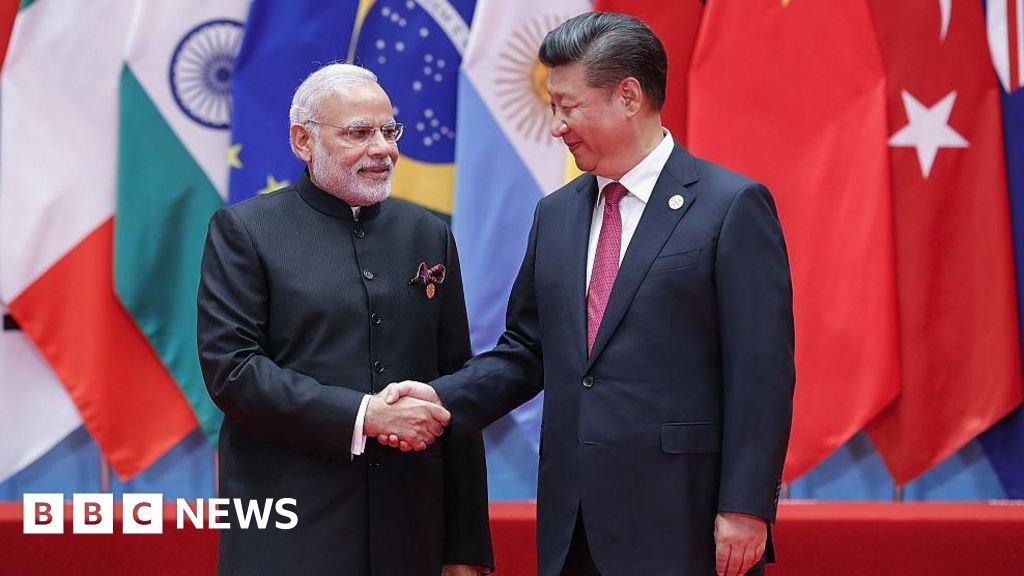
After years of border tensions, India and China appear to be gradually moving towards resetting ties – but larger challenges and suspicions remain.
The visit of two senior Indian officials to China late last month was seen as a sign of a thaw in bilateral relations.
In June, Indian National Security Adviser Ajit Doval and Defence Minister Rajnath Singh also made separate visits as part of the Shanghai Cooperation Organisation (SCO) meetings.
The SCO is a 10-member Eurasian security grouping that also includes China, Russia, Iran and Pakistan. Singh’s visit was the first by a senior Indian official to China in five years.
At the heart of India-China tensions is an ill-defined, 3,440km (2,100-mile)-long disputed border. Rivers, lakes and snow-caps along the frontier mean the line often shifts, bringing soldiers face to face at many points, sometimes sparking skirmishes.
The crisis escalated in June 2020 when the two forces clashed in the Galwan valley in Ladakh in what was the first fatal confrontation between them since 1975. At least 20 Indian and four Chinese soldiers died. Stand-offs between the militaries have since taken place in several places.
But geopolitical uncertainty and ground realities appear to have nudged the two sides to find common ground on several issues.
Late last year, they reached an agreement on the main friction points in Ladakh.
In January, Delhi and Beijing agreed to restore direct flights and relax visa curbs that were imposed after the 2020 clash.
The same month, Indian pilgrims were allowed to visit a sacred mountain, the Kailash, and a holy lake in the Tibet Autonomous Region after a gap of six years.
But experts point out there are other hurdles.
For India, China is the second-largest trading partner with bilateral trade reaching more than $127bn (£93.4bn) last year. It relies heavily on Chinese imports, particularly rare earth minerals.
Peace in border areas, therefore, is essential to boost economic ties.
 Getty Images
With its increasing focus on Taiwan, Beijing also wants peace in its Himalayan border with India – for now.
But at a strategic level, China suspects that Western nations are using India to counterbalance its rise and growing influence.
So, in addition to solving the border dispute, Beijing would want improvements in other areas as well, as it hopes to counter Delh’s increasing dependence on the US and its allies for security.
This includes more Chinese exports; increasing investments in India, and the removal of visa restrictions for Chinese engineers and workers. (India had banned dozens of Chinese apps and imposed restrictions on Chinese investments in the aftermath of the 2020 clash, citing security concerns).
Fast-changing geopolitics – particularly in the US since President Trump assumed a second term in power – has also compelled Delhi to reach out to China, experts say.
“India thought it would be a very close strategic ally [of the US] but they were not getting the support they were expecting from Washington,” Professor Christopher Clary of University of Albany in New York tells the BBC.
 Anbarasan Ethirajan/BBC
During recent border tensions with arch-rival Pakistan in May, Delhi also witnessed the growing military co-operation between Beijing and Islamabad. Pakistan used Chinese made fighter jets, air defence systems and air-to-air missiles in the four-day conflict.
In the aftermath of the conflict, Trump repeatedly asserted that he had mediated between the two sides for a ceasefire.
This embarrassed Delhi which insists that it directly spoke with Pakistani officials to stop the fighting, and vehemently denies any third-party mediation.
Weeks later, Trump also hosted Pakistani army chief Asim Munir for lunch at the White House, much to the dismay of Delhi.
At the same time, the US and India are also engaged in frantic talks to reach a trade agreement. Trump has already threatened to impose reciprocal tariffs on several countries, including India, if a deal is not reached by 1 August .
“Given President Trump’s statements about the mediation between India and Pakistan and about the trade talks, there’s a feeling in Delhi that this is the time to reach out to countries like China,” Clary says.
 Anbarasan Ethirajan/BBC
Strategic experts argue that Washington views Delhi as a bulwark against an increasingly assertive China. But given the US president’s unpredictability, there are now doubts in Delhi about how far the US will go to support India in any future conflict with China.
The Quadrilateral Security Dialogue – known as the Quad – involving the US, Japan, Australia and India has taken a back seat during the Trump administration’s second term.
“In recent years, China has also significantly increased its influence in other multilateral organisations like the SCO and the Brics grouping of emerging economies,” says Phunchok Stobdan, a former senior Indian diplomat.
So, India is taking a pragmatic approach, he says.
“At the same time, it does not want to be seen yielding too much to the Chinese demands for domestic reasons,” he adds.
And it’s not just the US – India is also keenly watching how its long-time ally and major weapons supplier Russia leaned towards Beijing due to the war with Ukraine.
Western sanctions in response to Russia’s invasion of Ukraine has increased Moscow’s reliance on China for energy exports.
Moscow also depends on Beijing for critical imports and investments, all of which has made Delhi wary of the Kremlin’s position in any future confrontation with China.
 Getty Images
China is also using its industrial might to squeeze many nations that depend on its imports – and countries like India feel the restrictions might impact their economic growth.
“China has lately been utilising trade as a weapon against India, suspending crucial exports such as rare earth magnets and fertilisers. These actions could affect India’s manufacturing and agricultural sectors,” Mr Stobdan says.
Rare earth magnets are especially crucial for automobile, home appliance and clean energy sectors. China imposed restrictions on its imports starting from April, requiring companies to obtain permits.
An Indian automobile industry association has warned that production could be severely impacted if the restrictions are not eased soon. Following these apprehensions, the Indian government said it was holding talks with Beijing.
Though China is keen on boosting business, it hasn’t shown any signs of compromise on its other territorial disputes with India.
In recent years, it has increasingly asserted its claim over the entire north-eastern Indian state of Arunachal Pradesh, which Beijing calls Southern Tibet.
Delhi asserts that Arunachal Pradesh is an integral part of the country and points out that people of the state regularly vote in elections to choose their state government and there’s no room for any compromise.
“If China and India would not abandon the concept of sovereignty, then they will continue to fight forever. If they can reach a deal on Southern Tibet [or Arunachal Pradesh], then the two countries would have eternal peace,” Prof Shen Dingli from the Fudan University in Shanghai tells the BBC.
For now, both Delhi and Beijing are aware that their territorial dispute cannot be solved in the near future.
They seem willing to strike a working relationship that’s mutually beneficial, and would want to avoid tensions altogether, rather than relying on any global power bloc for support.
Follow BBC News India on Instagram, YouTube, Twitter and Facebook.

