




10 June 2026
Last update:17 June 2026

e, the Ministers and representatives responsible for Education, Health, Gender, Youth and related sectors from countries across Sub-Saharan Africa, gathered in Livingstone, Zambia, on 27 May 2026 for the Ministerial Dialogue on The Role of Schools in Addressing the Triple Threat: HIV, Early and Unintended Pregnancy (EUP), and Gender-Based Violence (GBV), convened by UNESCO under the Our Rights, Our Lives, Our Future (O3)Programme…..
Weacknowledge thatthe TripleThreat is not only a health challenge, but also an education, development, gender equality, and human rights challenge…
Wecall upon Governments, development partners, regional institutions, communities, faith leaders, parents, caregivers, traditional leaders, and young people themselves to act with urgency and solidarity to protect and empower Africa’s children and adolescents.
Weleave Livingstone with renewed urgency and shared determination to act boldly and collectively to address the Triple Threat and to ensure that every learner — especially every girl — is safe, healthy, empowered, and able to thrive.
UNESCO
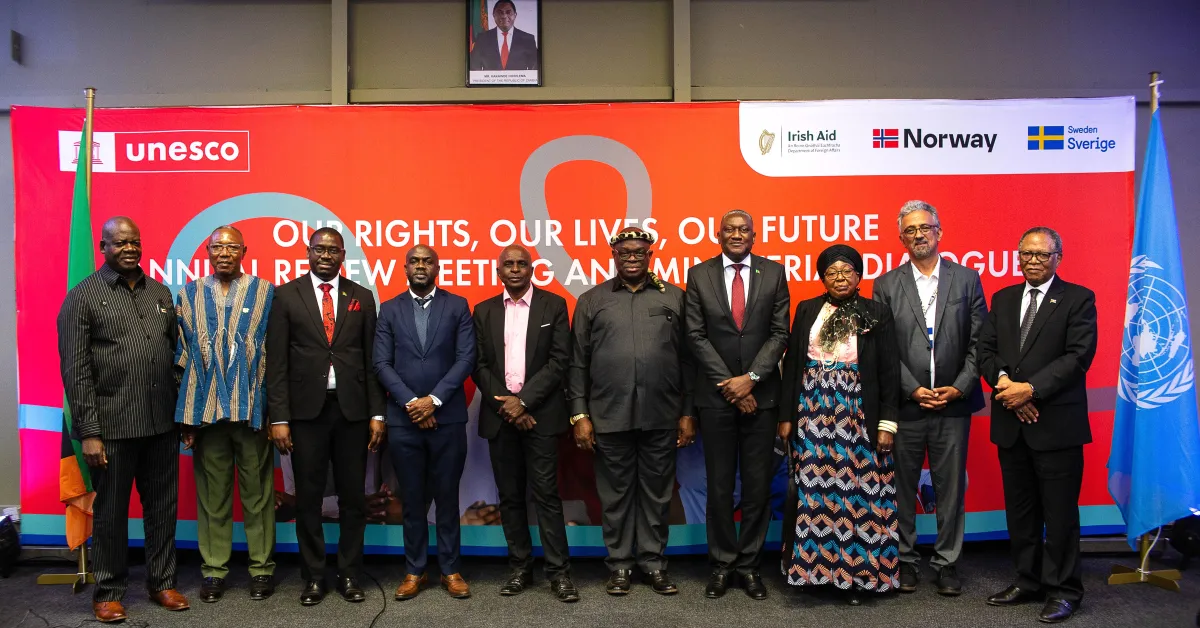
Livingstone, Zambia, May 2026:As ministers, senior government representatives and traditional leaders from across Sub-Saharan Africa gathered in Livingstone, Zambia to read out this communique, one message rang clear: Africa’s future depends on how well it protects, educates, and empowers its young people today.
The gathering, convened by UNESCO undertheOur Rights, Our Lives, Our Future (O3)Programme, brought together leaders from Eswatini, Ghana, Kenya, Malawi, South Africa, Tanzania, Zambia and Zimbabwe to confront the ‘Triple Threat’ facing adolescents across the continent: HIV, early and unintended pregnancy, and gender-based violence.
The leaders acknowledged that these challenges are not only health issues. They affect education, gender equality, economic development, and human rights. Their response was equally clear: schools must play a central role in equipping young people with the knowledge, skills, and support they need to navigate life safely and confidently.
- UNESCO
- UNESCO/O3
- UNESCO/O3
- UNESCO/O3
- UNESCO/O3
- UNESCO/O3
1/
For many young people, lifeskillshealth education can be transformative. It provides accurate information, builds confidence, strengthens decision-making skills, and helps learners understand where and how to access critical health and support services.
“The O3programmeis important for adolescents and young people because it equips them with accurate information, knowledge on how, what, where, and how to get services that they need in their daily lives,”says Angel Ukwishaka Uwimbabazi from Uganda representing AFRIYAN – a key partner of UNESCO in mobilizing young people across East and Southern Africa.“It helps them make informed decisions regarding their bodies and their lives as a whole,”she says.
Young people from West and Central Africa echoed the same message, stressing that access to reliable information is not only about knowledge, but also about protection, dignity, and participation.
“Millions of adolescents and young people in Africa are growing up without reliable education on their health, their bodies and their rights,” says Djamila Sawadogo, a member of the West and Central Africa Commitment’s Youth Community. “The O3Programmeis based on a strong principle: all adolescents and young people should have access to accurate and reliable information.” For Djamila this matters, because young people are often the first to experience the consequences of misinformation and silence, from forced marriage and HIV to female genital mutilation. “Theprogrammeplaces young people at thecentreof its strategies, not only as actors, but also as co-creators,” she says.
UNESCO/O3
Theprogramme’sstrength lies not only in what it teaches but also in how it brings people together. Governments, schools, communities, civil society organizations, young people, and development partners all contribute to creating safer and more supportive environments for learners.
“One unique thing about the O3programmeis the partnerships that we are building around it,”explainsChide, Director of Quality Assurance in Malawi’s Ministry of Education, Science and Technology.“Not just governments implementing, but we are working with civil society, communities, and development partners as well. We acknowledge that the problem we are dealing with cannot be handled by just one stakeholder.
This shared commitment was reflected in the communiqué adopted in Livingstone, which called on governments, development partners, regional institutions, communities, faith leaders, parents, caregivers, traditional leaders and young people themselves to act with urgency and solidarity.
The communiqué also called for sustained investment, strengthened technical cooperation and expanded South-South cooperation and learning to accelerate progress across the continent. The ministers left Livingstone with a renewed determination to act boldly and collectively.
With less than a year remaining in the current phase of the O3Programme(2023-2027), the call to collective action is more urgent than ever. Millions of learners still need access to quality life skills and health education that empowers them to make informed decisions, stay healthy, remain in school, and achieve their full potential.
Achieving that vision will require continued commitment and investment because when young people are equipped with knowledge, skills, and support, they are better prepared not only to overcome today’s challenges but also to shape Africa’s future.
***





