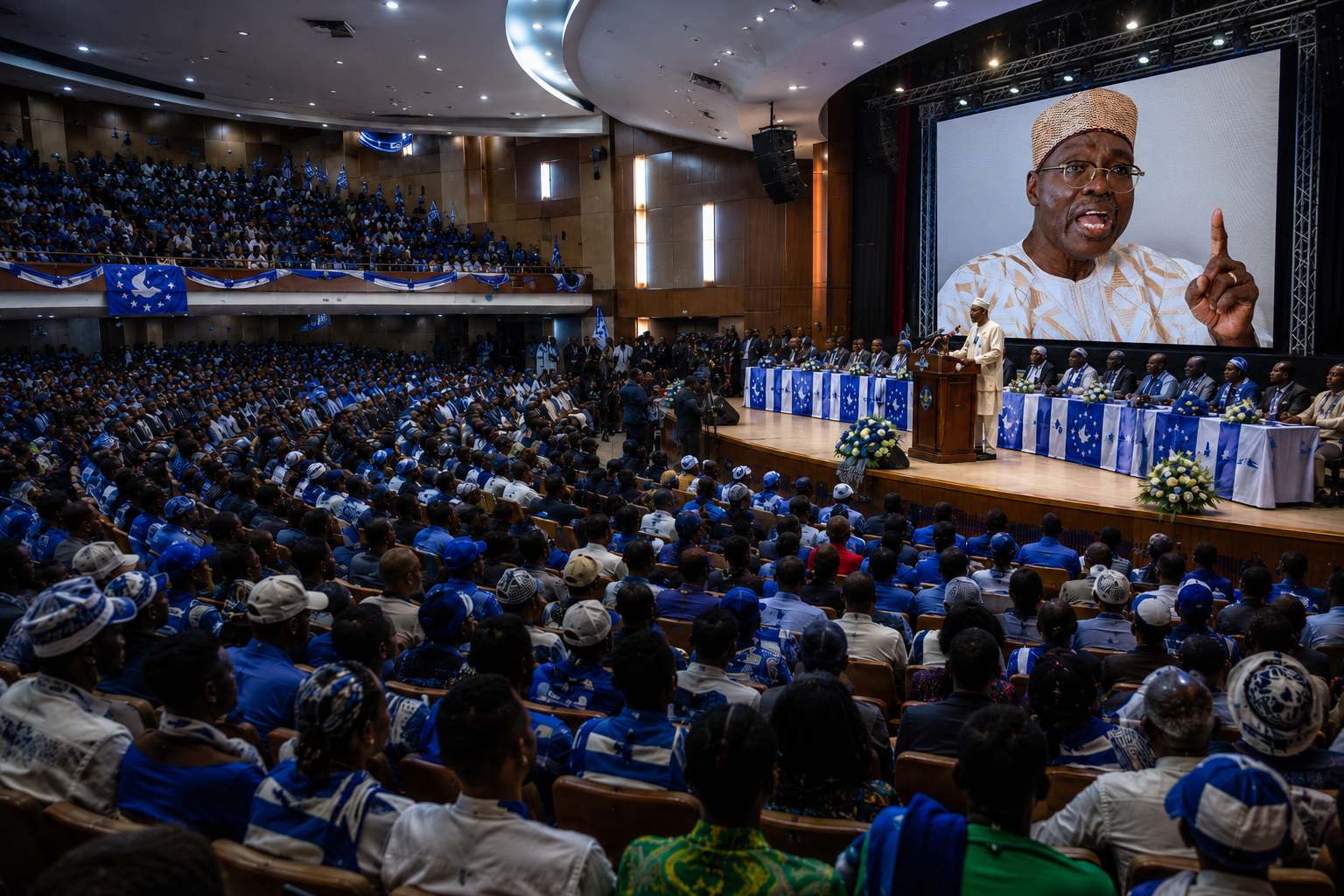
In politics, timing is rarely accidental. It often reveals more than the words spoken from the podium. That is precisely why Issa Tchiroma’s decision to hold what is being described as his first exclusive town hall meeting with Southern Cameroonians deserves close scrutiny.
Why now? The answer is not immediately obvious, but the political context surrounding Cameroon today offers several plausible explanations.
Cameroon is navigating one of the most uncertain moments in its post-independence history. President Paul Biya, has remained outside the country for an extended period amid persistent speculation about his health. Although no official declaration of incapacity has been made, the prolonged absence has intensified questions about succession and exposed visible fractures within the country’s political establishment.
Against this backdrop, Tchiroma’s outreach to Southern Cameroonians appears far more significant than an ordinary political engagement. Could this be the beginning of a broader political realignment? It is certainly possible.
Only weeks ago, Tchiroma reportedly appealed to the Cameroon military to facilitate what he described as his safe return from exile. That appeal alone suggested a politician actively preparing for another chapter in his political career rather than retreating from public life. And now comes this unprecedented engagement with a constituency that has historically viewed him with profound skepticism.
That sequence of events naturally raises an important question. Is Issa Tchiroma quietly assembling the geopolitical support necessary for a political comeback?
If Biya’s prolonged absence ultimately produces a succession crisis, every serious political actor will understand that no national coalition can realistically ignore the English-speaking territories. Regardless of one’s position on the Southern Cameroons question, the conflict has fundamentally altered Cameroon’s political landscape.
For decades, national politics largely revolved around regional balancing inside the Francophone political establishment. In any new dispensation, however, any credible claim to national leadership increasingly requires addressing the unresolved conflict in the Southern Cameroons. If Tchiroma harbors ambitions of reclaiming what he has consistently maintained was his stolen electoral mandate, then engaging Southern Cameroonians would not merely be symbolic—it would be politically logical.
Whether that is his objective remains uncertain. But the possibility cannot simply be dismissed. Equally significant is the audience he has chosen to address. Southern Cameroonians are unlikely to welcome him uncritically. Many within the Ambazonian movement remember Tchiroma not as an outsider but as someone who spent decades serving the Biya regime. To many, he remains part of the very political establishment they accuse of marginalization, repression and the denial of their right to self-determination.
That history cannot be erased by one town hall meeting. It must instead be confronted. This is precisely why expectations surrounding his remarks will be unusually high. The people will not merely want reassurances. They will demand clarity. They will demand cooperation in having their dreams fulfilled.
In previous statements, Tchiroma indicated his willingness to listen to the grievances of Southern Cameroonians/Ambazonians and even suggested that, when it becomes needful, he could support a referendum that would allow for greater autonomy. That statement, while noteworthy, leaves enormous political questions unanswered.
Does “greater autonomy” represent genuine constitutional federalism? Would it involve internationally supervised negotiations? Could it evolve into a referendum offering multiple political options? Or does it merely envision another decentralization initiative that many Southern Cameroonians have repeatedly rejected? These distinctions matter enormously.
For many Ambazonians, the conflict is no longer about administrative reforms or expanded local governance. It has evolved into a struggle centered on independence, international recognition and the right of self-determination. Consequently, Tchiroma’s audience will almost certainly expect him to address these issues directly rather than relying on carefully crafted political language. Silence or ambiguity could reinforce long-standing distrust.Clarity, even if controversial, may at least demonstrate political courage.
Another intriguing possibility deserves consideration. Could Tchiroma believe that Cameroon is entering a rare political opening—one in which new alliances become possible as old power structures weaken? History has shown that periods of leadership uncertainty often produce unexpected political coalitions. Politicians who once occupied opposing camps suddenly discover shared interests when national power is being renegotiated.
If that is indeed the current political moment, then speaking directly to Southern Cameroonians becomes less surprising. It becomes strategic. None of this confirms Tchiroma’s intentions. Only he can fully explain why he has chosen this particular moment and this particular audience.
Yet politics often speaks through actions before it speaks through speeches. An exclusive town hall with Southern Cameroonians, coming amid mounting uncertainty over Cameroon’s future leadership and shortly after publicly seeking assistance to return from exile, is almost certain to fuel speculation about larger political ambitions. Whether this marks the beginning of a genuine effort at national reconciliation, an attempt to rebuild political legitimacy, or the first step in assembling a broad geopolitical coalition ahead of a potentially transformative period in Cameroon remains to be seen.
One thing, however, appears beyond dispute. Southern Cameroonians will not simply be listening to what Issa Tchiroma says. They will be carefully judging whether, after decades of political participation within the system they reject, he is finally prepared to offer something fundamentally different.