There is perhaps no political phrase more symbolic of Paul Biya’s four decades in power than the famous expression attributed to him: “Na Caterpillar go move me for ya.” In plain English, the message was unmistakable: only a bulldozer could remove him from office.
For years, that statement became more than a joke. It became the governing philosophy of a political system where retirement seemed optional, succession was taboo, and public office was treated less as a constitutional responsibility than a lifetime possession.
Today, Cameroon finds itself confronting the irony of that statement. President Biya has now spent weeks away from the country in Geneva, Switzerland, where government officials insist he continues to govern despite mounting questions about his prolonged absence and his ability to personally oversee state affairs. The uncertainty has fueled intense political speculation inside and outside the country.
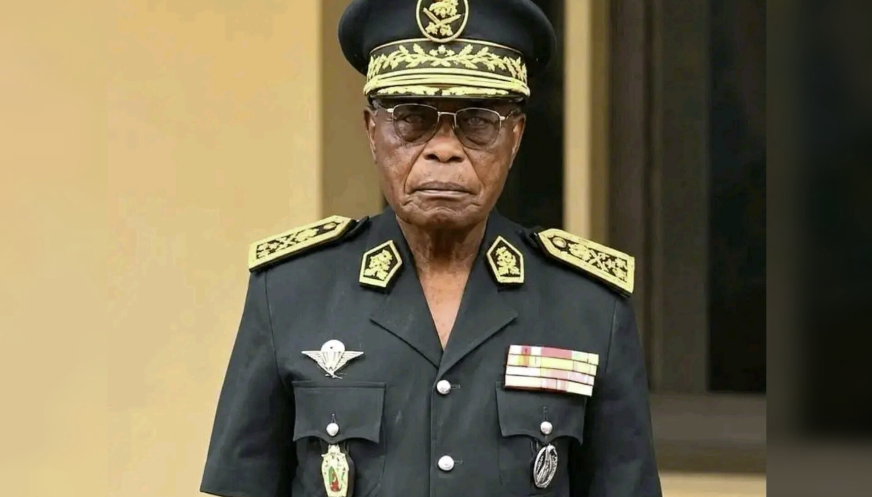
And then came another extraordinary controversy. Reports circulating in Cameroon suggest that a very senior military officer— Major General Hector Marie Tchemo, in his eighties, reportedly questioned the authenticity of a presidential decree announcing his retirement over CRTV arguing that President Biya did not personally sign it. While the circumstances remain disputed, the episode has ignited debate over who truly exercises authority inside the presidency during the president’s prolonged stay abroad.
On July 28, the presidential decree (read on CRTV and later confirmed by the Civil Cabinet of the Presidency) admitted General Tchemo to the “deuxième section” — the formal status for retiring senior officers from active duty while retaining rank, uniform rights, and certain privileges. This occurred while President Paul Biya (93) remains out of the country for over 50 days.
News reports and social media circulating from around July 29, claimed that General Tchemo continued reporting to his office the next day and carried on with his usual activities. That he contested the decree’s authenticity, saying it did not come from Paul Biya (given the president’s prolonged absence). He said the decree was possibly the work of another authority (some sources specifically named Ferdinand Ngoh Ngoh). These accounts explain his refusal to retire based on allegations that the letter was forged or unauthorized.
Today, Friday, the Ministry of Defence (MINDEF) issued a statement firmly denying the refusal reports. It described Gen. Tchemo as a servant of “absolute loyalty” whose “moral rigor and fidelity to republican orders are unwavering,” and stated that he accepted his retirement “with full dignity.” However, there hasn’t been any independent confirmation of a public statement directly from Gen. Tchemo himself.
He was the Major General (effectively the number 2) at the État-Major des Armées (General Staff of the Armed Forces), serving under Chief of Staff René Claude Meka, aged 87, still serving but who has been absent for health reasons.
If the report of Gen. Tchemo refusing to retire ultimately proves accurate, the political symbolism would be impossible to ignore.
The philosophy of “na only caterpillar go move me for ya” would have found its perfect disciple. If the President cannot retire me…then nobody can. William Shakespeare once observed that “the king dies, but the kingdom lives on.” Cameroon appears trapped inside a different political tragedy. Here, power risks forgetting the king long before the kingdom is prepared to acknowledge his absence.That is what makes this episode so politically fascinating.
Because the real story may not be about one general refusing retirement. The larger question is this: Who inside Etoudi is afraid of the generals? If it turns out that a retirement decree was indeed issued without the President’s direct approval, what purpose would such a move serve? One possible explanation is perfectly ordinary administrative confusion. Another, far more political interpretation, is that competing factions could be attempting to reshape the military hierarchy ahead of an uncertain succession.
Again, there is no public evidence proving such a scenario. But in politics, perception often travels faster than confirmation. Cameroon is experiencing an unusually delicate period. President Biya’s prolonged absence, the reintroduction of the vice presidency without an appointee, delayed government formation, and visible tensions over succession have created an atmosphere in which almost every administrative decision is viewed through a political lens.
And whenever succession becomes uncertain, one institution inevitably attracts attention. The military. History teaches that governments facing leadership transitions often seek absolute confidence in the chain of command. Could that explain the timing of controversial personnel decisions? Could someone be attempting to ensure complete control over the armed forces before events overtake politics? Or are Cameroonians simply witnessing the inevitable confusion that follows whenever power becomes increasingly centralized around one individual?
Ironically, the controversy also exposes a deeper truth about Cameroon’s political culture. For decades, authority has been personalized rather than institutionalized. Officials often obey the man more than the office. The consequence is predictable. When uncertainty surrounds the man, uncertainty spreads throughout the institution. Even retirement becomes negotiable. Even signatures become political. Even decrees become subjects of national debate. Perhaps that is the greatest lesson from this unfolding drama.
Strong institutions are designed to function regardless of who occupies the highest office. Systems built around one individual eventually discover that uncertainty at the top produces uncertainty everywhere else. The old saying, “Na Caterpillar go move me,” may once have sounded like the ultimate declaration of political invincibility. Today it carries a different meaning. It reminds Cameroonians that when leaders refuse to prepare for orderly transitions of power, everyone else eventually begins refusing to move as well.