

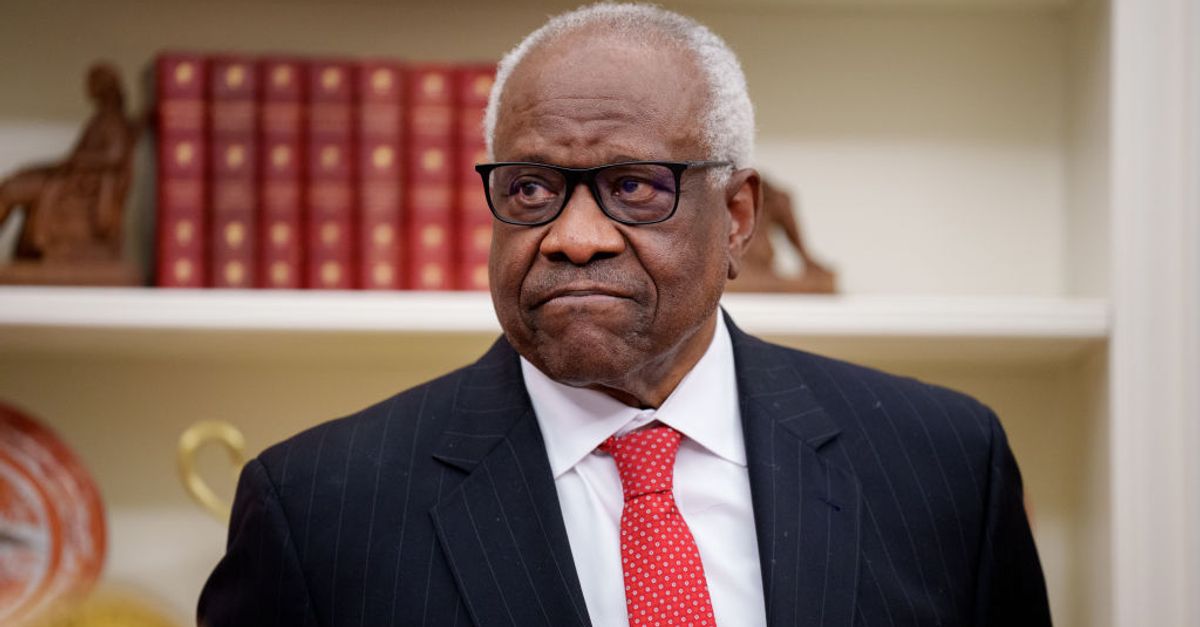

Justice Clarence Thomas on Thursday afternoon spoke on the issue of shared national values. In an appearance at a conference outside Miami for judges and lawyers from the U.S. Court of Appeals for the 11th Circuit, which includes Alabama, Florida, and Georgia, Thomas described growing up in Georgia during segregation and said that “we shared a country, no matter how badly we were treated, with our fellow citizens.”
Thomas was interviewed for over an hour by Kasdin Mitchell, a former clerk who was recently nominated to serve as a federal judge in Texas. Mitchell asked Thomas to discuss remarks that he had made last month at the University of Texas to commemorate the 250th anniversary of the Declaration of Independence.
Thomas emphasized that the ideals outlined in the Declaration of Independence provide common ground for everyone in the United States. “We have different religions, we live in different places,” he said, but what do we have in common? “We can say this is something that we all treasure and we all agree on.” Even under segregation, he continued, we had that: as a child, he said, we “raised the flag everyday” and “said the Pledge of Allegiance.”
In response to a question from Mitchell about what it means for rights to be self-evident, Thomas suggested that “we’ve disenfranchised most people” with discussions of legal theories like textualism and originalism – the principles that laws should be interpreted based only on the plain meaning of the text, and that the Constitution should be interpreted according to how it would have been understood when it was enacted. “Most people don’t understand those,” Thomas said. Instead, he explained, “we were taught from the cradle that we were equal in God’s eyes. … We could own property.” “Others may intrude upon those rights … but it was not theirs to take away.” He concluded, “Even people who are unlettered when I grew up took it as a given that in God’s eyes we were equal.”
Noting that he had only planned to live in Washington, D.C., for two years but had stayed on for more than four decades, Thomas suggested that in Washington and other places many people fall short of the ideals outlined in the Declaration of Independence. These people, he said, “make promises and platitudes,” “but when it’s time to actually have courage … they fail or they find a reason or an excuse” not to act. He compared them (unfavorably) with the signers of the Declaration of Independence – who, he said, “put their names down” and “sealed their fate by signing” the document, because they faced the possibility that they could be hung for treason.
Mitchell noted that last week Thomas became the second-longest serving justice (and in two years could become the longest-serving justice). Thomas responded wryly, “Thanks for letting me know that.”
As he has in previous public appearances, Thomas expressed nostalgia for earlier iterations of the Supreme Court, telling Mitchell that “it’s a different court now” and he was “really grateful I had an opportunity to be on the court that I joined.” When he joined the Supreme Court in 1991, he said, the court included several members of the “greatest generation” – the cohort born during the first quarter of the 20th century. “Most of them had been in the military” and “lived through the depression. They thought the institution” of the Supreme Court and “the Constitution were much bigger than they were,” Thomas stressed.
Thomas indicated that during that era, “the friendships were much, much deeper than” they are now, adding that “I came of age on that court.” He had just turned 43 when he was confirmed, while some of his colleagues at the time “had children older than I was and yet they treated me very fairly.”
By contrast, he continued, he had known “the last four members of the current court” – Justices Neil Gorsuch, Brett Kavanaugh, Amy Coney Barrett, and Ketanji Brown Jackson – when they served as law clerks at the court, while he was a sitting justice. “The relationships are different,” Thomas said, “even though they are not negative in any way.”
Thomas addressed his increased participation in oral arguments after the onset of the COVID-19 pandemic, which prompted the court to switch at first to telephone arguments, in which each justice took turns asking questions. When the justices returned to the courtroom in September 2022, they reinstated the “free for all” questioning that they had used before the pandemic, but they now follow it up with a “round robin” round of questions in which each justice has a chance to ask questions without interruption from the other justices. Before the pandemic, Thomas rarely asked questions – even though, as Mitchell told the audience, his clerks were instructed to provide possible questions with each memorandum that they prepared before oral arguments.
Thomas said that the “round robin” questioning during the pandemic “brought an order to the process.” Before the pandemic, he believed that the myriad interruptions were “rude and I said so.” He expressed satisfaction with the current set-up for oral arguments, which can often go well over the hour normally allotted. He said that “the current approach may run on a bit long, but you cannot say you have not had a chance to say your piece. … I can sit there all day.”
Thomas also discussed his hiring of law clerks and his efforts to hire clerks from a variety of law schools outside of the Ivy League. He said proudly that he had had law clerks “from each of the flagship law schools in the” 11th Circuit – the University of Florida, the University of Georgia, and the University of Alabama. “I think there’s smart kids a lot of places,” he said, adding that he had “a young woman coming” to start as a law clerk “who started in community college” because of financial and family circumstances. “I like kids from regular backgrounds,” he said, with “parents who worry about the mortgage and fixing the transmission on the car.”

