Mitsubishi’s Pajero returns for 100 countries, and Europe isn’t on the list
The fifth-generation Pajero is a ladder-frame seven-seater built in Thailand, with 480 Nm of diesel torque and 230 mm of ground clearance. Mitsubishi named ASEAN, Latin America and the Middle East.
The first new Pajero in 20 years is a Thai-built ladder-frame seven-seater
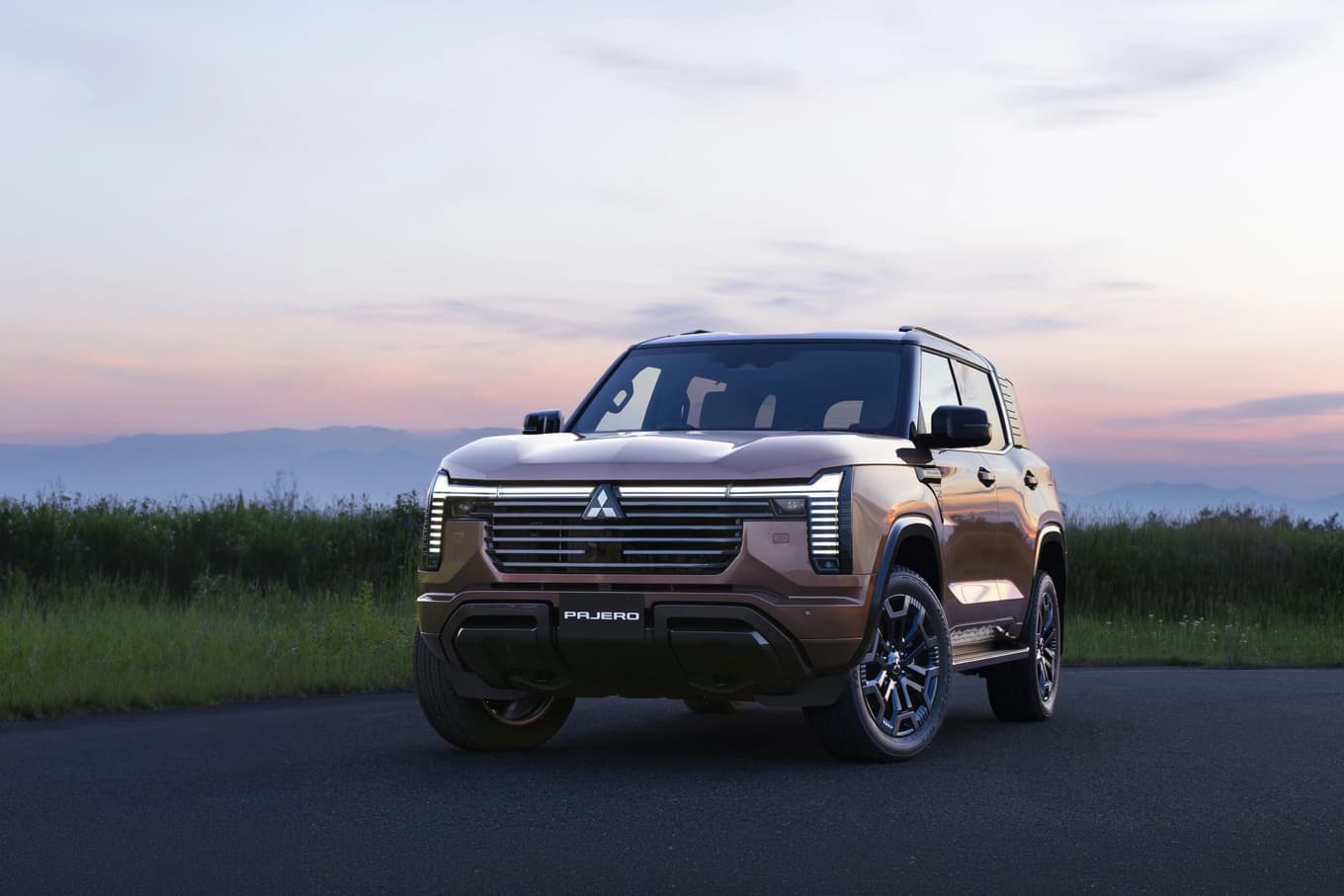
Mitsubishi pulled the covers off the fifth-generation Pajero in Tokyo on Wednesday, twenty years after the fourth generation arrived and five years after the nameplate died. It is body-on-frame, seven seats, diesel only, and built in Thailand rather than Japan. Thailand also gets it first, with Japan and Australia following before the end of March 2027, and around 100 countries from fiscal 2027 onwards.
A 2.4-litre diesel rated at 480 Nm, with no power figure published
Mitsubishi gave torque and withheld power. The 2.4-litre clean diesel, which the company calls specially developed, uses a single wide-range variable-geometry turbocharger and is rated at 480 Nm, falling to 470 Nm on some specifications. It drives through a newly developed eight-speed automatic with a sport mode. There is no petrol option, no hybrid and no plug-in hybrid at launch, which is a pointed choice from the company that spent a decade selling Europe the Outlander PHEV.
230 mm of ground clearance and a 30.4-degree approach angle
On 20-inch tyres the Pajero clears 230 mm, with approach, breakover and departure angles of 30.4, 22.6 and 25.8 degrees, and a 52:48 weight distribution. The ladder frame uses more high-tensile steel and a bigger cross-section, the front suspension is a double wishbone and the rear is a new five-link rigid axle on coil springs. Super Select 4WD-II carries over with its 2H, 4H, 4HLc and 4LLc modes, and for the first time on a Pajero it is combined with S-AWC, the torque-vectoring system Mitsubishi built for the Lancer Evolution. Seven terrain modes run from Gravel to Rock.
Two 14.3-inch screens and Mitsubishi’s first centre airbag
The dashboard is one horizontal panel carrying two 14.3-inch displays, with 12.3-inch units on lower specifications, and the old triple-gauge cluster returns as a digital Multi-Meter reading altitude, compass heading, pitch and roll. Physical climate controls survive underneath. Soft-touch trim borrows a stitching technique from kimekomi, a traditional Japanese craft, and there are eight airbags including the company’s first SRS centre airbag between the front seats. The Pajero measures 4,920 mm long on a 2,870 mm wheelbase.
Mitsubishi named ASEAN, Latin America and the Middle East
Thailand builds the car and buys it first, with Japan and Australia inside fiscal 2026, which ends on 31 March 2027. From fiscal 2027 Mitsubishi will take it to roughly 100 countries, and it named three regions: ASEAN, Latin America and the Middle East. Every earlier Pajero was assembled in Japan, latterly at the dedicated Pajero Manufacturing plant in Sakahogi, Gifu, which employed around 1,200 people and shut in 2021. Neither Europe nor North America appears on Mitsubishi’s list.
Mitsubishi killed the Pajero and froze Europe in the same 2020 plan
The two decisions were announced together. On 27 July 2020, facing an operating loss it put at 140 billion yen, Mitsubishi said it would close the Pajero plant and freeze the introduction of new models in Europe, refocusing on Southeast Asia and Oceania. Six years on it has reversed the first half and left the second alone. Europe still buys Mitsubishis, but the ASX is a Renault Captur, the Colt is a Clio, the Grandis is a Symbioz and the Eclipse Cross is a Scenic E-Tech. Only the Space Star and the Outlander are the company’s own.
AutoNext Take
The freeze has outlived its reason. Mitsubishi imposed it while losing money and shrinking, and it has now spent real engineering budget on a new frame, a new diesel and a new eight-speed automatic, then pointed all of it away from a continent where this segment is demonstrably alive. Europe’s CO2 fleet targets do make a large diesel expensive to sell here. Toyota pays that price for the Land Cruiser 250, Ineos pays it for the Grenadier and Land Rover pays it for the Defender, and all three stay.
So here is the test. Mitsubishi’s European range is two of its own cars and four Renaults, and the 2020 freeze is the reason. If the Pajero is still missing from Europe when the fiscal 2027 rollout is finished, then that plan stopped being a restructuring some time ago and became the strategy, and the most credible badge Mitsubishi owns will have come back as a product for other people. What stands between the two is one homologation programme and a decision that is six years late.
Mitsubishi Pajero returns in 2026 as new Triton-based SUV
The Mitsubishi Pajero is coming back. That alone is big news. After disappearing from overseas markets in 2021, one of Mitsubishi’s most iconic off-road names will return to the global stage with a world premiere planned for autumn 2026. The new Pajero will become a proper cross-country SUV again, based on the strong ladder-frame platform of the Mitsubishi Triton pick-up.
Read the article
New Models
10/08/2026
Fans wanted a new Pajero, and Mitsubishi gave them a rebadged Foxconn EV
The new Mitsubishi ASX VR-e is a lightly restyled Foxtron, the EV arm of iPhone-assembler Foxconn, designed by Italy’s Pininfarina and rebadged by Mitsubishi. It offers up to 400 hp, a 57.7 kWh battery and launches in Australia this year. Fans wanted a new Pajero; they got a car in which Mitsubishi designed, engineered and built nothing, and the real story is Foxconn’s plan to become the contract builder of the car world.
Read the article
Automotive Industry
05/07/2026
Mitsubishi’s new boss dreams of bringing back the Lancer Evo (but it’s only a dream, for now)
Mitsubishi’s new president Keisuke Kishiura has said he would love to see the company build a car like the Lancer Evo again, calling the Evo, Galant and Diamante treasures, and dreaming of a return to the World Rally Championship. But he offered no timeline, powertrain or specifications, and stressed nothing is planned. With Mitsubishi focused on SUVs and electrified models and leaning on cost-sharing with Nissan and Renault, a new Evo remains firmly in dream territory.