

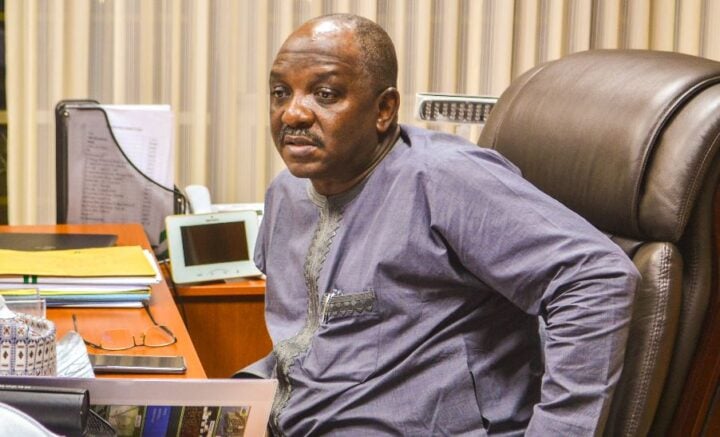
Anuja, Nigeria – A Nigerian court has sentenced former Minister of Power Saleh Mamman to 75 years in prison after convicting him on multiple counts of fraud and money laundering tied to major hydroelectric power projects, in what analysts describe as one of the most significant anti-corruption convictions involving a senior public official in recent years.

Justice James Omotosho of the Federal High Court in Abuja handed down the sentence Wednesday after finding Mamman guilty on all 12 charges brought against him by Nigeria’s Economic and Financial Crimes Commission, or EFCC. Prosecutors accused the former minister of laundering and diverting about 33.8 billion naira, roughly $24 million, from funds allocated to the Mambilla and Zungeru hydroelectric projects.
The court ordered that the prison terms attached to each count run consecutively rather than concurrently, resulting in the unusually lengthy 75-year sentence. Mamman was sentenced in absentia after failing to appear in court for the judgment. Justice Omotosho directed Nigerian security agencies and Interpol to arrest the former minister wherever he is found and hand him over to correctional authorities to begin serving his sentence.
The EFCC alleged that Mamman used private companies to funnel public funds meant for critical electricity infrastructure projects during his tenure as power minister under former President Muhammadu Buhari. Prosecutors said large sums were diverted from projects designed to address chronic electricity shortages in Africa’s most populous nation.
Nigeria continues to struggle with widespread power outages despite decades of government investment in the sector. Much of the population still depends on generators due to unstable grid electricity. Analysts have long blamed corruption and mismanagement for undermining efforts to improve power supply.
In addition to the prison sentence, the court ordered the forfeiture of recovered assets, foreign currencies and several Abuja properties linked to the former minister. The judge also directed Mamman to refund outstanding amounts from more than 22 billion naira investigators said had been traced to diverted project funds.
The EFCC first arraigned Mamman in 2024 on amended charges of conspiracy and money laundering. During the trial, prosecutors presented 17 witnesses and dozens of exhibits to support claims that funds intended for national power infrastructure were illegally siphoned away. Mamman had pleaded not guilty.
The conviction is being viewed as a rare high-profile victory for Nigeria’s anti-graft campaign, where prosecutions of senior political figures have often dragged on for years without convictions. Mamman is reportedly the first major cabinet member from the Buhari administration to receive a prison sentence over corruption allegations.

