


Access through your institution
Buy or subscribe
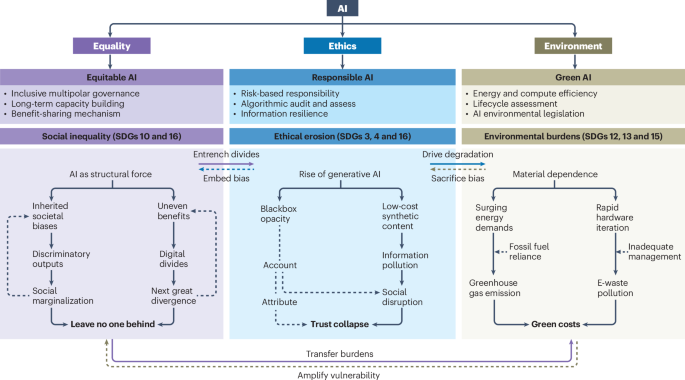
The rapid expansion of AI infrastructure is creating unprecedented challenges in energy consumption and electronic waste (e-waste) management. Data centres accounted for approximately 1.5% of global electricity consumption in 2024, with their energy demand projected to more than double by 20304. Where electricity generation relies on fossil fuels, this growth compounds greenhouse-gas emissions and complicates decarbonization pathways, hindering progress towards SDG 13 (climate action). Under aggressive growth scenarios, e-waste from generative AI could increase by nearly three orders of magnitude between 2020 and 2030, reaching an estimated five million tonnes5. However, less than one quarter of e-waste is formally collected and recycled6. Informal practices such as open burning, landfilling and uncontrolled dumping release hazardous substances that contaminate soil, water and air, obstructing advances towards SDGs 12 (responsible consumption and production) and 15 (life on land).
AI technology can be used to effortlessly generate highly realistic but factually incorrect texts, images and videos at low cost, which blurs the boundary between truth and fabrication7. The resulting spread of misinformation and synthetic content remains difficult to regulate, and a critical risk is the collapse of public trust in authentic information, dissolving the shared factual foundation essential to SDGs 3 (good health and well-being) and 4 (quality education). This challenge is compounded by the opacity and limited explainability of black-box AI algorithms8. When biased outputs or false claims arise, inscrutable decision pathways make it nearly impossible to trace reasoning or assign accountability. This fundamentally threatens SDG 16 (peace, justice and strong institutions), which relies on effective, accountable, and transparent social operation and governance frameworks.
This is a preview of subscription content, access
Access options
- Purchase on SpringerLink
- Instant access to the full article PDF.
Prices may be subject to local taxes which are calculated during checkout
References
-
United Nations Department of Economic and Social Affairs. The Sustainable Development Goals Report 2025 (United Nations, 2025).
-
Gohr, C. et al. Nat. Sustain.8, 970–978 (2025).
-
Vinuesa, R. et al. Nat. Commun.11, 233 (2020).
-
International Energy Agency. Energy and AI: World Energy Outlook Special Report (IEA, 2025).
-
Wang, P., Zhang, L.-Y., Tzachor, A. & Chen, W.-Q. Nat. Comput. Sci.4, 818–823 (2024).
-
Baldé, C. P. et al. Global E-waste Monitor 2024 (ITU, UNITAR, 2024).
-
Augenstein, I. et al. Nat. Mach. Intell.6, 852–863 (2024).
-
Rudin, C. Nat. Mach. Intell.1, 206–215 (2019).
-
United Nations Development Programme. The Next Great Divergence: Why AI May Widen Inequality Between Countries (UNDP, 2025).
-
Bengio, Y. et al. Science384, 842–845 (2024).
Acknowledgements
This study was jointly supported by National Natural Science Foundation of China (NSFC) (grant nos. 42230510; 42371253).
Authors and Affiliations
Ethics declarations
Competing interests
The authors declare no competing interests.
Rights and permissions
About this article
Cite this article
Feng, R., Li, Z., Fu, B. et al. Realigning AI technology towards the Sustainable Development Goals.
Nat Mach Intell (2026). https://doi.org/10.1038/s42256-026-01271-3
-
Version of record:14 July 2026
-
DOI
:https://doi.org/10.1038/s42256-026-01271-3


