



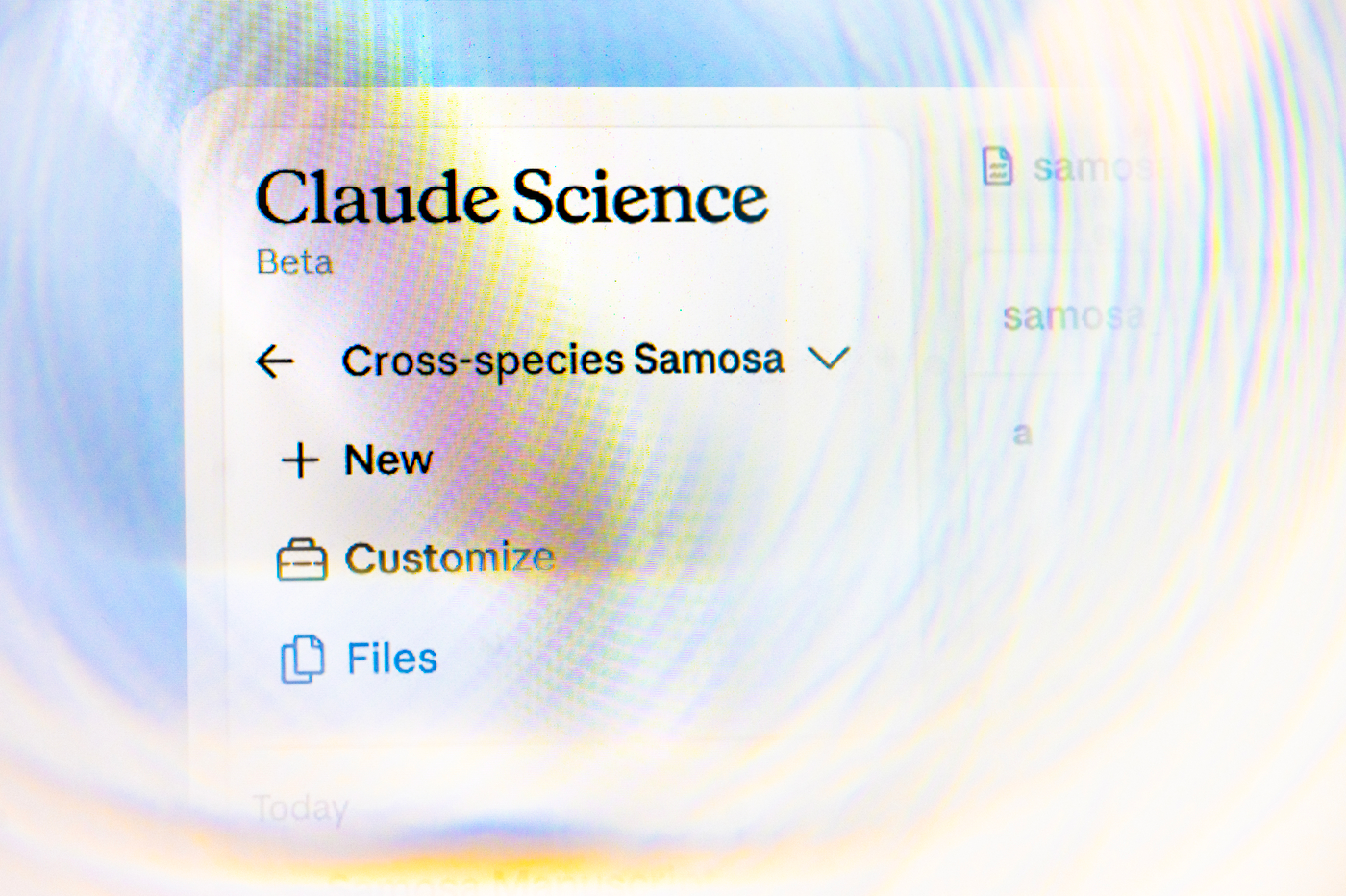
On Tuesday, Anthropic announced the release of Claude Science — a platform that integrates over 60 scientific databases and computation tools in a single workplace. The result? Researchers have everything they need at their fingertips to solve complex problems and analyze results.
Claude Science is Anthropic’s answer to GPT-Rosalind, the AI model designed to speed up research and drug discovery, released by OpenAI in April.
Northeastern Global News asked a few Northeastern scientists, Jeffrey Agar, Zhenyu Tian, Bryan Spring, Sijia Dong, Donald O’Malley, Jared Auclair, George O’Doherty, and <a href="https://roux.northeastern.edu/people/admin-page-michael-pollastri/” rel=”nofollow noopener” target=”_blank”>Michael Pollastri two questions:
- 1) If you find AI helpful in your work, how are you currently using it in your research?
- 2) If you don’t currently use AI, are you interested in trying out this technology in the future?
Here’s what they thought:
Jeffrey Agar’sresearch deals with protein changes in amyotrophic lateral sclerosis (ALS), also known as Lou Gehrig’s disease. He’s excited about the new developments.
“I use AI a lot, sometimes for many hours a day,” he says. “The Sonnet to Opus transition was big for scientists — the improvement was palpable and almost 20% for some areas of science.”
He was referring to other AI models created by Anthropic
Likewise, he feels that “Claude became Ph.D.-level in some areas of physics, chemistry and biology.”
“I like what Anthropic is doing with Claude Science and can’t wait to take it for a spin,” he says.
Michael Pollastri thinks that “Claude Science looks like it’s going to be an unbelievable tool.”
His research deals with repurposing existing drugs, with a particular focus on tropical diseases. Identifying candidates is a lengthy process, and AI could help researchers jump through procedural and administrative hoops with more ease, he says
“If Claude Science is able to automate so much of the information gathering … and help inform the ultimate decisions about where to go next, it would increase the pace of our experimentation by orders of magnitude,” Pollastri says. “I can’t wait to give this a try!”
Zhenyu Tang agrees that in his research on organic pollutants, “the identification of small molecules is still a bottleneck” that AI could help unclog. He already uses AI for his research and teaching, and thinks “this new release of Claude Science will be worth trying, especially for some of [his lab’s] mass spectra data analysis.” This lab technique allows scientists to identify chemicals in a sample by determining their weight and charge
He hasn’t had a chance to try it hands-on yet, but has experienced technical snags. For one thing, “Claude Science beta is only available for Mac and Linux,” he says, referring to computer operating systems
Also, he says that his version of Claude’s connector page doesn’t display the major chemical databases at the moment
Bryan Spring, whose research bridges biophysics, biomedical optics and cancer biology, says he’s excited about the release of Claude Science. He adds that Anthropic is adept at dealing with a “large ecosystem of incompatible tools and constantly integrating information from many different
Having found it helpful in his work, he uses it to “refine scientific writing, brainstorm ideas, summarize literature, and reduce the burden of the growing regulatory and administrative workload,” which he says “often keeps faculty working late into the night.” Likewise, manuscript prep is an area where AI has been a lifesaver, given that it “has the potential to save enormous amounts of time,” Spring says
In the end, Spring thinks that AI won’t replace scientists, but will instead significantly unburden their day, leaving more time “for creative thinking, experimental design, mentoring students, and actually doing science.” As such, “it has the potential to significantly accelerate scientific discovery,” he says
Jared Auclair has found AI to be “instrumental” and even “transformative” in his work on cell and gene therapy development
That said, he’s “cautiously optimistic about tools like Claude Science.” What worries him is that a “general-purpose AI can hallucinate or miss nuance in regulatory guidance or assay design — errors that carry real consequences in drug development.”
He argues that “the question isn’t whether AI is useful,” but whether it’s a “tool [that] can be deployed safely and verifiably within validated workflows in regulated industries.”
In the right hands, it could work wonders and reduce drug development “from 10 to 15 years on average to two to five years,” Auclair says, noting, however, that “it’s not a shortcut to discovery — it’s a co-pilot that requires a skilled pilot.”
Donald O’Malley, Dong Sijia and George O’Dohertydon’t use AI extensively in their work
O’Malley “initially found ChatGPT to be quite useful,” but since then has “gotten hooked on Perplexity,” an AI search engine, which he sees as being “more nuanced and reliable in the stories it tells.”
Sijia hasn’t used Claude Science yet, but says he’s looking forward to trying it “once we have better data protection put in place by an institutional subscription.”
O’Doherty hasn’t used AI directly in his medical and organic chemistry research. However, he turns to it when it comes to doing scientific literature research, and “AIs have really positively impacted these searches,” he says
At the same time, O’Doherty is disturbed by how much information seems to come from Wikipedia. Still, the “speed at which information is being shared is game-changing,” he says





