

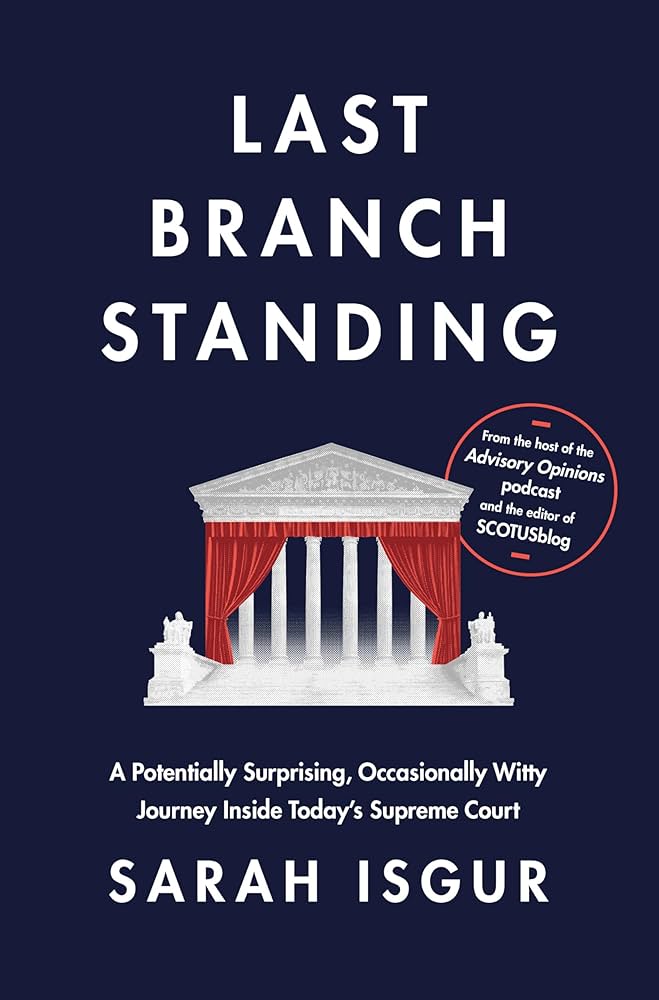
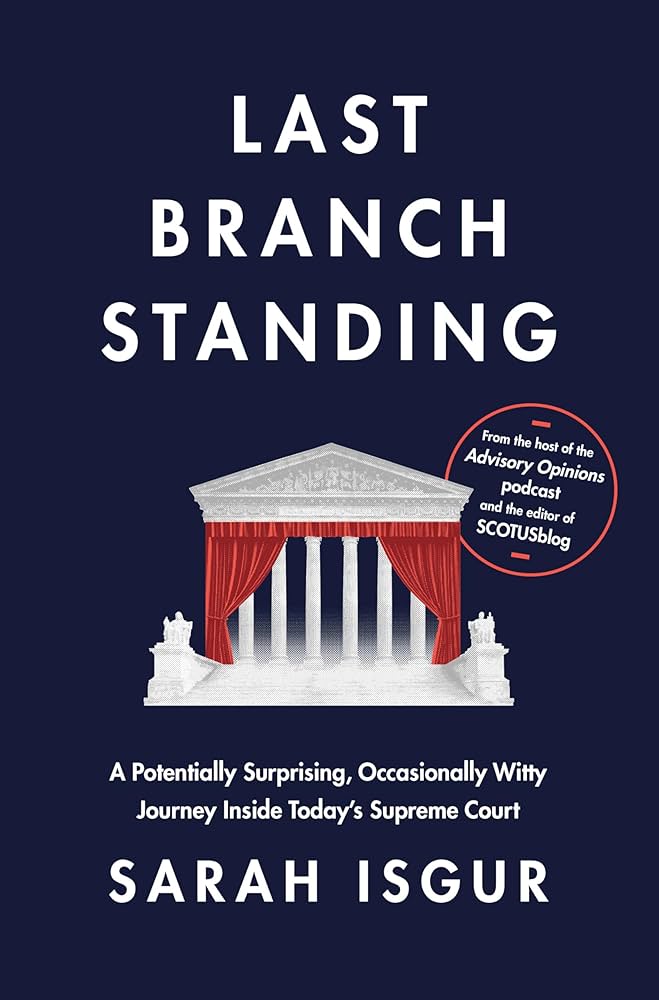
For the past six years, in her role as co-host of the popular Advisory Opinions podcast, and more recently as editor of SCOTUSblog, Sarah Isgur has covered the Supreme Court’s decisions. “Without a functioning Congress . . . and with a too-powerful executive branch,” Isgur argues, the Court today is the “Last Branch Standing” because it is “the only one of three that our Founders would recognize” (p. xvi). Drawing on her work covering the Court, Isgur has written an insightful and entertaining book that illuminates how the Court actually works today, its role throughout the Nation’s history, and how it might be improved through various reforms.
The book takes aim at “the fast-food political pundits who cover the Supreme Court the same way they talk about Congress or the White House” (p. xxiii-xxiv). At its core, the Supreme Court’s work involves a highly structured two-step process in which nine individuals first decide which cases to accept for review and then apply methods of statutory or constitutional interpretation, and weigh competing legal arguments, to resolve carefully defined questions of federal law on which the lower courts typically have provided different answers. Isgur maintains that the Court’s “merits” decisions are often incorrectly portrayed in the press (especially in headlines) as if the Court were choosing a politically desired outcome in much the same way as Congress and the President do, respectively, in passing a statute and signing it into law.
Last Branch Standing consists of three parts. Part One sets out Isgur’s basic argument about how the public should understand the justices, whom she says fall into three distinct but far-from-homogeneous groups: (1) the “Lonely Liberals” (Justices Sotomayor, Kagan, and Jackson); (2) the “Conservative Honey Badgers” (Thomas, Alito, and Gorsuch); and (3) the “Deciders” (Kavanaugh, Barrett, and Chief Justice Roberts), who hold the swing votes. Her principal target is legal realism and those critics of the Court who maintain that it decides cases based largely or exclusively on political grounds and desired outcomes. Such critics often emphasize the 6-3 decisions in important cases (such as Trump v. United States, involving presidential immunity) that sharply divide the justices appointed by Republican and Democratic presidents.
Isgur acknowledges that political orientation (and perhaps its close cousin, judicial philosophy), which she describes as “the external forces that affect justices’ views of the law along a conservative-to-liberal axis” (p. xxv), do play a significant role in judicial decisionmaking. She plots this continuum as an “x-axis” on a graph. But, she argues, so do a cluster of “institutionalist” concerns that she calls the “y-axis.” The latter, she says, consist of “internal forces that affect which cases the justices hear, when they decide them, and how much they try to protect the legitimacy and credibility of the Court itself” (p. xxiii). More specifically, Isgur appears to have in mind a justice’s respect for precedent, willingness “to consider[] questions outside the facts and law of a specific case” (p. 11) such as a decision’s anticipated effects in the real world or on the law, willingness to join other justices’ opinions versus writing separately, and inclination to decide issues narrowly or avoid deciding at all. She gives each justice a score of 1 to 9 on the x- and y-axis.
To support her argument that the y-axis or institutionalist concerns are important, Isgur points to statistics concerning voting patterns in the Court’s 60-odd merits decisions from the 2024-25 term. For example, the 6-3 by-presidential-appointment configuration cited by critics occurred in only 9% of all cases; in another 6%, 6-3 votes featured three Republican-appointed justices in dissent. If 5-4 decisions are considered, 15% featured the three liberal justices in dissent, and yet 15% also featured three conservative justices in dissent. 42% of the decisions were unanimous. Moreover, although she contends that Justices Kavanaugh and Gorsuch “are as close to a twin study as the Supreme Court will ever have” (p. 9) given parallels in their life histories and professional experience, Justice Kavanaugh is more likely to agree with every other colleague than Justice Gorsuch except for Justice Jackson. A main reason, Isgur argues, apart from Justice Gorsuch’s libertarian streak and strict textualist approach to statutory interpretation (x-axis factors), are the “y-axis” factors: Justice Gorsuch is less likely than Kavanaugh to follow precedent, be influenced by a decision’s anticipated real-world effects, or compromise with other justices or join a group opinion. According to Isgur’s analysis, Justices Kavanaugh and Kagan and the Chief Justice all score high on the “institutionalist” y-axis, whereas Justices Gorsuch, Thomas and Jackson all score low.
Yes, one might say, but what about the handful of “big” cases every year like the presidential immunity decision? Basically, Isgur argues that if you look at the cases forecast to be the “big” cases at the beginning and end of the Supreme Court’s term, those lists will be somewhat different. If a case projected to be “big” is resolved by a lopsided margin or in a surprising way compared with the political optics of the moment, then those cases tend to drop off the list of big cases. She cites several examples of such confirmation bias to support this claim. This is only a partial answer, however. Many cases projected to be “big” end up being decided 6-3 with the “Lonely Liberals” in dissent.
When it comes to the Court’s emergency, interim, or “shadow” docket, which in the current term has ballooned and featured lopsided results in favor of the Trump Administration (often, again, by votes of 6-3 along political lines), Isgur acknowledges that it represents “a new threat to the Court’s legitimacy” because it “shines a harsh light on the justices’ ideological differences along the x-axis and institutional differences along the y-axis” (p. 333). This is a very important topic, and Isgur’s take differs significantly from that of Georgetown Law Professor Stephen Vladeck, who literally wrote the book on this subject (The Shadow Docket, 2024) and who is working on a much-anticipated sequel. In all of these cases, the Supreme Court is being asked very early in litigation to exercise its equitable authority and grant emergency relief (a stay or injunction) affecting the status quo while the underlying legal challenge works its way through the lower courts. To make these decisions, the Court examines various equitable factors including whether the party asking for emergency relief will suffer irreparable injury if relief is withheld.
In just over a week since Isgur’s book was published, there have been two major developments concerning the emergency docket. First, the New York Times published a story, based on leaked internal memos, concerning a 2016 case involving President Obama’s Clean Power Plan in which a 5-4 Court reportedly issued emergency relief in a new and more expansive setting. See https://www.nytimes.com/2026/04/18/us/politics/supreme-court-shadow-docket.html. Evidently for the first time, the Supreme Court suspended a nationwide regulatory program that had not yet been reviewed by any lower court.
Second, Justice Jackson delivered a speech at Yale Law School in which, drawing on her experience as a federal district court judge and as a Supreme Court law clerk in 1999-2000, she examined the history and current state of the emergency docket, argued that “there is no such thing as an interim docket,” criticized the Court’s “scratch-paper musings” in emergency docket cases for their uncertain effects on lower courts, and offered several ideas for reform. See https://vimeo.com/1183042359?share=copy&fl=sv&fe=ci. As these developments and the Court’s decisions in recent emergency docket cases demonstrate, there is a robust debate within the Court about how much discretion the Court retains to resolve these emergency requests summarily and without explanation, how extensively the Court should explain these decisions, and whether the President’s inability to exercise his asserted constitutional authority immediately counts as irreparable injury given that such “constitutional” harm is highly abstract in nature and nonexistent if the President’s action is illegal (as the underlying lawsuits seek to establish). See id. at 1:04:26 to 1:07:42. One can only hope that this vigorous public debate – to which Isgur’s book makes a contribution – will lead to improvements in how the Court handles the emergency docket.
Part One of Last Branch Standing also includes illuminating and at times gossipy chapters on Supreme Court law clerks and oral arguments. The chapter on law clerks is written in a clever epistolary form, as a series of letters to a clerkship applicant and law clerk over the course of a year (with such salutations as Dear 3L, Dear Elect-ed, Dear Indentured and Dear Exhausted). Deploying her trademark references to popular culture, Isgur supplies many fun details of life in the Court’s inner sanctum including, for example, certain goings-on at clerk happy hours. There are also interesting chapters on each group of three justices in which Isgur provides clearer portraits of the justices as people. And for each justice, she ends with a tagline or accolade. For example, Justice Gorsuch is the justice “you’d most want to have on your side in a bar fight” (p. 87) and Justice Kagan the justice “you’d most like to be besties with” (p. 103). The book succeeds in giving the public a much more vivid sense of the justices as people.
Isgur’s analytical framework would have benefited from more emphasis on the fact that individual justices have developed specific approaches and methods in certain areas of law. To be sure, she does mention Justice Gorsuch’s special solicitude for both the rights of Native Americans in Indian law cases and the rule of lenity in criminal cases, but there are myriad other examples such as Justice Thomas’s rejection of implied “obstacle” preemption and the late Justice Scalia’s solicitude for the Confrontation Clause. Still, Isgur has shed significant light on how Supreme Court practitioners actually approach the task of persuading a majority of justices to rule in their favor in individual cases. The author’s Federalist Society credentials, and unabashed admiration of the more conservative justices, also set this book apart from most in the field.
Part Two of the book details the “political” history of the Supreme Court. It includes a sustained discussion of the first Chief Justice, John Jay; the second Chief Justice, John Marshall; and numerous landmark cases including Marbury v. Madison, Dred Scott v. Sandford, Plessy v. Ferguson, Roe v. Wade, and Lochner v. New York. It also includes a history of the confirmation process, the abolition of the filibuster for Supreme Court nominations, and a chapter on how Congress and the Presidency have changed.
The most interesting chapter in Part Two is on the Federalist Society (founded in 1982) and its influence on American law and the selection of Supreme Court justices by Republican presidents. As a former President of the Federalist Society Chapter at Harvard Law School, Isgur is well-situated to tell this story, which includes current disagreements over how to deploy originalism as a method of constitutional interpretation as well as whether originalism can survive ascendant populist forces in the Republican party who advocate for “common good constitutionalism” or believe “an activist judiciary is great again as long as their decisions are good” (p. 192).
Part Three purports to revisit the y-axis, but in fact covers a potpourri of diverse topics, including a discussion of the Court’s declining docket, why the Court takes the cases it does, changes in the professional composition of the Supreme Court and the Supreme Court bar, different views about stare decisis and precedent, various threats to the Court’s independence, and proposals for Court reform. In this part as elsewhere in the book, Isgur includes passages, cleverly set out in a different typeface, that deal in a more legalistic manner with issues that interest her: e.g., setting forth eight “great” constitutional amendments, criticizing various “made-up” legal doctrines, and describing the various methods of judicial interpretation.
Last Branch Standing should be of interest to anyone who cares about the Supreme Court and wants to understand it better. And the book will be especially useful to those who are considering going to law school, given its inclusion of a special appendix containing advice from Isgur and ten prominent legal figures, including three justices, on whether to take that plunge.
