

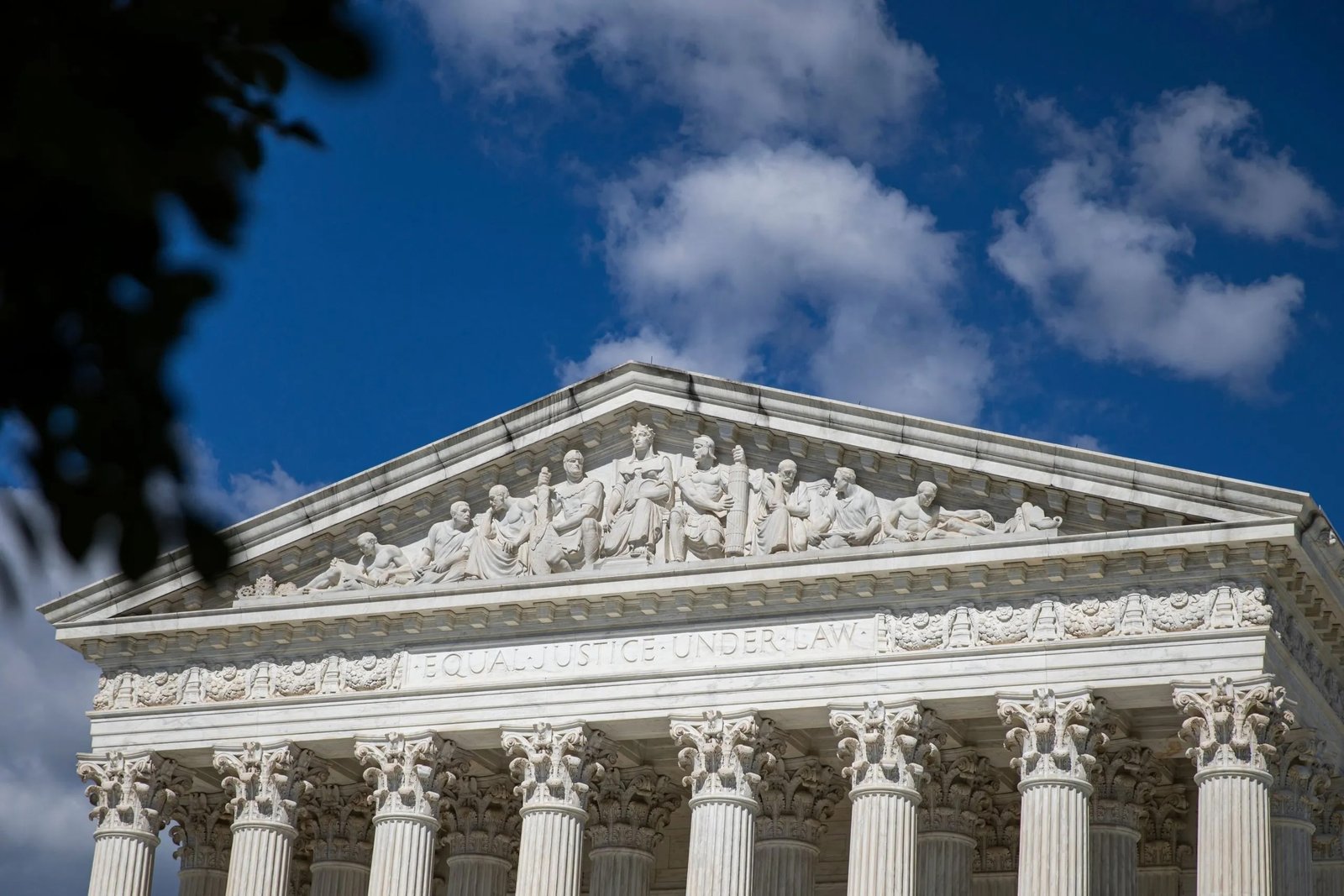
The Supreme Court on Thursday revived a lawsuit filed by the mother of a Texas man who was shot and killed during a traffic stop by a police officer on a highway outside Houston.
Roberto Felix of the Harris County Constable’s Office pulled Ashtian Barnes, who was Black, over because his girlfriend’s rental car, which he was driving to pick up her daughter from day care, had unpaid tolls. When Barnes began to drive away, with the driver’s door still open, Felix jumped on the running board and fired twice on Barnes, killing him at the scene.
Barnes’ mother, Janice Hughes Barnes, filed a civil rights lawsuit, but her suit was dismissed when a lower court found that the officer had not used excessive force in violation of the Fourth Amendment. Eight years after her son’s death, she then brought the case to the Supreme Court.
The question before the justices was whether a federal appeals court had used the correct test to determine whether Felix had violated Barnes’s constitutional rights by using excessive force against him. In a unanimous decision written by Justice Elena Kagan, the Supreme Court concluded that it had not, and the justices sent the case back to the U.S. Court of Appeals for the 5th Circuit for another look.
The case dates back to 2016, when Felix stopped the Toyota Corolla that Barnes was driving because he had received a radio alert that the car had unpaid toll violations. When asked for his license and proof of insurance, Barnes said that he did not have his license with him, and that his girlfriend had rented the car.
Felix told Barnes to get out of the car. Barnes opened the door but then turned the car back on, prompting Felix to jump onto the car’s doorsill as the car began to move forward. Felix fired two shots into the car and Barnes stopped the car, as recorded by dashcam footage. Barnes died on the scene.
Janice Barnes, Ashtian’s mother, went to federal court, where she alleged that Felix had violated her son’s right under the Fourth Amendment to be free of excessive force.
The lower courts threw out her claim. Under the Fourth Amendment, the question is whether the force that Felix used was reasonable. But when an officer uses deadly force, the court of appeals explained, courts use a test known as the “moment of threat” doctrine, which looks only at whether the officer “was ‘in danger at the moment of the threat that resulted in his use of deadly force.’” Anything that happened in the moments leading up to that time, the court of appeals emphasized, were “not relevant.”
In Barnes’s case, the court of appeals reasoned, the “moment of the threat” was the two-second period when Felix was standing on the doorsill of the Corolla while it was moving forward – a period in which, the court of appeals concluded, Felix could have reasonably believed that his life was in danger.
Judge Patrick Higginbotham wrote separately in that decision to express concern over the 5th Circuit’s use of the moment-of-threat doctrine and its reliance on analysis of the “precise moment” of deadly force. “A routine traffic stop has again ended in the death of an unarmed black man,” he wrote.
Janice Barnes came to the Supreme Court, which on Thursday threw out the 5th Circuit’s decision. In a nine-page opinion, Kagan explained that a court’s “inquiry into the reasonableness of police force requires analyzing the ‘totality of the circumstances,’” which can in turn involve a highly fact-bound analysis. But, she stressed, such an inquiry “has no time limit,” and – the 5th Circuit’s suggestion to the contrary notwithstanding – courts can consider the facts and events leading up to the use of force, because they “may bear on how a reasonable officer would have understood and responded to later ones.” “A court deciding a use-of-force case,” she concluded, “cannot review the totality of the circumstances if it has put on chronological blinders.”
Indeed, Kagan observed, it is so clear that the 5th Circuit’s rule is wrong that even Felix himself does not dispute it. Instead, he simply argues that the 5th Circuit does allow courts to consider the broader facts and circumstances. But even if that is generally true, Kagan wrote, “the decisions below applied a rule about timing,” looking “only to a two-second snippet of the encounter.”
Kagan also emphasized that the justices were not weighing in on whether or who courts should consider, as part of their reasonableness analysis, the extent to which a police officer may have contributed to the dangerous situation leading to the use of force. “The courts below never confronted the issue,” she said, “precisely because their inquiry was so time-bound.”
The justices therefore sent the case back to the lower courts “for them now to consider the reasonableness of the shooting, using the lengthier timeframe we have prescribed.”
Justice Brett Kavanaugh wrote a concurring opinion, joined by Justices Clarence Thomas, Samuel Alito, and Amy Coney Barrett, to note the dangers of traffic stops for police officers. When assessing whether the use of force against a fleeing driver was reasonable, he suggested, courts should consider not only whether the underlying traffic violation creates a risk for broader public safety but also whether the driver’s decision to flee the traffic stop does so. A Fourth Amendment analysis, Kavanaugh wrote, should take into account “the suspect’s attempt ‘to evade’ the officer” and “the extraordinary dangers and risks facing police officers and the community at large.”
Posted in Featured, Merits Cases
Cases: Barnes v. Felix
Recommended Citation:
Amy Howe,
Supreme Court revives excessive force suit against officer in deadly Houston-area traffic stop,
SCOTUSblog (May. 16, 2025, 1:59 PM),
https://www.scotusblog.com/2025/05/supreme-court-revives-excessive-force-suit-against-officer-in-deadly-houston-area-traffic-stop/

