The FIFA president has built a loyal base among the continent’s soccer federations, but it’s not clear what they’re getting in return


Kwangu Liwewe AgyeiKwangu Liwewe Agyei is Africa Editor at New Lines magazine
August 12, 2026
Share
Soccer’s governing body, FIFA, is changing, and not everyone is happy about where Gianni Infantino is taking it.
The FIFA president had faced growing criticism over his plans to bring private investment into some of the organization’s biggest competitions. European soccer officials had pushed back, exposing divisions inside FIFA over how the organization should be run and who should control its commercial future.
On July 31, Infantino abandoned the proposal to sell minority stakes in FIFA’s commercial and event businesses to private investors. Days later, he traveled to Rabat, Morocco, to apologize for how the plan had been handled and received the backing of FIFA’s senior management. The following day, the Confederation of African Football (CAF) executive committee unanimously reaffirmed its support for him.
The support mattered because Africa has 54 FIFA member associations, more than any other confederation. Those votes alone cannot guarantee a FIFA president’s reelection, but they give Africa considerable influence over who leads world soccer.
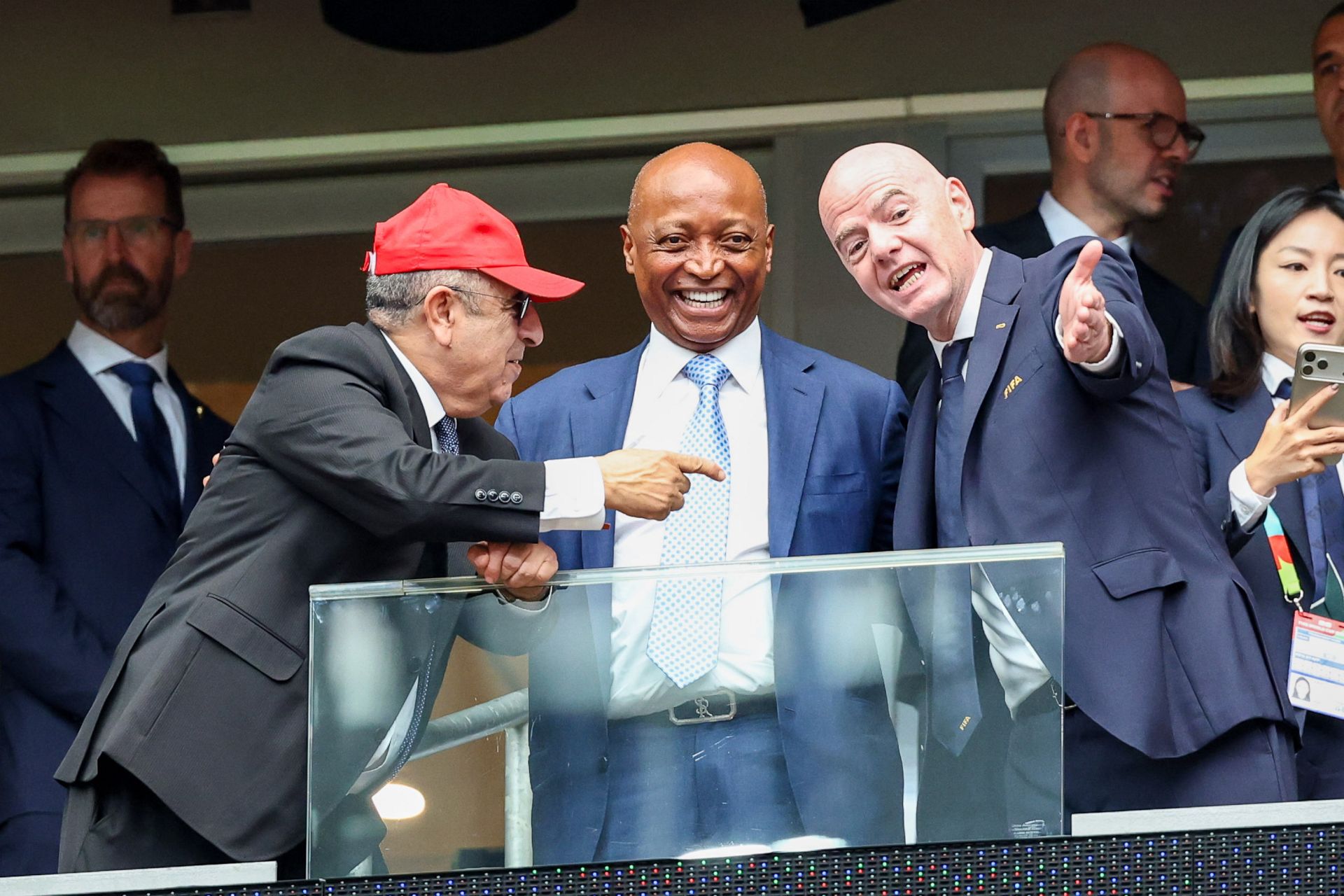
Since taking office in 2016, Infantino has also built close relationships with African soccer leaders. His support for Patrice Motsepe’s rise to the presidency of CAF in 2021 further strengthened those ties.
The relationship between Infantino and CAF raises a difficult question: Why does Africa continue to stand by him when criticism of his leadership is growing elsewhere? So far, the Union of European Football Associations (UEFA), the Asian Football Confederation (AFC) and the Confederation of North, Central America and Caribbean Association Football (CONCACAF) — three of FIFA’s six continental confederations — have publicly condemned Infantino’s conduct and called for change in FIFA’s leadership.
Part of the answer lies in a relationship that secures for the continent’s soccer federations something they need most: FIFA’s money.
For many of these federations, the problem is not a lack of interest in developing the game, but a lack of money. Sponsorship, broadcasting and ticket revenues are often not enough to cover the cost of running national teams or maintaining domestic leagues. Governments and international grants have traditionally helped fill the gap, but many federations still rely heavily on FIFA to keep their programs running.
That dependence has given FIFA considerable influence across the continent. Gerard Akindes, a sports researcher and consultant on sports management at Northwestern University in Qatar, said the financial challenges facing African soccer make FIFA support difficult to replace.
“On average, African football federations don’t have enough reipate in qualifiers, whether AFCON [Africa Cup of Nations] or the World Cup. It also costs a lot of money to run a league, and that is where FIFA stepped in and became a major Lines
Through its FIFA Forward program, the soccer governing body provides funding to member associations for development and operations. Since Motsepe came into office in March 2021, the organization has received at least $62.7 million from the program, according to CAF’s audited accounts. This includes $46.1 million in the 2022-23 financial year and $16.6 million in 2023-24. The money is separate from other FIFA funding for African soccer, including funds given directly to national associations and regional bodies.
For federations that struggle to generate their own income, that money can be essential. But it also creates an uncomfortable imbalance as the organization providing the money is led by a president who needs the political support of those same federations. A similar dynamic can exist in other parts of world soccer, where federations rely on FIFA funding. UEFA is different because its wealth gives European soccer more room to challenge Infantino and resist pressure.
With CAF, Akindes believes that relationship has gradually translated into political loyalty.
“And consequently they indirectly buy the loyalty of African federations,” he said.
CAF strongly rejects that idea. Luxolo September, the organization’s head of communications, said it was wrong to assume that African soccer leaders support Infantino simply because they receive money from FIFA. He argued that African leaders have their own interests and are capable of making their own decisions.
“We resent the stereotype that we, the Africans, cannot think for ourselves,” September said in a written response to New Lines. He also pointed to Motsepe’s personal wealth, arguing that he has no financial reason to depend on FIFA. (Motsepe is one of South Africa’s best-known businesspeople and one of Africa’s wealthiest. Forbes estimated his fortune at about $3.7 billion in 2026, built mainly through mining and investments in finance, energy and other businesses.)
“I think you and the world must accept that we, the ‘new’ Africans, can make decisions that are in our interests.”
September’s argument is that African soccer leaders are acting in African soccer interests. But the financial relationship between FIFA and African federations still matters because Infantino has made soccer there a priority, increasing funding to national associations and backing projects aimed at developing the game across the continent.
Simon Chadwick, a professor of Sport and Geopolitical Economy at Emlyon Business School in Lyon, France, argues that FIFA has kept African federations dependent by giving them enough support to survive without fundamentally changing the conditions that keep them dependent.
“FIFA appears to be working on the basis of ‘just enough’ — that is, give member associations just enough to keep them happy without ever really helping enough to propel them away from the problems many of them perpetually face,” Chadwick told New Lines.
The result, he says, is a continent with significant voting power but limited independence.
“Hence, Africa has long been locked into a role of political pawn, better to deny and suppress and keep them wanting more, which helps make its member associations more malleable,” Chadwick said.
And that relationship became particularly visible in the 2021 CAF presidential election.
When Motsepe became president, he was the only candidate left in the race after several other candidates withdrew. Critics of the election say Infantino played an important role in making that happen.
“He was responsible for the installation of Patrice Motsepe as president in 2021,” broadcaster and soccer journalist for The Guardian and The Observer Osasu Obayiuwana told New Lines.
“He made sure that the CAF election, where he was expected to face several opponents, never really became a contest because Infantino got the other candidates to step down, allowing Motsepe to take office unopposed.”
Akinde recalled what happened at the CAF general assembly before the vote.
“Before the vote, there were four or five candidates,” he said. “Infantino was at the CAF general assembly and negotiated with them. They all withdrew.”
The election helped cement a relationship that has remained important to Infantino. But the bigger question is what Africa has received from that relationship.
According to Akindes, the decision to move AFCON from every two years to every four years came from Infantino and was adopted without consultation with national associations. He argues that the change benefits European clubs, which will no longer have to release African players for AFCON as often, while also fitting Infantino’s broader effort to give FIFA greater control over international soccer.
The same questions arise around Morocco, which has become one of the most influential countries in African soccer. Morocco will co-host the 2030 World Cup and has increasingly positioned itself as a center for major soccer events on the continent.
But Morocco’s relationship with FIFA is also driven by its own ambitions. The country is currently home to Africa’s highest-ranked men’s national team and reached the quarterfinals of the 2026 World Cup.
Prior to securing the 2030 spot, it had tried repeatedly to host the World Cup.
“Morocco has its own interests. It has been trying to host the World Cup since the 1994 tournament and has had several bids fail,” Obayiuwana explained.
The country made five unsuccessful solo bids to host the men’s FIFA World Cup before finally succeeding on its sixth attempt, when it was named the 2030 cohost alongside Spain and Portugal.
Morocco’s pursuit of the World Cup is one example of how African countries have their own interests in their relationship with FIFA. But that relationship raises a more difficult question: What happens when some African soccer leaders challenge Infantino?
Francis Gaitho, a Kenyan digital activist and commentator, said political support can come with less scrutiny of how federations use FIFA money.
“It’s an unwritten rule that if you serve my political objectives then we, on the other hand, won’t enforce the financial transparency and accountability,” Gaitho told New Lines.
Obayiuwana made a similar allegation about the use of FIFA’s audits and ethics system.
“If you happen to be an [association] president that is loyal to him, you’re most likely not going to be audited or to have your expenditure monitored. But if you happen to oppose him politically, you could end up having your books audited and you could be put before the ethics committee and banned if you are found guilty,” he said.
New Lines contacted FIFA’s communications department for a response to these allegations and questions about its relationship with African soccer leaders, but did not receive a response.
Infantino needs Africa’s votes. African soccer needs FIFA’s money. That gives both sides leverage, but not necessarily equal power.
The continent has the numbers to influence who runs world soccer. The bigger question is whether it can use that power to shape how world soccer is run, or whether its financial dependence on FIFA will continue to limit how far its leaders are willing to push back.
Africa may be central to Infantino’s survival. But if the continent has 54 votes and still struggles to challenge the man who needs them, who is really holding the power?
“Spotlight” is a newsletter about underreported cultural trends and news from around the world, emailed to subscribers twice a week. Sign up here.