

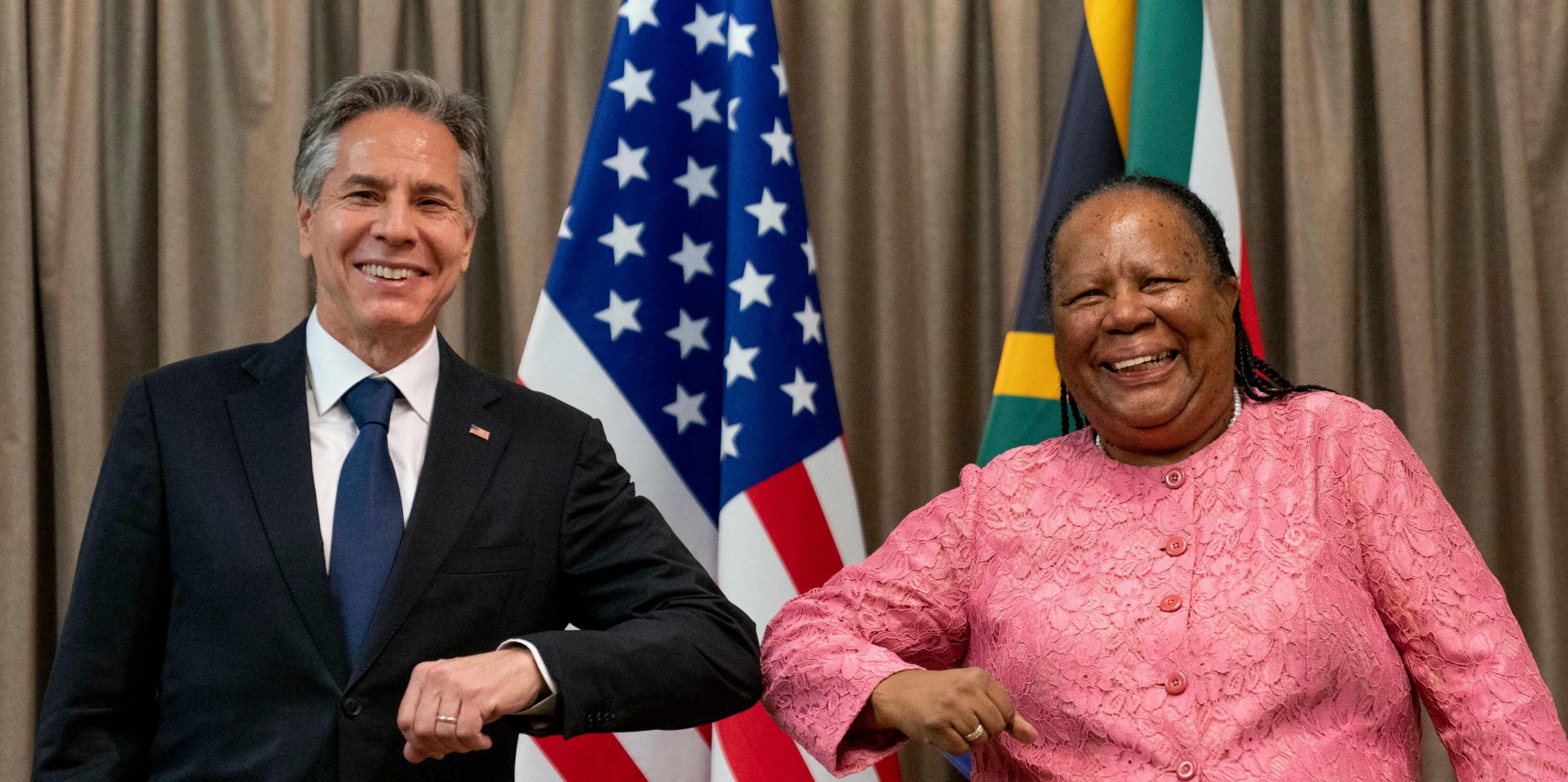

Secretary of State Antony Blinken launched the new U.S. Strategy Toward Sub-Saharan Africa on August 8 in Pretoria as part of his visit to South Africa, the Democratic Republic of Congo, and Rwanda. The new strategy document is an important first step in a lengthy journey to transform U.S-Africa relations into strong partnerships with African agency as a guiding principle
Status Quo
The new U.S.-Africa strategy is a departure from previous Africa strategy documents and a novelty in U.S. engagement in Africa, which has evolved little since the colonial era and the Cold War. The fall of the Berlin Wall provided the United States with a unique opportunity to adapt its approach to the realities of post-Cold War Africa and effectively help reshape African geopolitics. Instead, a lack of imagination and creativity, and overreliance on European former colonial powers, had stymied the emergence of the type of policy that fosters mutually beneficial partnerships with African countries, which exist with South Korea, the Philippines, and Thailand.
The United States often works in close partnership with former colonial powers under the assumption that these countries, such as France, Belgium, the United Kingdom, and Portugal, have a good grasp of developments in independent African countries. Nothing is further from the truth, as seen in Mali and the Central African Republic, where France has long struggled to maintain its influence and Russia has now gained a foothold.
In Africa, the United States has struggled to clearly define its strategic interests beyond an obsession with short-term stability that props up unpopular political regimes at the expense of the populations. The United States’ backing of long-standing, undemocratic leaders in Chad, Gabon, and Cameroon, for example, is counterproductive. It fuels instability in the long run and undermines U.S. support for democratization efforts in countries such as Zambia and Malawi, which have registered impressive democratic gains, and Zimbabwe, which is grappling with a repressive regime. Today, as it did during the Cold War, the United States continues to bet on strongmen as beacons of stability.
The status quo of the U.S. approach to Africa—poorly articulated and at times heavy-handed and paternalistic—has left the United States flat-footed at a time of intensifying geopolitical contestation and more assertive African leaders. China continues to deepen its strong economic and political ties throughout Africa, as Russian influence and paramilitary activities expand across the continent. The United States, once reliably the major foreign player on the continent, finds itself in a crowded field vying for influence. Thus, the new strategy lays the groundwork for a whole-of-government shift in U.S. engagement with Africa from an uneven relationship to partnership. This demarcation from the current ad hoc type of engagement is notable and long overdue and may serve as the basis for the creation of a new U.S.-Africa policy that moves these relations into the twenty-first century.
Unpacking the New U.S. Strategy
The U.S. Strategy Toward Sub-Saharan Africa identifies four strategic objectives for U.S. engagement in Africa, outlines several approaches to engaging African states as partners, and explores how existing tools and institutions can be reinvigorated for “a 21st century U.S.-African partnership.”
The strategy is centered around the following four main objectives
- Promoting fair and open societies:The strategy calls for more accountability among African states by supporting checks and balances ranging from the independence of judiciaries to investigative journalism, and by encouraging transparency, including combating corruption and digital repression. Open societies, the strategy argues, are more likely to share common goals with the United States and more likely to counter “harmful activities” by Russia, China, and others.
- Advancing democratic efforts and tackling security challenges:The strategy affirms U.S. support for democracies on the continent by supporting civil society organizations (CSOs), empowering marginalized groups, supporting fair elections, and deploying a mix of tools to tackle democratic backsliding. The strategy also reaffirms the 3D approach (defense, development, diplomacy) for peacebuilding efforts, such as the Global Fragility Strategy and for addressing the drivers of conflict in Africa. The strategy prioritizes “civilian-led, non-kinetic [counterterrorism] approaches” where possible, and the use of direct “unilateral capability” when both “lawful and awful and the threat is most acute.”
- Supporting a robust pandemic recovery:The strategy emphasizes Covid-19 recovery in Africa by supporting ongoing vaccination efforts and building health resiliency in the long term by expanding public health infrastructure and the capacity of African states to respond readily to public health crises and pandemics. The United States will work with partners to support economic recovery efforts through programs such as the Partnership for Global Infrastructure and Investment, an infrastructure investment initiative by the G7 with a funding goal of $600 billion to rival China’s Belt and Road Initiative.
- Encouraging climate adaption and green energy transitions:The United States will support African states in building climate-resilient infrastructure, climate adaptation efforts, and conserving ecosystems in Africa, an important bulwark against negative climate impacts. The strategy supports green energy programs as an avenue to meet growing energy demands on the continent.
To achieve these four objectives through partnerships across the continent, the strategy offers several approaches to build more equal engagement with African actors. These include more consultative dialogue between the U.S. and African states, broadening senior-level engagements, strengthening civil societies, deepening relations with the African Union and regional bodies, and encouraging U.S. private sector engagement in Africa.
The strategy also identifies a host of existing and potential initiatives that can be used to implement the strategy and be reinvigorated to fit the mold of a twenty-first-century partnership. This includes revamping the 3D approach. The strategy calls for modernized diplomatic engagement through embassies to make the latter more accessible and to increase human capital and financial resources. Staffing at diplomatic posts underpin U.S. efforts at partnership and engagement in Africa, yet key posts at embassies and special envoy posts in Africa have been notoriously vacant in the last few years and many diplomatic missions are chronically underfunded. Addressing staffing and capacity issues at U.S. embassies in Africa from the top of government is crucial step in implementing this new strategy.
The United States will support sustainable development efforts that build resiliency across the spectrum from food security to gender equality. Furthermore, the United States will capitalize on existing trade and commercial agreements and initiatives such as Power Africa and Prosper Africa to expand U.S. investment and trade in Africa. As noted below, focusing on making existing initiatives more effective is an important step in realizing the goals laid out in the strategy. Additionally, the strategy also calls for the United States to reinvigorate its relationship with African militaries and security partners to encourage “effective, legitimate, and accountable” conduct among these actors, which in turn, can support democratic and open societies on the continent. As explored below, it is imperative that the United States transform its security engagement in Africa to prioritize civilians first.
This new strategy comes at a critical time as the United States faces a trust deficit in Africa. If implemented the right way, the strategy may help the United States rebuild trust and reclaim its brand. Both exercises are long-term projects and cannot be achieved with the fly-by diplomacy that has come to characterize U.S.-Africa relations
Reinvigorating Existing Initiatives
The U.S. Strategy Toward Sub-Saharan Africa does not call for the creation of new economic and development initiatives programs. Rather, it highlights existing flagship initiatives, such as Power Africa, Prosper Africa, and Feed the Future. This is an acknowledgement by the Biden administration that the United States has the tools it needs to engage, but it requires some reworking and reinvigoration to make it effective. This also marks a departure from the existing approach going back to President Clinton, where successive administrations launched their own signature development program for Africa, some of which came at the expense of the ones that came before.
For instance, the 2019 merger of the Overseas Private Investment Corporation and the Development Credit Authority of the U.S. Agency for International Development (USAID) spawned the United States Development Finance Corporation (USDFC), which brought great optimism for United States investment in Africa. To date, however, U.S. investment in Africa remains timid. With the new strategy, one wonders how these initiatives will increase U.S. engagement and impact in visible and recognizable ways to Africans.
The challenge lies in the implementation of the strategy, as it presents current initiatives that have not always delivered on their promises. Weaving the old initiatives and the new strategy into interoperable systems and coherent policy will come with some hurdles, and time will tell how well the pertinent institutions and programs will work together to deliver on the promises of the strategy and reset U.S. engagement in Africa.
Rethinking Security and Defense
On the security front, the United States has provided substantial security assistance (e.g., training, equipment, etc.) to its African and European partners in Africa over the years. Yet it is unclear how these security partnerships have impacted military-civilian relations and stability in Africa. This security assistance is built on military-to-military and government-to-government models that effectively evaluate kinetic activities, the numbers of aviation sorties, trained officers and units, and enemies killed. These models, however, fail to measure peace and stability. The new U.S. strategy largely upholds this status quo. While the strategy encourages greater collaboration with local security actors, U.S. engagement in the security arena continues to largely focus on protecting U.S. interests more than advancing African interests. The U.S. urgently needs a new approach to security cooperation that aligns with the interests of local partners.
Security is a service and U.S. security cooperation missions need to approach it accordingly. There has been consistent breakdown between security providers (e.g., military, police, customs, border control) and the “end users” of security (i.e., civilians) across Africa. Civilians are demanding better services from their providers, yet the providers often fail to meet the expectations of the civilians they are sworn to protect. This failure has fueled public discontent across the continent and has led to protests, unrest, and in some cases, protracted instability. In Mali, for instance, public discontent over security has been a key driver of armed conflict.
In regions such as the Sahel where the United States maintains a substantial security engagement, conflict has not abated, and communal violence is on the rise. The region has also witnessed a string of constitutional and military coups, and the civilian population is not safer as the conflict causes a humanitarian crisis and furthers the political crisis. Yet, due to the traditional nature of military-to-military cooperation, the design and delivery of U.S. security assistance ignores input from local civilian stakeholders who are the end users of security. As the United States rethinks its engagement with Africa, the U.S. military needs to align with the new Africa strategy and rethink its contributions to peace and security in Africa. Now is the time to reevaluate and consider input and the role of security end users can play in the design, delivery, and assessment of security partnerships.
There is a pressing need for greater civilian involvement and a policy that both bridges the gap between military assistance and its impact on the security of the local populations, and ensures potential positive outcomes for peace and stability
A Mismanaged Covid-19 Response
During the Covid-19 pandemic, the United States and Western European countries hoarded vaccines while African countries struggled to meet the public health needs of their populations. Furthermore, the United States hesitated to acknowledge the validity of the AstraZeneca vaccines widely used across Africa to privilege U.S.-made Pfizer-BioNTech, Moderna, and Johnson & Johnson vaccines. Yet, African countries were turned down when they petitioned the U.S. for the patents of those vaccines. Two years into the Covid-19 pandemic, a deal for a partial intellectual property waiver for Covid-19 vaccines was reached at the World Trade Organization this June.
The West has controlled the response to the Covid-19 pandemic, setting up protocols and policies that affect the world. Despite their experience dealing with epidemics, African medical experts were mostly ignored. The lack of African voices and input contributed to the mistrust of the vaccine campaign across Africa that has undermined these initiatives. In contingencies like this, African public health practitioners should be readily consulted and represented for effective policymaking.
Climate and Fuel
As the continent that pollutes the least, the dynamics of climate change politics proportionately demand too much of African countries. Still, African states were forcefully instructed to adopt the green energy agenda and stop their natural gas and fossil fuel investment projects to save the planet, no matter their energy needs. Multilateral institutions and other Western lending groups limited capital and credit for such projects in these countries. This approach is counterproductive and hypocritical given that Europeans now seek to invest in oil and natural gas production in Africa, while the United States is petitioning Saudi Arabia to increase its oil output. Within this new strategy, the United States should lead the way and rally developed nations in meeting the Africans where they are, accept their realities, and turn financial pledges into real funding to support green economy initiatives in Africa.
Low Appetite for Paternalism
In his speech launching the new strategy, Secretary Blinken stressed that “the United States will not dictate Africa’s choices, and neither should anyone else.” Despite the generosity of Blinken’s speech, the United States’ ability to dictate African decisions was arguably waning before his remarks. In the UN vote earlier this year to condemn Russia’s invasion of Ukraine, the African bloc, one of the largest in the UN General Assembly, was not uniform in its votes. Out of 54 African member states, 28 voted in favor of the resolution and 35 countries abstained (most notably South Africa, a regional powerhouse and where the U.S. government, months later, launched its Africa strategy). Eight countries did not submit a vote for the resolution and only one country, Eritrea, voted against the resolution. The differing votes not only speak to nuanced and individualized foreign policy by African states, but it also came as a wake-up call to the United States to work on its relationships on the continent.
Expect Growing Pains
The new strategy calls for a whole-of-government transformation of U.S. relations with African states. Time will tell how thoroughly the new strategy will be implemented, but it is safe to say growing pains should be expected. The current U.S. approach to engaging with African states is marred by a history of paternalism and a dismissal on the international stage. Unrooting this practice will be incredibly difficult work but is nonetheless crucial for genuine engagement with African states as partners first. With a remarkably young populations and growing economies, Africa offers bold ideas anchored in innovation that would benefit from sustained long-term engagement with the United States.
Catherine Nzuki is a research associate with the Africa Program at the Center for Strategic and International Studies (CSIS). Mvemba Phezo Dizolele is a senior fellow and the director of the CSIS Africa Program
The authors would like to thank Cameron Hudson for his feedback on this piece. They also thank the Dracopoulos iDeas Lab for their outstanding publication support
Commentary is produced by the Center for Strategic and International Studies (CSIS), a private, tax-exempt institution focusing on international public policy issues. Its research is nonpartisan and nonproprietary. CSIS does not take specific policy positions. Accordingly, all views, positions, and conclusions expressed in this publication should be understood to be solely those of the author(s).
© 2022 by the Center for Strategic and International Studies. All rights reserved
Image
Associate Fellow, Africa Program
Image
Mvemba Phezo Dizolele
Former Senior Associate (Non-resident), Africa Program

