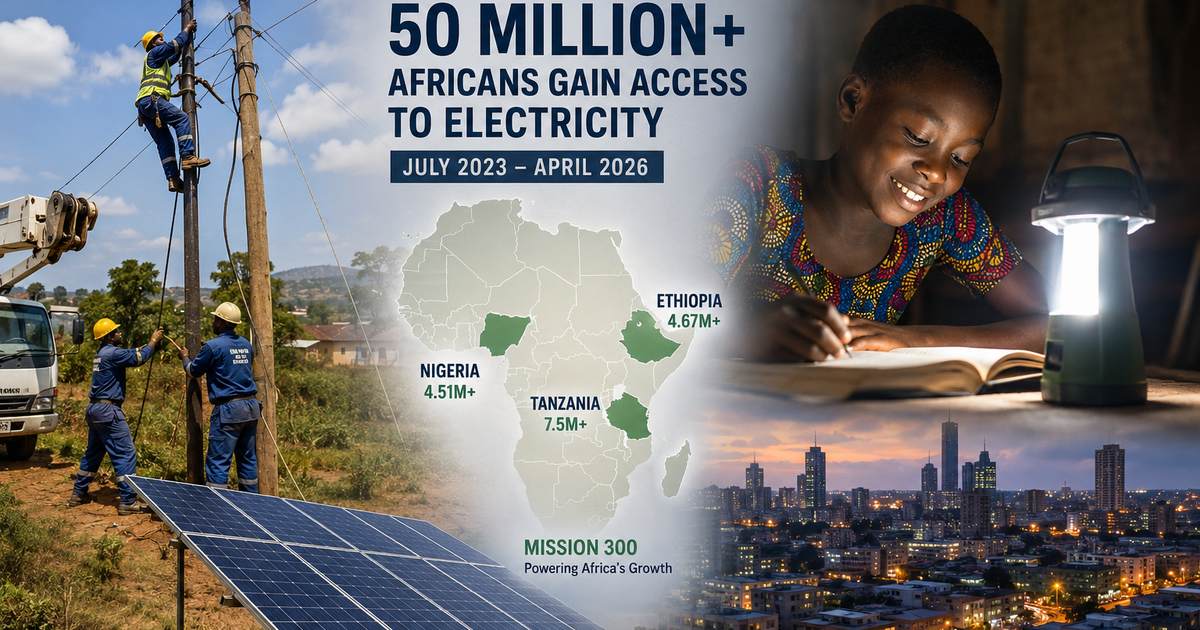
- More than 50 million Africans gained access to electricity between July 2023 and April 2026 under the World Bank-backed Mission 300 initiative.
- Tanzania, Ethiopia and Nigeria led the gains, with Nigeria connecting over 4.5 million people, largely through off-grid renewable energy projects.
- Despite the progress, nearly 600 million Africans still lack electricity, underscoring the continent’s vast energy access challenge.
- The report says sustained investment, faster project delivery and expanded renewable energy solutions will be essential to achieve universal electricity access by 2030.
The milestone, achieved between July 2023 and April 2026, was recorded under Mission 300, a World Bank Group-backed initiative that
But despite the rapid progress, the latest Mission 300 Progress Report underscores the scale of Africa’s energy challenge
Nearly 600 million people across the continent still lack access to electricity, leaving Africa with the world’s largest electricity access gap and highlighting the investment still required to support industrialisation, digital transformation and economic development
The report, which tracked electricity connections delivered through 85 World Bank-financed projects across 40 African countries, also revealed stark disparities in progress
While a handful of countries accounted for millions of new connections, eight countries have yet to record a single electricity connection despite having approved or ongoing World Bank-supported projects
World Bank Group President Ajay Banga described the 50-million milestone as an important achievement but said the pace of implementation and long-term partnerships behind the initiative matter even more
“Mission 300 is helping countries move faster, connect more people, and build a platform that will last well beyond this effort, which others can use, build on, and scale for years to come. At the end of the day, electricity is not just about power. It is about what it enables: jobs, business, health care, education, and opportunity,” Banga said
Tanzania, Ethiopia and Nigeria lead Africa’s electricity gains
According to the report, Tanzania recorded the highest number of new electricity connections, bringing power to 7.5 million people through its Rural Electrification Expansion Programme and the Tanzania Accelerating Sustainable and Clean Energy Access Transformation Programme
The country has increased its pace of electrification nearly five-fold compared with the years before Mission 300, driven by stronger financing and policy reforms
Ethiopia ranked second after connecting about 4.67 million people through four major electricity projects
The Ethiopia Electrification Programme alone accounted for about 3.4 million new connections, while the Electricity Network Reinforcement and Expansion Project added another 1.1 million beneficiaries
The Access to Distributed Electricity and Lighting in Ethiopia project connected an additional 165,000 people
Nigeria placed third, with approximately 4.51 million people gaining access to electricity despite the country’s long-standing power sector challenges
The report attributed much of Nigeria’s progress to the Distributed Access through Renewable Energy Scale-up (DARES) project, which connected 3.6 million people, accounting for nearly 80% of the country’s total new electricity connections during the reporting period
Additional gains came through the Nigeria Electrification Project, which connected 619,000 people, and the Distribution Sector Recovery Programme, which added another 292,000 beneficiaries
Nigeria’s performance means the country accounted for almost one in every 11 new electricity connections delivered under Mission 300 across Africa
Beyond the top three performers, Côte d’Ivoire connected about 2.9 million people, followed by Mozambique (2.67 million), Madagascar (2.65 million), Uganda (2.5 million), Rwanda (2.38 million), Kenya (2 million), Malawi (1.9 million) and Chad, which surpassed one million new connections
Collectively, these countries accounted for a substantial share of all electricity connections recorded under World Bank-supported operations during the review period
Off-grid energy powers Nigeria’s progress
The report highlights the growing role of renewable energy and decentralised electricity systems in expanding electricity access across Africa
In Nigeria, off-grid and renewable energy projects contributed significantly to the country’s progress, with DARES emerging as the single biggest driver of new electricity connections
The findings reinforce the increasing importance of mini-grids and standalone solar systems in reaching rural and underserved communities where extending the national grid remains costly and technically challenging
While the report measures new electricity connections, it does not necessarily reflect the reliability or quality of electricity supplied, an issue that continues to affect many African countries, including Nigeria
Eight countries still record no electricity gains
While many countries made significant progress, the report revealed that Angola, Cabo Verde, the Republic of Congo, Guinea-Bissau, Mauritania, Senegal, South Sudan and Sudan have yet to record a single electricity connection under Mission 300-tracked World Bank operations
According to the report, projects in those countries remain at preparatory stages, have not commenced implementation or are yet to produce measurable electricity access outcomes
For instance, Angola’s Electricity Sector Improvement and Access Project and Angola Secondary Cities Support Programme had not recorded any new electricity connections during the review period
Similarly, Senegal’s Energy Access Scale-Up Project, Guinea-Bissau’s Solar Energy Scale-Up and Access Project and South Sudan’s Energy Sector Access and Institutional Strengthening Project had yet to produce recorded beneficiaries as of April 2026
Regional projects expand electricity access
Beyond national programmes, regional initiatives also contributed significantly to Africa’s electrification drive
In West and Central Africa, <a href="https://absafricatv.com/duma-gqubule-mass-deportations-in-south-africa-would-break-international-law/” title=”DUMA GQUBULE | Mass deportations in South Africa would break international law”>International Finance Corporation (IFC)and Multilateral Investment Guarantee Agency (MIGA)-backed projects connected about 6.4 million people
The Regional Off-Grid Electricity Access Project added another 227,000 beneficiaries, while the ECOWAS Regional Electricity Access Project connected approximately 255,000 people
In Eastern and Southern Africa, the Regional Infrastructure Finance Facility delivered about 2.6 million electricity connections, while the Regional Energy Access Financing Platform added another one million
Reliable electricity remains one of Africa’s biggest barriers to economic growth
Limited access to power continues to constrain manufacturing, healthcare, education, digital services, mining and industrial development across much of the continent
The latest Mission 300 figures show that Africa is making measurable progress in closing its electricity access gap
However, with nearly 600 million people still living without power, sustaining investment, accelerating project implementation and expanding renewable energy solutions will be critical if the continent is to achieve universal electricity access and unlock its long-term economic potential