


Two Years On: Persistent Defiance of International Law in the Occupied Palestinian Territory
Statement to mark the second anniversary of the ICJ’s Advisory Opinion of 19 July 2024
19 July 2026 marks two years since the International Court of Justice (ICJ) rendered its landmark Advisory Opinion on the Legal Consequences arising from the Policies and Practices of Israel in the Occupied Palestinian Territory, including East Jerusalem. The Court affirmed by a strong majority that Israel’s continued presence in the occupied Palestinian territory (oPt) is unlawful and must end as rapidly as possible. Two years on, this finding has gone unheeded. This must change.
What the Court found
The Opinion was issued in response to a request by the General Assembly concerning the legal consequences of Israel’s prolonged occupation, settlement, and annexation of the Palestinian territory occupied since 1967 and related discriminatory measures. The Court’s conclusions were far-reaching. In addition to finding that Israel’s policies and practices in the oPt transgress basic rules of international humanitarian law (IHL) and human rights law, the Court found that Israel’s continued presence in the oPt violates the prohibition on the acquisition of territory by force and the right of self-determination of the Palestinian people – norms of peremptory status from which no derogation is permitted. As a result, the Court concluded that Israel must bring its unlawful presence in the oPt to an end as rapidly as possible, immediately cease new settlement activities and evacuate all settlers from the oPt, and make reparation for the damage caused.
The Court also identifiedclear obligations for third States and international organisations. Notably, all States are under an obligation not to recognise as lawful the situation arising from Israel’s unlawful presence, to refrain from rendering any aid or assistance in maintaining the unlawful situation, and to cooperate by lawful means to bring an end to the violations identified.
Two years of non-compliance
Rather than marking a turning point, the period since July 2024 has been characterised by continued and deepening disregard for the Court’s findings.
The Israeli authorities have been approving new settlements and resorting to other administrative measures to advance settlement expansion, including the resumption of the land registration process in East Jerusalem and Area C of the West Bank. The policies and practices identified by the Court — prolonged occupation, settlement expansion, annexation, displacement, exploitation of natural resources, discriminatory legislation and measures, restrictions on movement, demolitions, and the fragmentation of Palestinian territory and life — continue to shape the daily reality of Palestinians. Moreover, unimpeded settler violence in the West Bank – in which the Israeli authorities are implicated – has been escalating, forcing Palestinian communities from their land.
Unlawful presence in Gaza too
The Advisory Opinion concerned the oPt as a whole. As the Court itself reaffirmed, ‘the Occupied Palestinian Territory constitutes a single territorial unit, the unity, contiguity and integrity of which are to be preserved and respected’ (para. 78). While the Court chose not to examine Israel’s conduct in the Gaza Strip in response to the attacks of 7 October 2023 (para. 81), this does not limit the Court’s findings or their relevance to Gaza.
The attacks of 7 October 2023 constituted international crimes whose perpetrators must be held to account. Even assuming, for the sake of the argument (though the point is contested), that Israel could validly invoke its right to self-defence in response to these attacks, that right is subject to strict conditions of necessity and proportionality. As the IHL Centre and others have argued, Israel’s military response has far exceeded those limits. The right to self-defence, even if validly invoked, cannot justify the scale, nature and duration of Israel’s military operations in Gaza, let alone an open-ended presence aimed at countering some broadly defined ‘resurgent terror threat’. Self-defence requires a specific, ongoing, or imminent armed attack – it does not provide a blanket authorisation for indefinite occupation.
Thus, Israel’s continued presence in Gaza is no more lawful than its presence in the rest of the oPt. Accordingly, the Court’s finding that Israel must bring its presence in the oPt to an end as rapidly as possible applies also to Gaza.
Yet rather than bringing that presence to an end, current arrangements for the future governance of the Gaza Strip condone prolonged Israeli control over more than half of the enclave as well as potentially indefinite control over a so-called ‘security perimeter’. These arrangements largely cast aside the Palestinian people’s right to self-determination, placing significant political and economic decision-making powers in the hands of foreign-led bodies without legitimate Palestinian representation. The endorsement of these arrangements by the United Nations Security Council does not change their legal character. As the Court made clear, the right of the Palestinian people to self-determination is a peremptory norm from which no derogation is permitted (para. 233) – not even by the Security Council.
The (human) cost of non-compliance and the obligation to act
The United Nations General Assembly responded to the Advisory Opinion in September 2024 by demanding that Israel bring its unlawful presence in the oPt to an end within 12 months. That deadline has long passed. Non-compliance with the General Assembly’s demand, which reflects the authoritative findings of the ICJ and the collective voice of the international community, carries implications not just for Palestinians, but also for the credibility and integrity of the international legal order.
The consequences of non-compliance have been devastating. The continued denial of the Palestinian people’s right to self-determination, expansion and entrenchment of settlements, restrictions on movement, displacement, demolitions, confiscation and exploitation of land and natural resources, discriminatory legal and administrative regimes, and the fragmentation of territory and communities are not abstract violations of the law. They have had a crushing effect on the lived experiences of individual Palestinians and on communal life in Palestine and have diminished the prospects for a just and sustainable peace for Palestinians and Israelis alike. In Gaza, two years of devastating hostilities – marked by blatant defiance of international law – have resulted in a man-made catastrophe which has caused untold suffering and continues to afflict millions of civilians.
The question today is not what the law has to say. The ICJ has spoken with exceptional clarity. The question is whether the law will be respected and upheld. The obligation to act rests, first and foremost, with Israel. But third States are not bystanders devoid of obligations. It is incumbent on them all to ensure respect for international law.
This second anniversary must not become another marker of impunity. Two years after the Advisory Opinion, continued non-compliance is indefensible. The authority of the Court, the integrity of the United Nations system, the life and wellbeing of millions of individuals, and the rights of the Palestinian people as a whole require urgent, collective action to implement the Court’s findings without any further delay.
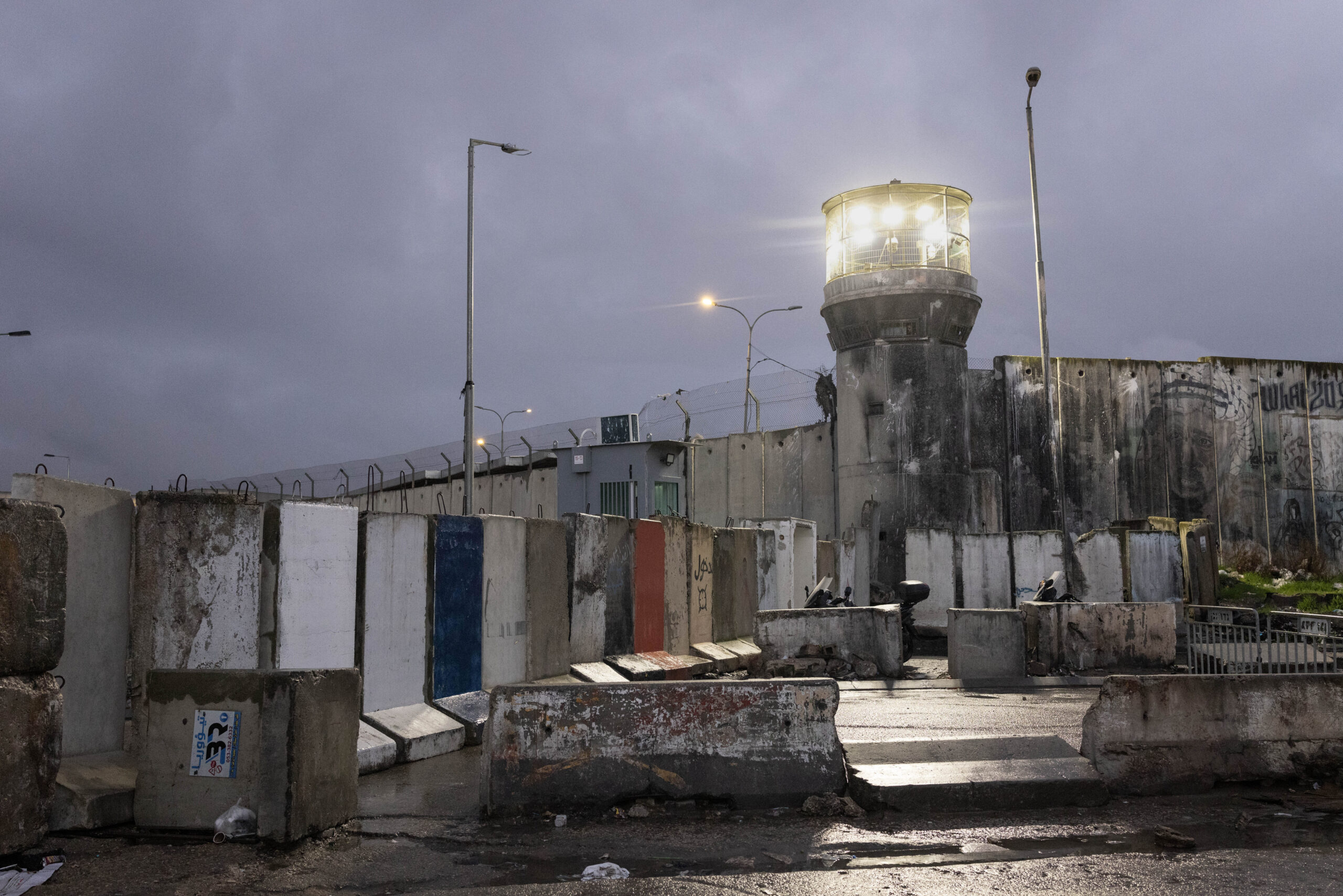
Cover photo: Palestinians at Qalandiya checkpoint on way to Al-Aqsa Mosque, 27.02.2026. Photographer: Oren Ziv/ActiveStills Photo Collective. All rights reserved.


