


Listen to this article
Estimated 4 minutes
The audio version of this article is generated by AI-based technology. Mispronunciations can occur. We are working with our partners to continually review and improve the results.
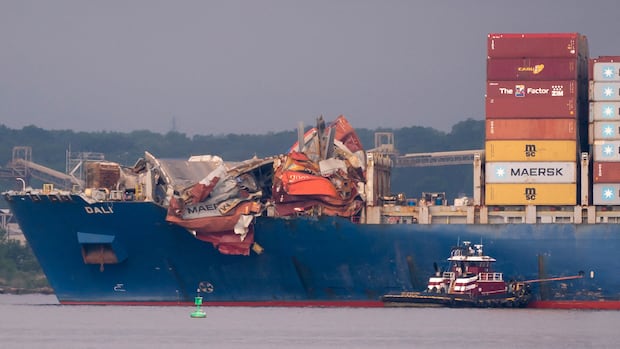
The U.S. Justice Department said on Tuesday a grand jury indicted two foreign operators and a shoreside superintendent in the March 2024 collision of the 300-metre cargo ship Dali that destroyed Baltimore’s Francis Scott Key Bridge and killed six construction workers.
Synergy Marine Pte Ltd., based in Singapore, and Synergy Maritime Pte Ltd., based in Chennai, India, along with Radhakrishnan Karthik Nair, 47, an Indian national who worked for both companies as the technical superintendent for the Dali, are charged with conspiracy, willfully failing to immediately inform the U.S. Coast Guard of a known hazardous condition, obstruction of an agency proceeding and false statements.
“The collapse of the Francis Scott Key Bridge was a preventable tragedy of enormous consequence,” Todd Blanche, acting attorney general, said in a statement.
Prosecutors said Nair is believed to be in India. It was not immediately clear if the U.S. had reached out to Indian authorities to assist with extradition.
The companies and individual were charged with conspiracy to defraud the United States and with causing the death of six construction workers on the bridge, among other charges.
The companies and Nair are also charged with providing false statements and documents to the National Transportation Security Board.

Engineers in Baltimore used explosives to clear the remains of the Francis Scott Key Bridge, bringing them one step closer to reopening a critical shipping channel. Andrew Chang explains what made the operation so delicate, why the ship and its crew have remained in place for weeks and what challenges still lie ahead.
The two Synergy corporations are also charged with violations of the Clean Water Act, Oil Pollution Act and Refuse Act for the discharge of pollutants into the Patapsco River.
According to the indictment, the Dali lost power twice in a four-minute span, as it was leaving the Port of Baltimore. The ship crashed into a supporting column of the Key Bridge at about 1:30 a.m ET, collapsing parts of the bridge into the river along with the workers born in Mexico, El Salvador, Honduras and Guatemala who died in the accident.
The Justice Department said the defendants are accused of relying on a flushing pump to supply fuel to two of the Dali’s four generators, but the flushing pump was not designed to automatically restart following a blackout, and the Dali’s generators could not operate without a fuel supply.
The indictment alleged that if the Dali was using proper fuel supply pumps, the vessel would have regained power in time to safely navigate under the bridge.
Civil settlement recently announced
The final report issued from the investigation into the incident by the NTSB found that two electrical blackouts — one caused by a loose wire aboard the Dali and another by problems with a fuel pump — disabled the controls of the huge cargo ship before it crashed into the bridge.
The bridge, a longstanding Baltimore landmark, was a vital piece of transportation infrastructure that allowed drivers to easily bypass downtown. The original 2.6-kilometre steel span took five years to build and opened to traffic in 1977.

The Justice Department said the collision caused at least $5 billion US in damages and significant environmental damage.
The true cost of the collapse was far greater, according to the Maryland Attorney General’s Office. It halted shipping at the Port of Baltimore, disrupted the livelihoods of thousands, rerouted road traffic through communities already bearing disproportionate burdens and triggered economic problems statewide.
The indictment comes on the heels of a settlement in principle between the state, Synergy Marine and Grace Ocean Private Ltd., the Singapore-based ship owner, Maryland Attorney General Anthony Brown announced in April.
That lawsuit alleged the crash was the result of negligence, mismanagement and the reckless operation of a vessel that was not seaworthy and should never have left port. Plaintiffs include the families of the six construction workers who died, owners of cargo that was on the ship and local governments seeking damages for economic losses.
The details of the settlement haven’t been disclosed and some portions of the lawsuit remain unresolved.
