


Listen to this article
Estimated 5 minutes
The audio version of this article is generated by text-to-speech, a technology based on artificial intelligence.
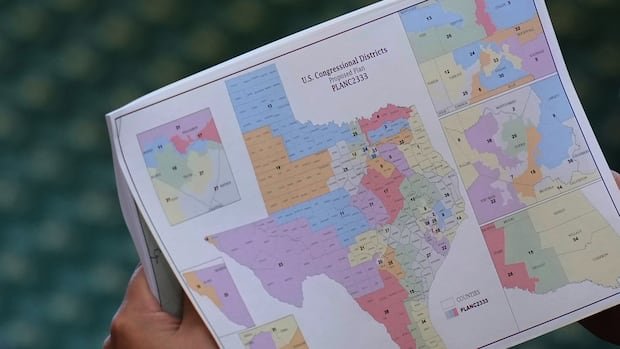
The U.S. Supreme Court on Thursday revived a redrawn Texas electoral map designed to add more Republicans to the U.S. House of Representatives, boosting President Donald Trump’s quest for his party to keep control of Congress in the 2026 midterm elections.
The Supreme Court, whose 6-3 conservative majority includes three justices appointed by Trump, granted a request by Texas officials to lift the lower court’s ruling blocking the map. The lower court had concluded in a 2-1 decision the map likely was racially discriminatory in violation of U.S. constitutional protections.
“The District Court improperly inserted itself into an active primary campaign, causing much confusion and upsetting the delicate federal-state balance in elections,” the justices said in a brief opinion explaining the decision.

Redistricting generally occurs to reflect population changes as measured by the national census conducted each decade. This year has been the redrawing of maps in several Republican-led states motivated by securing partisan advantage and spurred on by President Donald Trump.
Gerrymandering — the redrawing of district boundaries in order to marginalize a certain set of voters and increase the influence of others — is unlawful if driven primarily by race. The U.S. Constitution’s 14th Amendment guarantees equal protection under the law and the 15th Amendment prohibits racial discrimination in voting.
The Supreme Court in a 2019 ruling declared that gerrymandering cannot be challenged in federal courts.
Texas Democrats this summer held a two-week walkout to prevent Republicans from passing redistricting legislation — including leaving the state for a time — but they ultimately did not have the numbers to prevent its inevitability.
The justices are separately considering a case from Louisiana that could further limit race-based districts under Section 2 of the landmark 1965 Voting Rights Act, which expanded the franchise to millions more Black Americans.
Redistricting expected to continue in several states
Republicans currently hold slim majorities in both chambers of Congress. Ceding control of either the House or Senate to the Democrats in the November 2026 elections would endanger Trump’s legislative agenda and open the door to Democratic-led congressional investigations targeting the president.
Representation in the 435-seat House of Representatives is based on population. California, the most-populous state, has the most House members with 52, while Texas is second with 38. Republicans currently hold 25 of 38 U.S. House seats in Texas, and the new map in the Lone Star State could flip as many as five currently Democratic-held U.S. House seats to Republicans.

Democratic-governed California reacted to the Texas redistricting by initiating its own effort targeting five Republican-held districts in the state. California voters in November overwhelmingly approved a new map beneficial to Democrats.
Republicans in the Indiana state House of Representatives are expected on Friday to approve a new map targeting the state’s only two Democratic U.S. House members. It is unclear whether the map has enough support to pass that state’s Republican-controlled Senate.
Other states including Republican-led North Carolina, Missouri and Florida and Democratic-led Virginia and Maryland have either passed new maps or are considering doing so.
The redrawn maps are facing court challenges in California and Missouri. A three-judge panel allowed the new North Carolina map to be used in the 2026 elections.
Trump-appointed judge believed race was primary factor
The Supreme Court majority cast doubt on the lower-court finding that race played a role in the new map, but acknowledged the “avowedly partisan goals” of the Texas Republican Party.
Liberal Justice Elena Kagan criticized the court’s majority, saying it disrespected the work of the lower court.
“We are a higher court than the district court, but we are not a better one when it comes to making such a fact-based decision,” Kagan wrote in a dissent joined by Justices Sonia Sotomayor and Ketanji Brown Jackson.

At the behest of state Republicans, the Texas House of Representatives passed a redistricting map on Wednesday after the return of Texas Democrats who were absent from the capitol for two weeks. Now, Democrats have been barred from leaving the capitol without signing a permission slip and agreeing to be watched by a police escort. Some of them are protesting the new rules. Texas Democratic Rep. Mihaela Plesa joins Power & Politics to discuss.
The court’s stay, the Kagan dissent continued, “ensures that many Texas citizens, for no good reason, will be placed in electoral districts because of their race. And that result, as this court has pronounced year in and year out, is a violation of the Constitution.”
U.S. District Judge Jeffrey Brown, appointed by Trump, authored the El Paso-based court’s 2-1 ruling on Nov. 18, siding with civil rights groups that sued to block it.
“To be sure, politics played a role in drawing the 2025 Map,” Brown wrote. “But it was much more than just politics. Substantial evidence shows that Texas racially gerrymandered the 2025 Map.”
Republican Texas Attorney General Ken Paxton cheered Thursday’s order, saying the map “reflects the political climate of our state and is a massive win for Texas and every conservative who is tired of watching the left try to upend the political system with bogus lawsuits.”
Democratic lawmakers in Texas expressed anger.
“The Supreme Court failed Texas voters today, and they failed American democracy. This is what the end of the Voting Rights Act looks like: courts that won’t protect minority communities even when the evidence is staring them in the face,” said Gene Wu, the Democratic State House minority leader.
