As German troops crashed into Belgium in August 1914, British Foreign Secretary Sir Edward Grey gazed out of his office in Whitehall and concluded: “The lamps are going out all over Europe. We shall not see them lit again in our time.”
His prescience wasn’t shared by his European peers, including his own prime minister, Herbert Asquith. European leaders had sleepwalked into a world war that would kill over 20 million, laying the ground for a succession of fascist regimes and a second war in which four times as many would die.
READ MOREFrom ‘rising’ to resilient: Managing the transition to African economic sovereignty
Yet the dominant colonial powers, France and Britain, preferred to cling to the delusion that their countries were at the peak of power. The outbreak of war in 1914 marked the beginning of Europe’s slow retreat. This century, it has accelerated in lockstep with Asia’s rise.
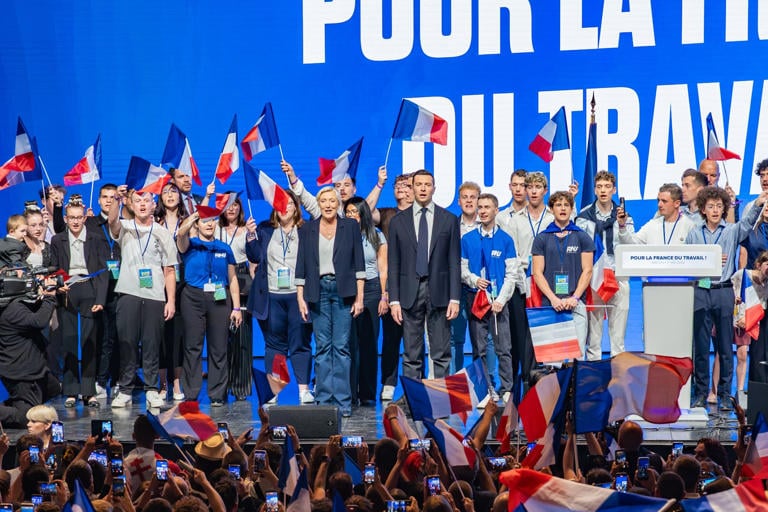
Europe’s far right marches towards power
That raises the question of whether states in Africa should concern themselves with the paroxysms now engulfing their continental neighbour to the north. European politics is at its ugliest for decades. The far-right and soi-disant fascist parties are on the march in 15 European states. In states such as Austria, Italy, Portugal, the Netherlands, Norway and Sweden, they are picking up on average a third of the vote.
There is a realistic prospect that France’s Rassemblement National, a party whose roots can be traced to the pro-fascist and collaborationist right of the 1940s, could win France’s presidential elections next year.
In Germany, the Alternative für Deutschland is less coy than its Gallic counterpart about its authoritarian roots and chalked up a groundbreaking victory in Saxony-Anhaltin September. Some of its supporters want to see a more sympathetic official account of the Third Reich, falsely claiming it achieved an economic miracle.
READ MOREThe Greenland fallout: Could Africa be EU’s strategic shield against Trump?
Many Britons try to reassure themselves that their far-right Reform party, surrounded by more malign micro-fascist parties, veers towards the tragi-comic. Its leader Nigel Farage, like Mussolini, proves a politician can be dangerous and ridiculous at the same time.
Farage was seriously challenged in a by-election in his home base by a serial candidate known as Count Binface, who wears a dustbin over his head and recites classical Greek poetry fluently. But the brutalist spectre of the far-right and its foreign sponsors is as robust in Britain as in continental Europe.
… uber nationalist tactics are not the ticket to the future for Europe
Farage’s Reform, Marine Le Pen’s RN, or Elizabeth Weidel’s AFD are parroting the same far-right slogans. Their followers condemn all migration; some demand ‘remigration’, meaning a forcible removal of citizens of non-European heritage.
What does this mean for Africa?
Beyond this spiralling racism and a melding of anti-semitism and islamophobia in the cause of a Christian nationalist crusade, what does Euro-fascism 2.0 mean for Africa? In transactional terms, Africa and Europe need each other, for now.
Africa-Europe trade was running at $355.9bn in 2025, compared to Africa-China trade of $348bn and Africa-US trade of $83.3bn. But China’s trade with Africa is growing faster than Europe’s. More importantly, China is way ahead on the economies of the future: artificial intelligence and the green energy transition.
READ MOREPoll: US lags behind China in African hearts and minds
In government, parties such as the RN and AFD will obsess about migration control and deporting refugees. But their economic nationalism will clash with the power of the bigger economies in China and the US. They will try to mimic the transactional tactics of Beijing and Washington but with shallower pockets.
Fortress Europe turns to Africa
They get on better with fellow authoritarians. North Africa is becoming more and more like an armed European border zone, holding back tens of thousands of would-be entrants.
Giorgia Meloni’s Fratelli d’Italia government has paved the way for the European Union to cut lucrative anti-migration pacts with Tunisia’s Kaïs Saïed, Libya’s warlord Khalifa Haftar and Egypt’s Abdel Fattah el Sisi. They will build higher walls and dig deeper moats around Fortress Europe.
READ MOREHow Meloni’s video uses the distress of Africans to play into EU’s debates to block migrants
Whatever the proximate causes of the storming of the Spanish exclave of Ceuta from Morocco, in which over 80 drowned in August, it worked as a stage set for anti-migration propaganda. Every far-right television channel and YouTube influencer was on the ground within hours to sound their carefully rehearsed warnings about “the barbarians at the gate”.
Inside or outside government, the rise of the far-right casts a long shadow over Europe-Africa relations
Such uber nationalist tactics are not the ticket to the future for Europe. The far-right’s advocacy for Euro fecundity isn’t working. Europe’s population is ageing and shrinking, and its need for immigration across a range of skills and expertise is growing.
Yet far-right parties are influencing the political climate. Policies such as locking out foreign students (although their fees prop up European universities) and ending immigrants’ welfare rights are fed as populist red meat to communities whose living standards haven’t recovered since the 2008 financial crisis and ensuing austerity.
Aid and climate finance face the axe
Also, on the cutting room floor will be what remains of foreign aid projects, climate finance and support for democracy. If the far-right continues its march, that means less environmental action, more climate-driven migration and weaker international agencies such as the UN to ameliorate the multiple emergencies.
Inside or outside government, the rise of the far-right casts a long shadow over Europe-Africa relations. At the European Commission in Brussels, countless projects for collaboration between the continents, moving from aid to mutually beneficial trade, are floated then downplayed in favour of harsher migration laws and payola for thuggish enforcers.
READ MOREJoint Africa-Europe agenda could double bilateral trade to $1trn, BCG report
Euro-optimists insist the centre will hold. The continent isn’t about to repeat its history of the war-mongering fascist takeover of 100 years ago.
If the centrists continue to ape the far-right’s dog whistle racism and uber nationalism, it will be a pyrrhic victory. Those who want to see stronger and fairer relations between Europe and Africa will have to produce a much more creative and hardier réplique to the far-right’s nationalist bunker than the pale imitation currently on offer.
-
Editor-in-Chief of The Africa Report.