

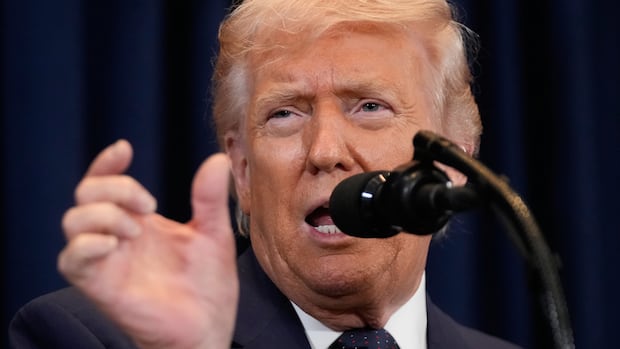
U.S. President Donald Trump is trying to downplay the effect of the Iran war on the domestic economy even as American drivers are already feeling the impact on their wallets every time they fill up their cars and trucks.
During a news conference in Florida Monday evening, Trump implicitly acknowledged the spiking prices of crude oil on world markets and the rising cost of gas at pumps in the U.S. by dismissing them as a short-term spin-off of the U.S.-Israeli military campaign against the Iranian regime.
“In the long run, oil supplies will be dramatically more secure without the threat of Iranian ships, drones, missiles, nuclear menace or anything,” Trump said.
“We’re putting an end to all of this threat once and for all, and the result will be lower oil prices, oil and gas prices for American families.”
Trump’s promise that the war will ultimately bring lower energy prices is a sign of how important the cost of living is in U.S. politics right now, and suggests that the president is aware of the potential impact a long-term increase in such costs could have on public opinion.
Dan Cassino, a polling expert and a professor of government and politics at Fairleigh Dickinson University in New Jersey, says for U.S. voters who drive, a jump in the price of gas at the pumps is visible evidence of the rising cost of living.
“Gas prices are important because they are so visceral. They are immediately experienced by almost all Americans,” Cassino told CBC News.

The national average price of a gallon of gas at the pumps hit $3.48 US on Monday, up 48 cents from the previous Monday, according to automotive and travel firm AAA.
That’s an even sharper spike than the biggest weekly increase triggered by Russia’s war against Ukraine, when the average price jumped 45 cents US a gallon in March 2022.
War could impact more than price of gas
Cassino says the political damage for Trump and his Republican Party will depend on how long prices stay high and how much the broader U.S. economy is affected as the year progresses.
Midterm elections happen in November and if the Republicans lose control of Congress, Trump will be handcuffed in pursuing his agenda for the final two years of his term.
“Democrats are salivating at the thought of being able to say that ‘President Trump increased your gas prices to fight this war in Iran,’ ” Cassino said.
If the war does not end quickly, the economic impact is likely to be felt well beyond the gas pumps. Rising transportation costs could affect the price of everything from family vacations to putting food on the table.
The countries surrounding the Persian Gulf also provide much of the global supply of certain fertilizers, so any lengthy disruption in shipments as a result of the war could disrupt farming and push up food prices worldwide, the New York Times reported.

Iran is reported to have thousands of cheap attack drones, but shooting each one out of the sky costs the U.S. and its allies millions. For The National, CBC’s Eli Glasner breaks down the math and the problem it reveals about modern air defence strategies.
Political risk for Trump
A surge in gasoline prices in a midterm year poses a risk for the president, says Kevin Book, a managing director for ClearView Energy Partners, a research and analysis firm based in Washington.
“If you go to the pump and you see a massive increase in prices you might not forget it in November even if prices retreat,” Book told Bloomberg. “The memory can last longer than the price spike, that’s the political risk.”
Brittany Martinez, executive director of Principles First, a U.S. conservative political organization, says the longer the war drags on, the more it risks triggering the kind of economic fallout that could hurt the Republicans this election year.
“The real question is whether this turns into a prolonged conflict that voters feel in their household budgets,” Martinez told CNBC this weekend.
“If energy prices rise or markets stay volatile, affordability becomes a harder message for Republicans to carry cleanly,” she said.

The ongoing uncertainty for the global oil supply because of the U.S.-Israel war with Iran caused a volatile day for markets on Monday, with oil prices skyrocketing in the morning only to tumble back down later in the day.
It’s anything but clear that the U.S. economy has the resilience to withstand a sustained increase in energy prices.
Employment numbers have been feeble for a year, with the U.S. economy creating far fewer jobs in 2025 under the Trump administration than it did in 2024 during the final year of Joe Biden’s presidency. Inflation remains as high as it was when Trump took office.
Trump’s top political advisers have been urging him for months to emphasize economic progress — particularly on reining in the cost of living — in his messaging to U.S. voters.
Over the weekend, key figures in the administration have been trying to reassure Americans that the price shock from the Iran war is unlikely to last for any significant length of time.
Energy Secretary Chris Wright said the worst case scenario for the spike in gas prices is a spike lasting weeks rather than months.
“We want it back below $3 [US] a gallon and it will be again before too long,” Wright told CNN on Sunday.

Manitoba farmers face higher fertilizer costs because of the U.S. and Israel-Iran war. The conflict has blocked shipments of nitrogen, phosphorus and sulfur — all key ingredients in fertilizer — through the Strait of Hormuz.
Trump won’t let
Yet Trump himself is risking undermining that message by downplaying the impact of the war on people’s wallets.
“I knew oil prices would go up if I did this, and they’ve gone up probably less than I thought they’d go up,” Trump said during Monday’s news conference.
Trump, who repeatedly boasted about low gasoline prices over the past year including in his state of the union address two weeks ago, has said he’s not concerned about the spike.
“They’ll drop very rapidly when this is over, and if they rise, they rise, but this is far more important than having gasoline prices go up a little bit,” he told Reuters last week.
Karl Schamotta, chief market strategist at Corpay, a global financial services firm, says while it’s conceivable that the war could push the price of oil to record highs, he doesn’t believe Trump will let things go that far before declaring victory.
“I think that we are going to see a TACO moment here at some point — a ‘Trump Always Chickens Out’ moment in which we have Mr. Trump saying that he’s accomplished his mission and is taking all of his toys and going home,” Schamotta told CBC News Network on Monday.
