

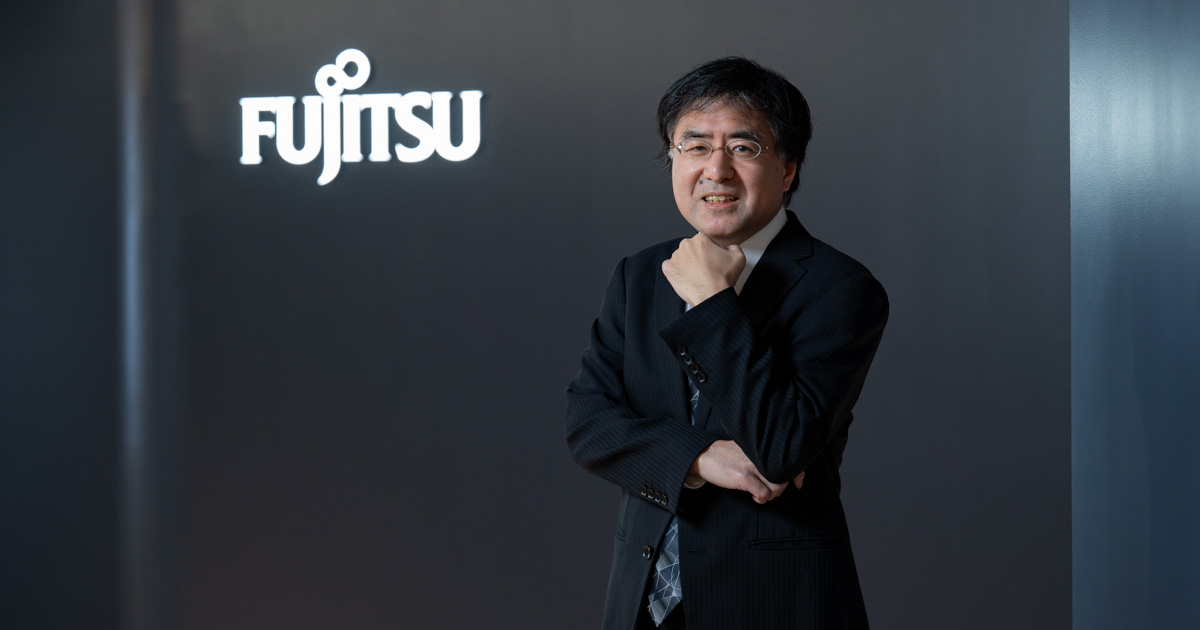
2030: The Year Of Practical Quantum Computing
How should companies prepare for the advent of practical quantum computing? The supercomputer Fugaku was a joint development by RIKEN and Fujitsu. Fujitsu, a major IT vendor in Japan and a leading global partner in digital transformation (DX), has its quantum researcher Shinji Kikuchi discussing the quantum computing paradigm shift anticipated around 2030, and how business leaders ought to approach their readiness.
The global technology firm Fujitsu is spearheading Japan’s quantum computing revolution. Its advanced development capabilities were evident with the supercomputer Fugaku, Japan’s flagship supercomputer, which held world No. 1 rankings in key global benchmarks for over five years. Possessing expertise in both the CPUs (central processing units) found in supercomputers and the QPUs (quantum processing units) utilized in quantum computers, Fujitsu is accelerating cutting-edge initiatives in the quantum domain. The company recently collaborated with the world-renowned research institution RIKEN to deliver a 256-qubit superconducting quantum computer. Now, Fujitsu aims to scale this technology to bring quantum computing into the mainstream by 2030.
Fujitsu’s dedicated quantum computing development facility, spanning 1,000 square meters across two floors, was finalized in autumn 2025 in Kawasaki, Kanagawa Prefecture. Preparations are currently underway to install and begin operating a 1,024-qubit class quantum computer during fiscal year 2026.
A survey conducted by Fujitsu, in collaboration with the Financial Times, reveals that 96% of global executives believe quantum computing will provide value to their organizations. Only 20% of these executives consider it too early to begin evaluating the technology. The era of merely predicting whether quantum computing will become practical has concluded; the focus has now shifted to preparation. Despite this, only 58% of companies were discussing quantum computing strategy in 2026, and many still lack a clear understanding of potential use cases, as noted by Shinji Kikuchi, Senior Project Director of the Quantum Application Core Project at Fujitsu Research.
“If a company plans to use quantum technology, it is essential to have staff who understand it, and choosing the ideal partner is also key. With no way to know which companies will come out on top after 2030, it’s natural to struggle with investment decisions,” says Kikuchi. Given this, how might Fujitsu’s approach to this advanced technology influence global business strategies? As practical quantum computing becomes increasingly viable, what steps should companies take to prepare and prioritize?
Kikuchi emphasizes that quantum technology will not simply replace existing computational systems. “Conventional computers calculate using binary, a system of 0s and 1s. Even AI and supercomputers are both based on that principle. However, quantum computers use 0, 1 and their superposition at the same time. For a given number of qubits, N, they can calculate 2N states in parallel with certain algorithms. In theory, computational space can expand exponentially in some situation in the future. Even all the resources of the supercomputer Fugaku together are equivalent to only about 50 qubits,” explains Kikuchi. The distinctive nature of quantum computing positions it as more than just an extension of traditional technology. It represents an entirely new computing infrastructure designed to complement AI and supercomputers. While AI accelerates decision-making and supercomputers simulate phenomena, quantum computing is anticipated to excel at rapidly identifying optimal solutions from countless possibilities. So, in practical business terms, how can this immense computing power be best utilized?
Kikuchi offers several examples. He highlights that the advantages for materials development represent one of the primary objectives. For instance, catalysts currently used in car exhaust filtration rely on rare earth metals, making the discovery of alternatives a crucial goal, both financially and geopolitically. “Supercomputers are excellent at simulating the characteristics of already-discovered materials. However, searching through unknown candidates at a wide scale is not so simple. Quantum computers have enormous potential for discovering materials and combinations from a wider range of investigation possibilities,” he adds. “We also have high expectations for drug discovery, as well as use in finance. In finance, we are working with Mizuho-DL Financial Technology to develop algorithms that can be utilized for financial problems such as portfolio optimization. In a portfolio of one- or two-hundred securities, it’s simply unrealistic to evaluate risk and return for all the combinations. But using quantum technology could accelerate the evaluation of a far wider range of options. We are also looking into some unique applications such as robotics. If we can realize precise manipulation of robots by quantum optimization technology, it can broaden the horizon of quantum computation,” he says.
It is also crucial not to view quantum computing in isolation. To harness its full potential, AI and supercomputers must also play their respective roles, with all technologies used in conjunction with appropriate software and applications. “Quantum isn’t a silver bullet. We can already find effective solutions for current issues by linking AI and supercomputers. What businesses need is a vision of where quantum will be most useful and a strategy for gradual implementation,” Kikuchi says. “Fujitsu is one of the few companies engaged in hardware, software and applications all in-house. We are building a structure that will offer concrete support from adoption through usage methods, including combinations with AI and supercomputers.”
The dawn of the quantum era is rapidly approaching. Kikuchi observes that just five years ago, generative AI was barely a topic of discussion. This illustrates the rapid pace of technological advancement. Fujitsu’s research corroborates this, with approximately 82% of business leaders acknowledging that AI’s swift progress in recent years has served as a reality check regarding how quickly technological breakthroughs can accelerate. He states: “We are living in an uncertain world where no one can predict what disruptions new technology may bring. But that is exactly why leaders need the vision to identify truly impactful changes when they arrive. We believe quantum computing is no longer far-future tech. A company’s ability to embrace the paradigm shift quantum computing brings is going to determine its competitiveness. Now is the time to start preparing.”

