

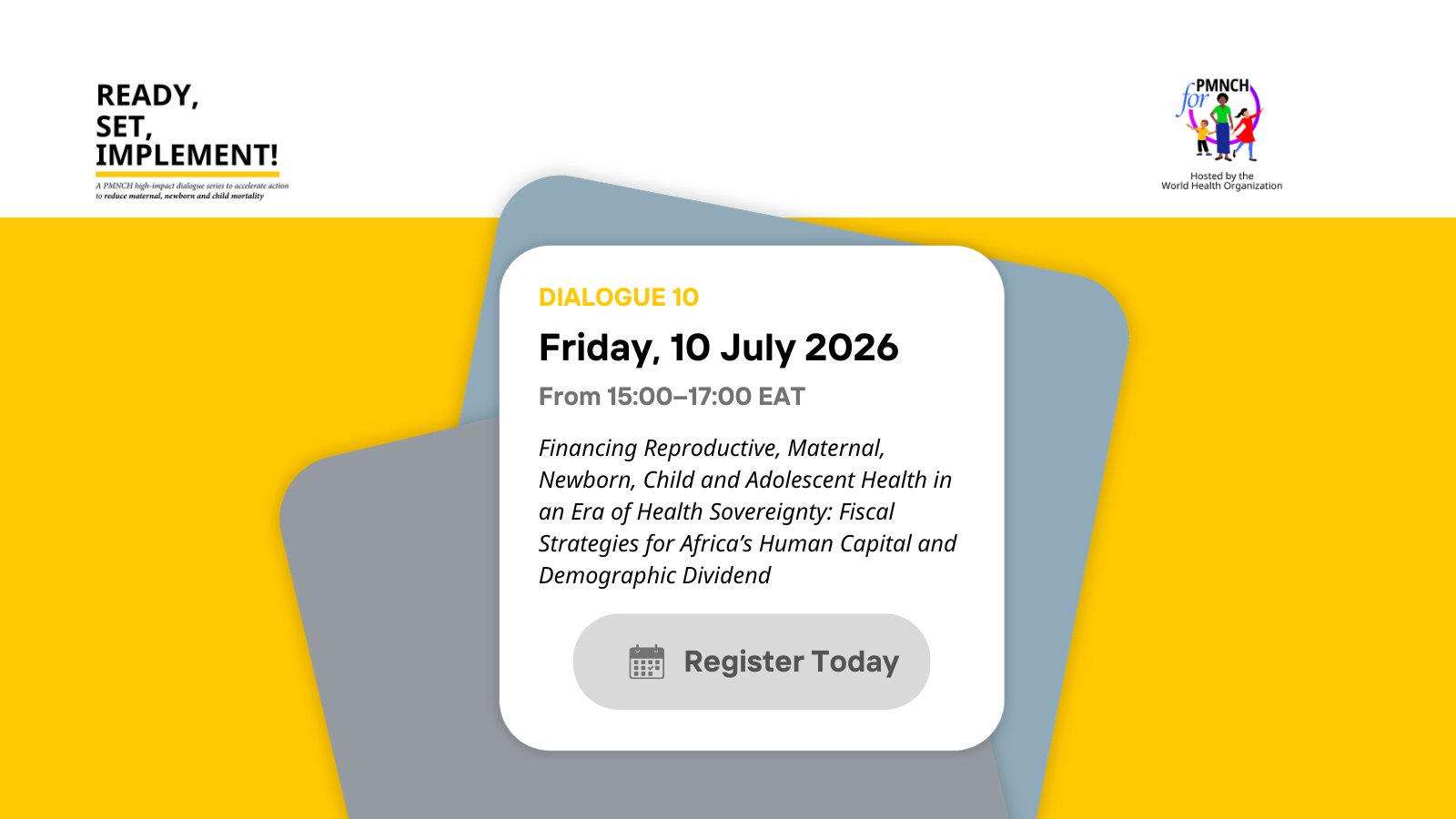
The African Union Commission, in collaboration with partners, has been convening a series of development-focused policy dialogues under the Fridays of the Commission platform to deepen reflection on Africa’s priorities and connect continental policy commitments with practical implementation pathways. Previous sessions in the series have combined high-level political framing with technical evidence and have focused on issues such as Africa’s engagement with the G20, reform of the global financial architecture, debt reform and beneficial ownership transparency as a tool for domestic resource mobilisation. These models have shown the value of bringing together ministers, technical institutions, regional bodies and partners around a focused reform agenda with clear follow-up potential.
This edition of the Fridays of the Commission organized in collaboration with the Ready, Set, Implement Series will highlight how African countries can better finance reproductive, maternal, newborn and child and adolescent health (RMNCAH) as part of a broader agenda on African health security and sovereignty, domestic resource mobilisation, investment in health and economic resilience. The session is convened by the Department of Economic Development, Tourism, Trade, Industry and Minerals (ETTIM) and Health, Humanitarian Affairs and Social Development (HHS) reflecting the recognition that RMNCAH financing is not only a health-sector concern but a determinant of labour-force participation, productivity, and the demographic dividend that underpins Africa’s economic transformation. This targets both Ministers of Finance and Health with strong policy support from senior economic policymakers, and a wider continental health outlook and development priorities.
Background
Africa is facing a more difficult health financing environment marked by declining external assistance, tighter fiscal space, rising debt service burdens, persistent commodity and supply vulnerabilities, and ongoing shifts in the global financing architecture. These pressures are forcing governments to make harder choices about how to protect essential services while financing growth, resilience and structural transformation. In this context, the language of health sovereignty under the Africa Health Security Agenda has gained increasing political traction across African institutions and Member States, reflecting a push for stronger domestic leadership over priority-setting, public financial management, financing choices, and resource allocation.
This conversation is no longer confined to health ministries. At the 8th Ordinary Session, the AU Specialized Technical Committee on Finance, Monetary Affairs, Economic Planning and Integration brought together Ministers of Finance, Ministers of Health and Central Bank Governors under the theme of bridging Africa’s health financing gap in a changing geo-economic context. The Ministerial Declaration called on Member States to implement annual increases in budget allocation to health with the goal of sustaining the 15% Abuja Declaration target, to introduce innovative health taxes on harmful products, to strengthen public financial management, to prioritize primary health care through costed Essential Health Benefit Packages, to achieve the 2019 African Leaders Meeting – Investment in Health Declaration and to pilot and scale innovative financing instruments, including blended finance and debt-for-health swaps. It also called on AU institutions and partners to support Member States on global health financing, debt restructuring and climate finance.
This AU declaration provides a strong and politically grounded rationale for a webinar aimed at finance and health ministries with the goal of reflecting on how to advance the implementation of the declaration. It signals that African Ministers have already recognised health financing as a matter of transformation, resilience and economic governance. The proposed webinar would build on that momentum by asking a more targeted question: how can RMNCAH be positioned within this health sovereignty and domestic resource mobilisation agenda in ways that are compelling to Ministries of Finance, and what role should continental institutions play in anchoring these investments within national development and fiscal strategies?
The case is strong. Investments in women’s, children’s and adolescents’ health, are among the highest-return investments available to governments. The Global Investment Framework for Women’s, Children’s and Adolescents’ Health estimates that every dollar invested in RMNCAH yields up to twenty dollars in economic returns through increased labour-force participation, higher educational attainment, accelerated demographic transition, improved productivity, and long-term macroeconomic stability. Yet these same areas are often among the first to face pressure when budgets tighten, external assistance declines, or essential services lose visibility in broader financing reforms.
Against this backdrop, this Fridays of the Commission session on financing RMNCAH would offer a timely and practical platform to connect AU policy commitments, finance-ministry decision-making, and emerging evidence on how to protect and expand investment in services that are central to Africa’s human capital and development trajectory.
The RMNCAH Financing Challenge in Africa
Despite measurable progress over the past two decades, Africa continues to bear a disproportionate share of the global RMNCAH burden. The continent accounts for roughly half of all maternal deaths and more than half of all deaths among children under five worldwide yet receives a declining share of global health financing. Out-of-pocket expenditure remains the primary source of health payment in many Member States, pushing millions of households into poverty each year.
The financing gap is structural. Most African countries allocate between 5 and 8 per cent of general government expenditure to health, well below the 15 per cent Abuja Declaration target. Within these constrained envelopes, RMNCAH services compete with infectious disease programmes, health-system strengthening, and emergency preparedness. At the same time, external financing for RMNCAH has plateaued or declined as development partners shift towards pandemic preparedness, climate adaptation, and broader primary health care platforms. The result is a growing mismatch between rising demand driven by Africa’s young and rapidly growing population and the fiscal resources available to meet it.
Addressing this gap requires a fundamental shift in how RMNCAH is positioned within national budgets. It must move from being treated as a recurrent expenditure line within health-ministry budgets to being recognised as a strategic investment in human capital and economic productivity, with direct bearing on labour supply, educational outcomes, and the realisation of the demographic dividend
Registration coming soon

