

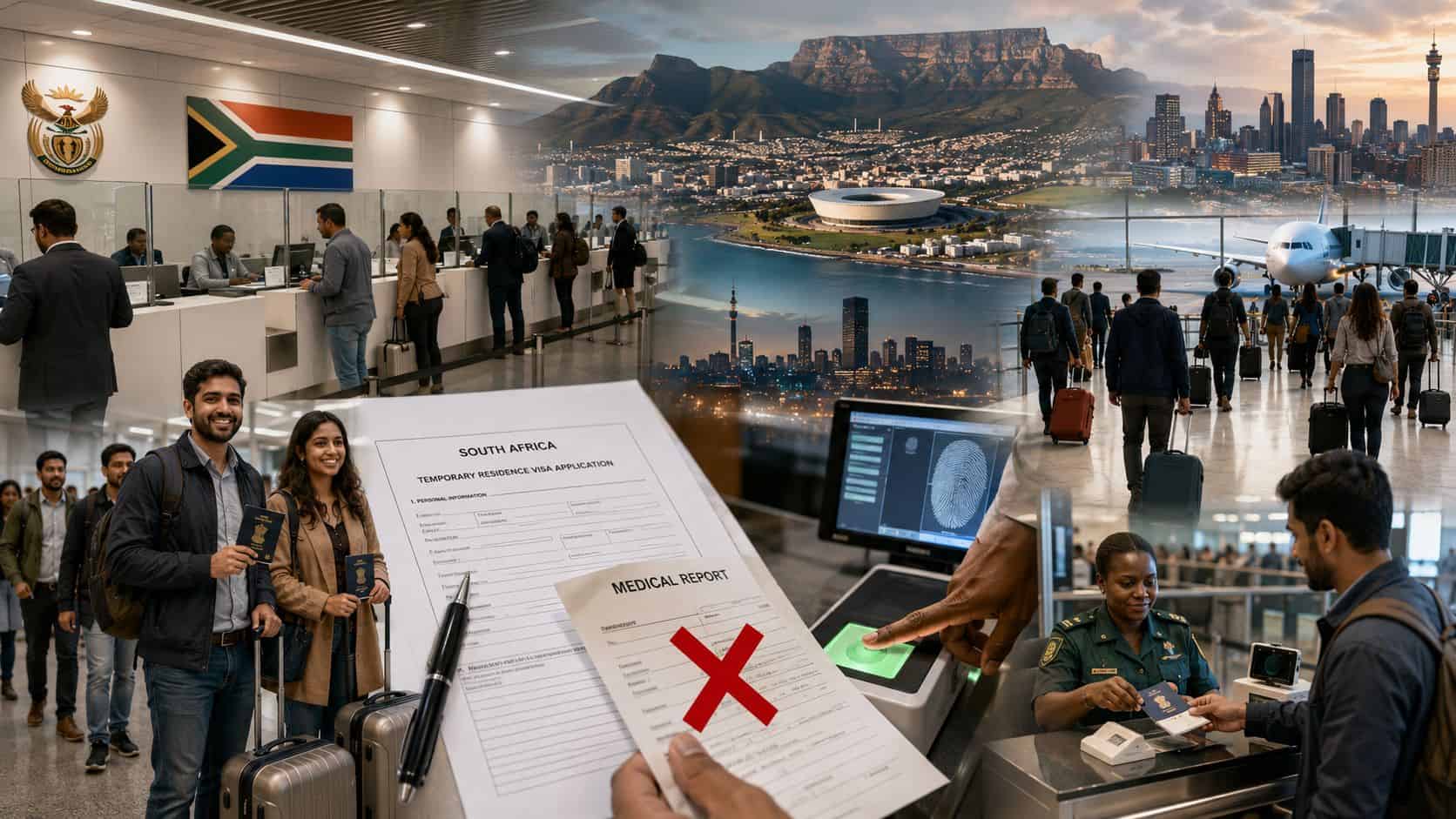
Planning to Move to South Africa? New Immigration Rules Eliminate Medical Report Requirement for Many Residence Visa Applications, Reducing Costs and Administrative Delays—Must-Read for Indian Students and Professionals – Travel And Tour World
Planning to Move to South Africa? New Immigration Rules Eliminate Medical Report Requirement for Many Residence Visa Applications, Reducing Costs and Administrative Delays—Must-Read for Indian Students and Professionals
South Africa has introduced another significant immigration reform by removing the mandatory medical report requirement for a broad range of temporary residence visa and permanent residence permit applications, a move expected to reduce paperwork, lower application costs and accelerate immigration procedures for thousands of foreign nationals, including a growing number of Indian professionals, students, researchers and long-term travellers. The measure took immediate effect after the country’s Minister of Home Affairs signed Ministerial Immigration Directive No. 10 of 2026 on 8 July, marking another step in Pretoria’s wider effort to modernise its immigration framework and reduce administrative barriers.
The latest policy change reinforces South Africa’s strategy of streamlining visa administration by eliminating documentary requirements considered outdated or of limited practical value. While applicants previously had to obtain a medical examination from a registered medical practitioner and submit an official medical certificate with their applications, that obligation has now been waived for eligible categories. For Indian nationals planning careers, higher education, investment opportunities or permanent settlement in South Africa, the reform represents a welcome simplification at a time when governments worldwide are increasingly embracing digital immigration systems and risk-based verification instead of routine medical documentation.
South Africa Visa Rules Enter a New Phase of Immigration Modernisation
The removal of the medical report requirement is part of a broader programme by South Africa’s Department of Home Affairs to modernise immigration procedures, reduce unnecessary bureaucracy and make the country’s visa system more efficient without weakening border security.
Under Ministerial Immigration Directive No. 10 of 2026, applicants covered by the directive are no longer required to submit the traditional medical certificate that had formed part of visa documentation for years. The document historically confirmed that an applicant had undergone a medical examination and was not suffering from serious infectious diseases or other specified medical conditions.
According to the directive, the waiver applies immediately and immigration officials processing applications must implement the revised requirements without delay.
Rather than representing a relaxation of immigration controls, the change reflects an administrative shift towards more targeted security screening, digital verification and document rationalisation, an approach increasingly adopted by immigration authorities globally.
Who Benefits From the New Policy?
The revised requirements affect specific categories of residence applications rather than every visa type.
| Application Category | Medical Report Required? | Applies Inside South Africa | Applies Outside South Africa |
|---|---|---|---|
| Temporary Residence Visa (submitted within South Africa) | No | Yes | Not applicable |
| Permanent Residence Permit | No | Yes | Yes |
| Temporary Residence Visa lodged overseas | Yes (currently remains required) | No | Yes |
The distinction is particularly important for Indian applicants.
Those already residing in South Africa and applying for temporary residence extensions or changes of status can benefit immediately from the simplified process. Likewise, applicants seeking permanent residence can omit the medical report regardless of whether they apply inside South Africa or through overseas channels.
However, applicants submitting new temporary residence visa applications from outside South Africa, including from India through diplomatic missions or Visa Facilitation Centres, should continue following the existing documentation checklist unless official overseas application guidance is updated.
A Natural Continuation of Earlier Immigration Reforms
The latest reform is not an isolated policy announcement.
Instead, it builds upon South Africa’s recent efforts to simplify immigration compliance by removing documentation considered unnecessarily burdensome.
In 2023, the government eliminated the requirement for radiological reports, commonly involving chest X-rays, for several immigration categories. Authorities also simplified police clearance requirements by narrowing the circumstances in which applicants must provide certificates covering previous countries of residence.
The removal of the medical report therefore represents another milestone in a continuing programme of administrative reform rather than a sudden policy reversal.
| Immigration Reform | Year | Impact on Applicants |
|---|---|---|
| Radiological report requirement removed | 2023 | Eliminated mandatory chest X-ray documentation |
| Police clearance documentation simplified | 2023 | Reduced documentary burden for applicants |
| Medical report requirement removed | 2026 | Eliminated mandatory medical certificate for eligible applications |
For immigration professionals, the sequence demonstrates a clear regulatory trend: fewer routine medical documents, greater reliance on digital processing and risk-based immigration assessment.
Why the Medical Report Requirement Was Considered Burdensome
For many applicants, obtaining the required medical report involved considerably more than visiting a clinic.
Applicants typically needed to:
- schedule appointments with registered medical practitioners;
- complete government-prescribed forms;
- undergo physical examinations;
- pay consultation fees;
- ensure documents met validity requirements before submission.
For overseas applicants, especially those living outside major metropolitan areas, arranging compliant medical documentation often added several days—or even weeks—to overall application preparation.
Although individual costs varied by country and medical provider, eliminating the requirement removes both direct medical expenses and indirect administrative costs associated with securing appointments, travelling to approved practitioners and replacing expired documentation.
The reform therefore improves not only affordability but also overall application efficiency for qualifying applicants.
Why the Reform Matters for Indian Professionals, Students and Long-Term Travellers
India has become one of South Africa’s increasingly importantvestment and specialised employment. Engineers, IT professionals, academics, healthcare workers, researchers, entrepreneurs and multinational company executives regularly relocate to South Africa under various temporary residence categories before becoming eligible for permanent residence
For these applicants, South Africa visa rules have historically involved assembling an extensive portfolio of supporting documentation, including passports, police clearance certificates, proof of qualifications, financial evidence, employment contracts, biometric information and, until now, medical reports.
The impact is likely to be particularly noticeable for applicants living outside India’s largest metropolitan centres, where appointments with registered practitioners familiar with South African immigration documentation could require additional travel and expense.
Students planning postgraduate education, multinational employees accepting assignments in Johannesburg or Cape Town, entrepreneurs establishing businesses and family members applying for permanent residence all stand to benefit from a simpler documentation process where the waiver applies.
While the change does not alter eligibility criteria for visas or permanent residence, it makes preparing an application considerably more straightforward.
South Africa Continues to Position Itself as a Competitive Destination
The latest immigration reform arrives as South Africa seeks to strengthen its position as one of Africa’s leading destinations for investment, higher education, business travel and skilled migration.
According to the Department of Tourism, international tourism has continued its recovery following the pandemic, while business travel has regained momentum across sectors including mining, renewable energy, financial services, technology and manufacturing.
Meanwhile, immigration policy has increasingly focused on balancing national security with administrative efficiency.
Rather than relying on blanket documentary requirements introduced decades ago, governments around the world are investing in digital identity verification, biometric systems and intelligence-led border management.
South Africa’s latest directive aligns with that broader international trend.
How South Africa’s Immigration Documentation Has Become Simpler
The cumulative effect of recent reforms illustrates how application requirements have gradually evolved.
| Immigration Requirement | Previous Position | Current Position |
|---|---|---|
| Medical report | Required for many temporary residence and permanent residence applications | Waived for eligible categories |
| Radiology report | Required for several immigration categories | Removed in earlier reform |
| Identity verification | Primarily document-based | Increasing reliance on biometric verification |
| Application administration | Paper-intensive | Progressively shifting towards streamlined processing |
For applicants, the overall direction is clear: less emphasis on routine medical paperwork and greater focus on identity verification, admissibility and immigration compliance.
Global Immigration Systems Are Moving Towards Risk-Based Processing
South Africa is not alone in reassessing long-standing visa documentation requirements.
Over the past several years, immigration authorities in numerous countries have reviewed application procedures introduced decades earlier when digital verification tools were limited.
Today, governments increasingly depend upon:
| Traditional Approach | Emerging Approach |
|---|---|
| Routine medical documentation | Risk-based health assessments where necessary |
| Extensive paper files | Digital document management |
| Manual verification | Biometric authentication |
| Multiple physical certificates | Electronic records and integrated databases |
| Administrative compliance | Intelligence-led border management |
This evolution does not necessarily mean immigration systems have become less stringent.
Instead, authorities are directing reentity verification, national security, fraud prevention and immigration integrity
Medical examinations continue to play an important role where public health legislation requires them, but routine examinations for every applicant are becoming less common in certain immigration categories.
Practical Guidance Before Submitting an Application
Although the removal of the medical report requirement represents welcome news, applicants should avoid assuming every immigration requirement has changed.
Before lodging an application, travellers should carefully review the latest documentation requirements applicable to their specific visa category.
Applicants should continue ensuring that essential documents remain valid, including passports, police clearance certificates where required, proof of financial support, employment documentation, educational qualifications and accommodation evidence.
Immigration requirements can differ depending on:
| Applicant Situation | Requirements May Differ |
|---|---|
| Applying inside South Africa | Yes |
| Applying from overseas | Yes |
| Temporary residence category | Yes |
| Permanent residence route | Yes |
| Employment, study or family-based application | Yes |
Prospective applicants should therefore verify the latest checklist before submitting documentation, particularly while overseas visa application guidance is being updated following the latest ministerial directive.
Administrative Efficiency Could Improve Processing Workflows
Although the Department of Home Affairs has not announced revised processing timelines, reducing documentation requirements may help improve operational efficiency.
Every document removed from an application reduces administrative tasks associated with:
- document verification;
- completeness checks;
- follow-up requests;
- applicant corrections;
- filing and record management.
For immigration officials managing thousands of applications annually, these efficiencies can contribute to smoother processing without altering substantive eligibility assessments.
Applicants likewise benefit from fewer appointments, lower preparation costs and a reduced likelihood of delays caused by missing or expired supporting documents.
As South Africa continues modernising its immigration framework, the latest reform signals a broader commitment to making South Africa visa rules more efficient while maintaining regulatory oversight.
The removal of the medical report requirement may appear modest on its own, yet for thousands of future applicants—including Indian professionals, students, investors and families—it eliminates a long-standing administrative hurdle and reflects the country’s continuing shift towards a more streamlined, digitally focused immigration system.
A Leaner Immigration System Signals South Africa’s Long-Term Direction
The latest amendment to South Africa visa rules is more than a procedural adjustment—it reflects a broader transformation in how the country manages immigration. By removing the mandatory medical report requirement for eligible temporary residence and permanent residence applications, the Department of Home Affairs has reduced an administrative step that many applicants regarded as time-consuming, costly and of limited practical value.
For Indian professionals, students, researchers, entrepreneurs and families considering South Africa for employment, education or long-term settlement, the reform translates into a simpler application journey with fewer documents to obtain before submission. Although applicants must still satisfy all eligibility requirements, including identity verification, police clearance where applicable and other supporting evidence, the removal of routine medical documentation should make the process more efficient and accessible.
The policy also mirrors a wider international trend in which immigration authorities are replacing legacy paperwork with digital verification, biometric screening and risk-based assessments. As South Africa continues modernising its immigration framework, travellers and prospective residents can expect further efforts aimed at improving processing efficiency while preserving border security and immigration integrity.
For anyone planning a move to South Africa, the key takeaway is clear: South Africa visa rules are becoming more streamlined, but applicants should continue checking the latest official documentation requirements before lodging their applications to ensure they comply with the most up-to-date immigration guidance.
Frequently Asked Questions (FAQs)
1. What has changed in South Africa’s visa application process?
South Africa has removed the mandatory medical report requirement for eligible temporary residence visa applications submitted within the country and for permanent residence permit applications lodged both in South Africa and from overseas. The change took effect immediately under Ministerial Immigration Directive No. 10 of 2026.
2. Does this change apply to Indian nationals applying for a South African visa?
Yes. Indian nationals who fall under the eligible visa and permanent residence categories can benefit from the removal of the medical report requirement. However, applicants should still check the latest documentation requirements for their specific visa category before submitting an application.
3. Is the medical report requirement removed for all South African visa applications?
No. The waiver does not automatically apply to every visa category. It primarily covers temporary residence visa applications submitted within South Africa and permanent residence permit applications filed both domestically and from abroad. Applicants applying for temporary residence visas from overseas should verify the current checklist with the relevant South African mission or visa application centre.
4. What was the purpose of the medical report previously required?
The medical report confirmed that an applicant had undergone a medical examination conducted by a registered medical practitioner and did not have serious infectious diseases or other specified medical conditions as required under earlier immigration regulations.
5. Will removing the medical report make South African visa processing faster?
Although the Department of Home Affairs has not announced revised processing times, removing one mandatory document is expected to simplify applications, reduce preparation time and improve administrative efficiency for both applicants and immigration officials.
6. What documents are still required for a South African residence visa or permanent residence application?
Applicants may still need to provide a valid passport, completed application forms, police clearance certificates where applicable, proof of financial means, employment or study documentation, photographs and other supporting documents depending on the visa category.
7. Why did South Africa remove the medical report requirement?
The reform is part of South Africa’s broader immigration modernisation strategy, aimed at reducing unnecessary administrative burdens while relying more on digital verification, biometric screening and risk-based immigration assessments.
8. Where can travellers verify the latest South African visa requirements?
Travellers should always consult the official South African Department of Home Affairs website or the nearest South African Embassy, High Commission or Consulate before submitting a visa or permanent residence application, as immigration requirements may change over time.
This content is protected under the Copyright Act. Unauthorized scraping, AI extraction, reproduction, or republication is strictly prohibited. Read ourCopyright Policy.Follow Travel And Tour World in Google News

PARTNERS








REGIONAL NEWS
Europe

France Unlocks Extended European Holidays Alongside Spain and Italy as the Schen

England Unveils a Potential Digital Breakthrough for Regional Tourism as One Ope
America
Spain Leads a Historic Global MICE Transformation in Barcelona as Germany, Italy

Key West Tops America’s Favourite Staycation Destinations as Yosemite, Myrtle
Middle East
Saudi Arabia Links With UAE, Oman, Qatar and More as Aseer’s 120 Metre Musical
Kuwait City Aligns with Amman, Doha and Manama Under Global Travel Spotlight as

Cambodia, Laos and Vietnam Unite for a Historic Tourism Transformation as “Thr

China Aligns With Malaysia, Indonesia, Singapore and More as Thailand Retains It
We use cookies on our website to give you the most relevant experience by remembering your preferences and repeat visits. By clicking “Accept”, you consent to the use of ALL the cookies.Do not sell my personal information.
Settings
Manage consent
X
