

White wizards, black mambas and battle for soul of African football – Türkiye Today
White wizards, black mambas and battle for soul of African football
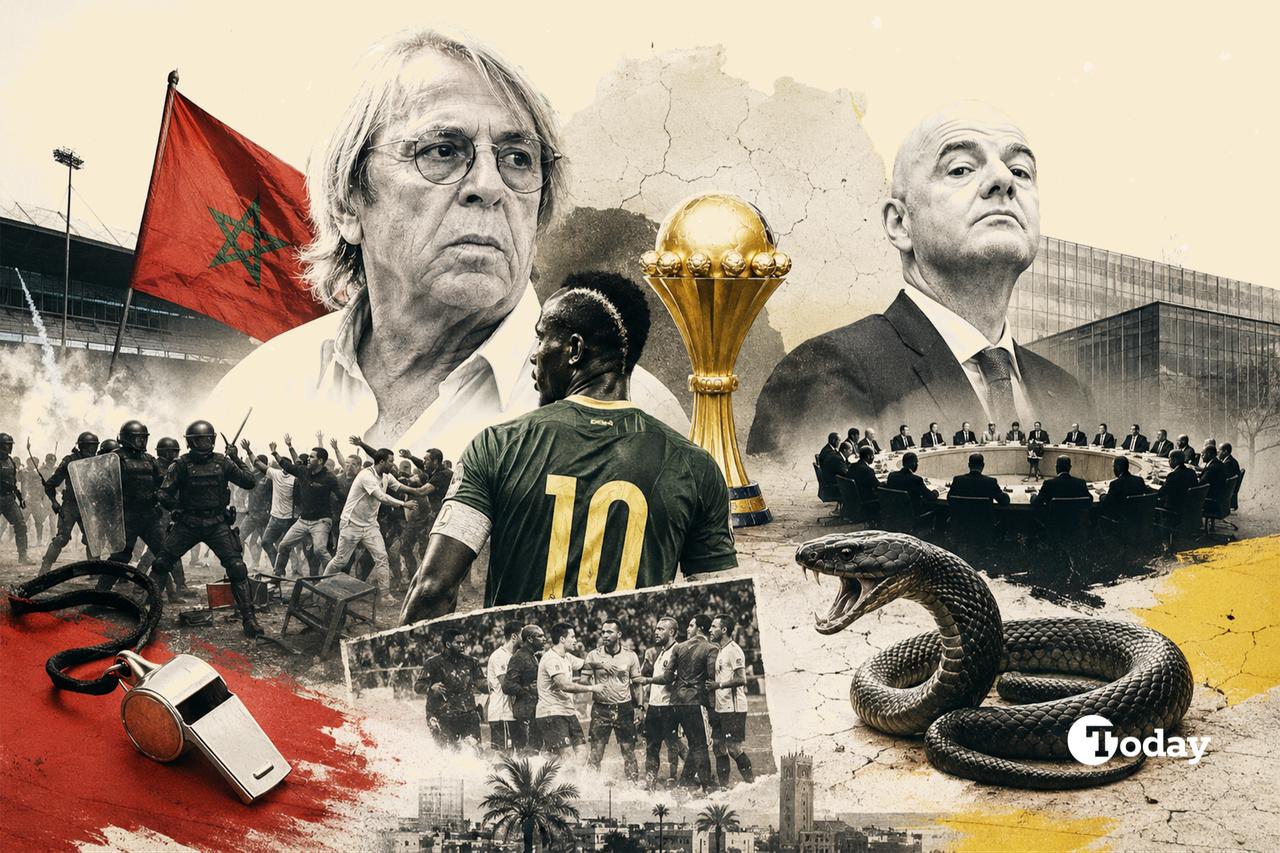
In international football politics, where dissent is generally communicated through smiles, handshakes, and knives concealed beneath the tablecloth, Le Roy isn’t some backseat driver—he’s behind the wheel. (Artwork by Türkiye Today/Zehra Kurtulus)
Ismail Jakobs cradled his Africa Cup winner’s medal like a newborn black mamba—carefully, lovingly, and with no idea when it might bite.
“That must have been the craziest final in football history,” the Galatasaray and Senegal defender rasped last January in Rabat, still sounding as if the venom hadn’t quite worn off.
He didn’t know half of it.
Because the final was not over. Not remotely. What followed has been a six-month fever dream of brawls, riot police, diplomatic fury, courtroom warfare, and a missing 8-kilogram trophy—with embattled FIFA president Gianni Infantino now facing an unlikely threat to his grip on African football: a 78-year-old Frenchman known as the White Wizard.
Infantino has cultivated Africa relentlessly. Its 54 football associations represent a formidable voting bloc in FIFA politics and have been central to the coalition underpinning his power.
Now Claude Le Roy—the “White Wizard,” one of the most influential outsiders African football has ever known—is back on the continent and openly attacking the man at the top.
Smiles, handshakes, and hidden blades
Le Roy has called Infantino a “multilingual idiot,” accused him of being “dangerous for football,” and questioned why Africa should continue backing him.
In international football politics, where dissent is generally communicated through smiles, handshakes, and knives concealed beneath the tablecloth, this is not subtle.
Nor is Le Roy some drive-by pundit howling from the cheap seats.
For nearly half a century, he has accumulated relationships with African presidents, federation chiefs, players, and coaches. Now he has returned to management in the Republic of Congo, giving one of Infantino’s loudest critics a fresh platform where the FIFA president can least afford a rebellion.
And all of this traces back, appropriately enough, to one gloriously deranged night in Morocco.
The clash against Morocco became, in a legal and metaphysical sense, possibly the longest final in history.
“This was a massive game that resonated well beyond Africa,” said football pundit Andy Scott. “It ended with fighting in the press box. Absolute chaos. I’ve never seen anything like it.”
Trouble had been circling before the players even tied their boots.
Senegal was furious with the decisions by Congolese referee Jean-Jacques Ndala. Then came the detonation: with the match goalless deep into injury time, Morocco were awarded a deeply controversial penalty.
Senegal walked off.
The stadium boiled. Officials scrambled. The whole thing teetered on the edge of farce and forfeiture.
Cue the Wizard.
Le Roy, working as a television pundit, swept past the phalanx of pitch-side security guards whose job is to keep journalists and other unauthorized mammals away from the action.
But there are ordinary accreditation rules, and then there are the rules governing Le Roy in Africa.
Most of Senegal’s players were already in the dressing room, unwilling to legitimize the penalty by returning.
Le Roy found Sadio Mané.
The pair went back years. Mane had first encountered the Frenchman as a scrappy teenager in Dakar. Now he was Senegal’s superstar captain, standing at the center of one of the strangest crises African football had seen.
Le Roy gave him six words in French.
“A penalty is not a goal.”
Mane listened.
Senegal came back out. And then football, that old lunatic, took over. Morocco missed the penalty.
Pape Gueye scored a stupendous Senegal winner, now in danger of becoming a footnote to everything that followed. The West Africans celebrated with the trophy.
Except the game still wasn’t over.
Morocco appealed. The result was overturned, and the final was awarded to them because of Senegal’s walkout.
Senegal appealed in turn.
And lurking behind their cause was Le Roy, a rare football creature combining sagacity, mischief, and an apparently congenital inability to keep his mouth shut when powerful men would prefer silence.
With his explosion of blond hair above an aquiline nose, the White Wizard has spent decades roaming African football, coaching Cameroon, Senegal, Ghana, Togo, and the Democratic Republic of Congo.
At 78, he had supposedly finished.
Then Denis Sassou Nguesso, ruler of the Republic of Congo for most of the past four decades, came calling. Le Roy agreed to lead the country for a second time.
It was hardly his first summons from an African strongman. Cameroon’s long-serving president Paul Biya has repeatedly wanted him back in Yaoundé.
This is the peculiar political currency Le Roy carries. In parts of Africa, he is less a football coach than an itinerant shaman with a contacts book and diplomatic immunity granted by reputation.
And that is what makes him troublesome for Infantino.
A multilingual idiot?
Infantino can count votes. Africa has 54 of them. But administrators do not always move the needle in football. Players do. Coaches do. Heroes do. And occasionally so does a white-haired Frenchman who has wandered African touchlines since Ronald Reagan was in the White House.
Asked by French television whether Africa should support Infantino’s re-election, Le Roy unloaded.
“Infantino has one quality, which is being multilingual. But he’s a multilingual idiot, dangerous for football, who has brought absolutely nothing positive and has made the sport scandalous in everyone’s eyes. Infantino gets away with anything in Africa. I am appalled that this man is still at the head of FIFA.”
So that would be a no.
And anyone waiting for the old man to discover diplomacy should find a comfortable chair.
Le Roy was raised by Breton communist parents on stories of African anti-imperialist politics. Deference to authority was apparently not among the family virtues.
During his second spell with Cameroon, he even threw the marabouts out of the team camp.
“I told them I am from Brittany, the land of Merlin.”
Try putting that into a FIFA technical report.
Meanwhile, the final that refuses to die drags deeper into extra time.
Fans are wondering what becomes of Jakob’s medal and the trophy itself, a monument to African unity that has instead become a magnificent physical embodiment of African football’s latest dispute.
The next whistle will not be blown by a referee.
It will come from three arbitrators at the Court of Arbitration for Sport.
The smart money is on Jakobs keeping his medal.
As for the trophy, good luck.
It is reportedly hidden somewhere in Dakar. Senegal’s position, encouraged by the White Wizard, is wonderfully uncomplicated: whatever the arbitrators decide, the cup stays where it is.
And so the longest final in football history continues, beyond the stadium, beyond Morocco, beyond the rule book and into the strange subterranean politics of FIFA itself.
Somewhere in Dakar sits 8 kilograms of gold-plated evidence.
Somewhere in Zurich, Gianni Infantino may be paying attention.
And somewhere in Africa, Le Roy is back at work.
Guler needs 4 minutes to answer Mourinho in Real Madrid rout
Sports 3 min read
Djokovic suffers earliest Grand Slam exit in 20 years at US Open
Sports 4 min read
Marc Marquez dominates Aragon MotoGP to close on Jorge Martin
Sports 1 min read
Leao joins Galatasaray on four-year deal, eyes new title
Sports 2 min read

