

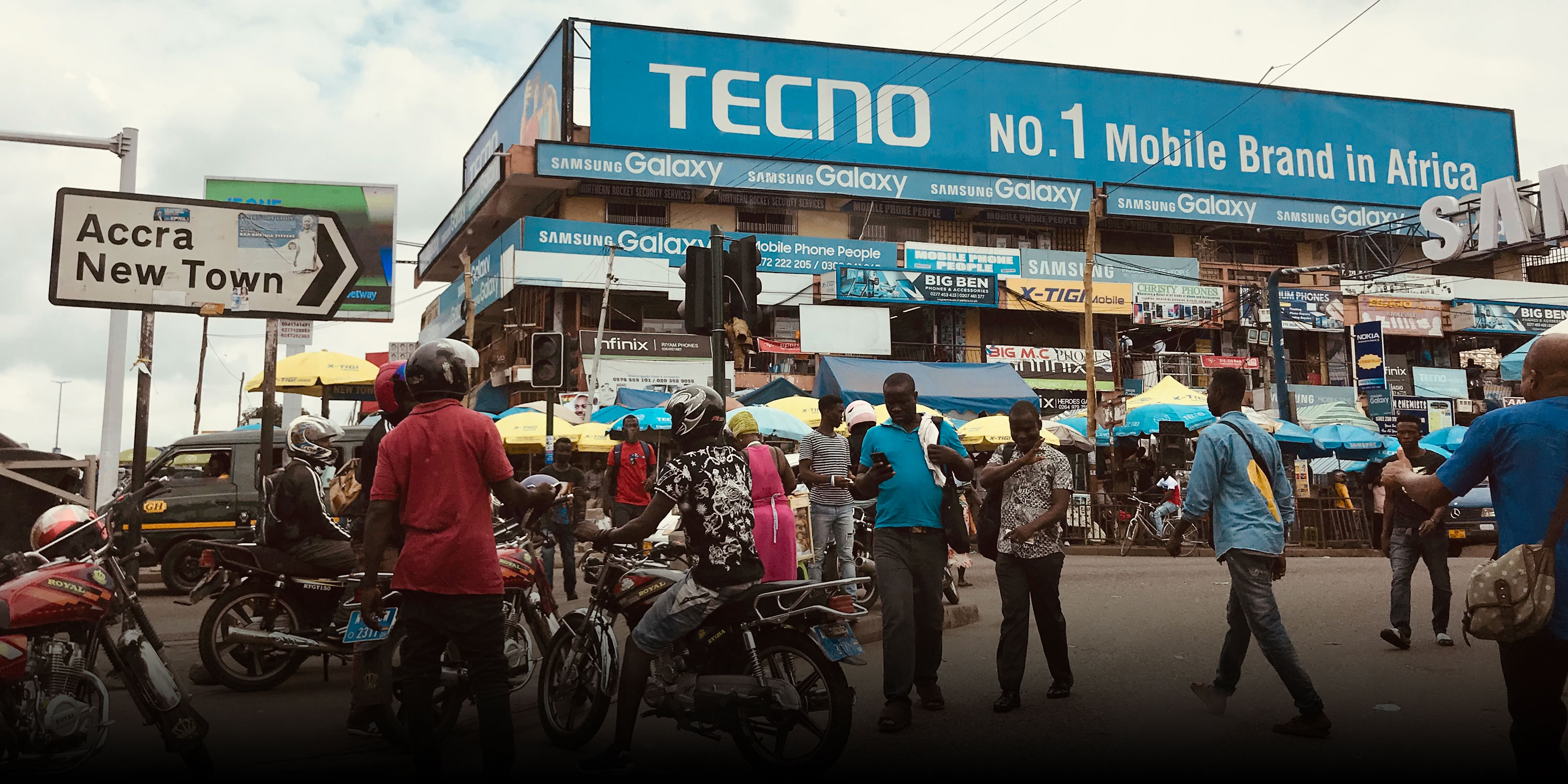
Few people in China have heard of Transsion Holdings, but hundreds of millions of people across the Global South use its phones.
The firm, headquartered in China’s southern tech hub of Shenzhen, has risen from obscurity to become a dominant player in Africa, where it makes <a href="https://omdia.tech.informa.com/pr/2026/aug/africa-smartphone-market-expected-to-decline-26percent-in-2026-following-first-contraction-in-three-years” rel=”nofollow noopener” target=”_blank”>nearly half of all phones bought on the continent every year, beating competition from Samsung, Apple, and domestic Chinese giants like Xiaomi and Huawei Technologies. It also holds more than a 10% share of the Southeast Asian and Middle Eastern markets.
Transsion’s rise has been all the more impressive given its humble origins: unlike many of its rivals, it hasn’t benefited from massive funding or market-leading technology.
Instead, it has built a global business almost from scratch — a decades-long journey spanning Shenzhen’s knock-off electronics markets, scrappy networks of African “suitcase entrepreneurs,” and years of careful, locally targeted innovation.
Lu Miao, a media anthropologist and assistant professor at Hong Kong’s Lingnan University, charts this fascinating tale in her book “The Transsion Approach: Translating Chinese Mobile Technology in Africa.”
Based on years of research, it explores the secrets to the company’s success in the Global South — and how its strategy offers an alternative to the “blitzscaling” model favored by many tech startups in both Silicon Valley and China.
In this interview, Lu talks to Sixth Tone and Zhang Lin, an associate professor at the University of New Hampshire whose research focuses on tech innovation, about the Transsion story and what it teaches us about global technology flows. The interview has been edited for brevity and clarity.
Sixth Tone: Your book explores how Transsion grew from the informal global phone market that emerged during the 1990s and early 2000s, when African and Arab traders began traveling to southern China to buy cheap knock-off — or shanzhai — handsets. What is the company’s connection to that era?
Lu Miao: Shanzhai phones were extremely common in the early 2000s. The Huaqiangbei electronics market in Shenzhen was a major hub, while Chungking Mansions in Hong Kong was an important gateway for knock-off phones going overseas.
The main buyers were small traders from Africa, the Middle East, and Southeast Asia. Some scholars call them “suitcase entrepreneurs” because they would arrive with a few suitcases, buy phones, take them home, and distribute them to smaller towns.
When I went to Ghana in 2019, I found that many of Transsion’s national distributors had started out-selling secondhand and shanzhai phones bought from traders in Chungking Mansions. After partnering with Transsion, they gradually became formal agents for a multinational company.
These local African distributors linked the shanzhai era to the Transsion era. The personal connections and distribution networks they had built up played a major role in helping Transsion establish itself.
There is also continuity in design. Features such as dual-SIM support and large batteries originated in the shanzhai phone ecosystem and were later adapted for African markets. Dual SIMs, for example, help users avoid costly cross-network calls in countries with patchy network coverage.
But Transsion also represented a break from that era. First, the phone business became more formalized and institutionalized. These distributors set up trading companies of their own, and their relationships with Transsion became governed by more formal contracts.
Second, Transsion did not want to make quick money and leave, as sellers had done in the shanzhai era; it wanted to build a brand and stay for the long term. That is why it invested heavily in its after-sales service network.
Shanzhai wasn’t simply about one manufacturer producing copycat phones. It was an ecosystem: factories, supply chains, designers, distributors … Transsion grew out of that ecosystem, but also moved beyond the shanzhai model of the time.
Sixth Tone: Looking at the bigger picture, how has Africa’s digital communications sector evolved over time, and how has that affected Chinese companies like Transsion?
Lu: Take Ghana as an example. The country’s telecommunications companies were originally state-owned. But in the 1980s and 1990s, the country had to turn to the World Bank and International Monetary Fund for loans to deal with ongoing economic and debt crises. One condition of these loans was structural adjustment, which meant privatizing the telecom sector.
After the reforms, one common outcome was a widening urban-rural gap. Commercial operators were reluctant to serve low-margin rural areas, where costs were high and consumer spending was low, so infrastructure such as base stations remained concentrated in cities.
The needs of rural and low-income communities were overlooked during the reforms, and after the state retreated, it did not step back in to meet those needs. That meant many people could only afford cheap Chinese shanzhai phones.
Transsion stepped into this market, offering affordable feature — or “dumb” — phones that were tailored to African users’ needs. It optimized its models for areas with sparse base-station coverage, making them better at picking up weak signals than many other phones. Electricity supply could also be unreliable in rural areas, so the long battery life of both shanzhai and Transsion phones was another important advantage.
Zhang Lin: Against this backdrop, you argue that we should understand global technology flows in terms of “technology translation” rather than “technology transfer.” What does this framework help us understand about how technology moves between countries?
Lu: I don’t really like the concept of “technology transfer” because it frames the process as one-way: advanced Western societies export technology to less-developed non-Western societies in order to help them develop. But the endpoint of development in this model is always Western modernity.
It also assumes that technology is neutral and fixed, as if transferring technology alone will solve social problems and generate economic growth. Yet many aid projects failed precisely because they transferred equipment without transferring the knowledge, skills, and institutional environment around it.
That is why I used the concept of “technology translation.” When a technology enters a new context, it is often reinterpreted, adjusted, and transformed. Examining the context and process of how technology is translated allows us to see how knowledge moves, and the politics embedded in the process.
Transsion did not simply take phones made in China and move them unchanged to Africa; its products were continually redesigned through their encounter with local markets. Chinese engineers and product managers, Ghanaian promoters, distributors, and repair workers all became “translators” in this process.
For example, Transsion’s dual- and multi-SIM functions were not simply extra hardware features; they responded to high communications costs, uneven network coverage, and users’ need to switch between operators. Cameras optimized for darker skin tones respond to the fact that imaging technologies have historically treated white skin as the default.
These features were not simply invented by an individual designer. They emerged through interactions among the company, users, distribution channels, and repair networks.
Zhang: You describe Transsion’s business strategy as “deep plowing” and contrast it with Silicon Valley’s “blitzscaling” model. How are they different?
Lu: “Blitzscaling” was a widely celebrated model in Silicon Valley from the mid-2010s onward. Popularized by (American internet entrepreneur) Reid Hoffman, it relies on large amounts of capital to expand rapidly, prioritizing speed over efficiency.
The idea is to capture the market first and then achieve winner-takes-all dominance. Facebook, Uber, and Airbnb are typical examples, as are Chinese companies such as ride-hailing firm Didi.
At its core, blitzscaling involves a deliberately inefficient use of capital. Companies sustain themselves through venture capital, and much of that money is wasted. It is a game only a small number of players can afford. Most fail; the few that survive can end up monopolizing the market.
“Deep plowing” is more commonly seen in the Global South. It is slower and depends much more on local knowledge and relationship networks. The term originally comes from agriculture, referring to a labor-intensive mode of production that requires long-term investment and continual care.
In business and technology, I use it to describe a market-driven, labor-intensive approach in which a company continuously interacts with local markets and adjusts its products and business strategies in response to feedback.
In many cases, this model is adopted out of necessity. Transsion chose to work deeply in rural markets overlooked by Western capital largely because it lacked large pools of capital and core technologies. It often had to create room for itself by understanding markets in much finer detail.
(Header image: An entrance to the Circle Market in Accra, Ghana, 2019. Courtesy of Lu Miao)

