

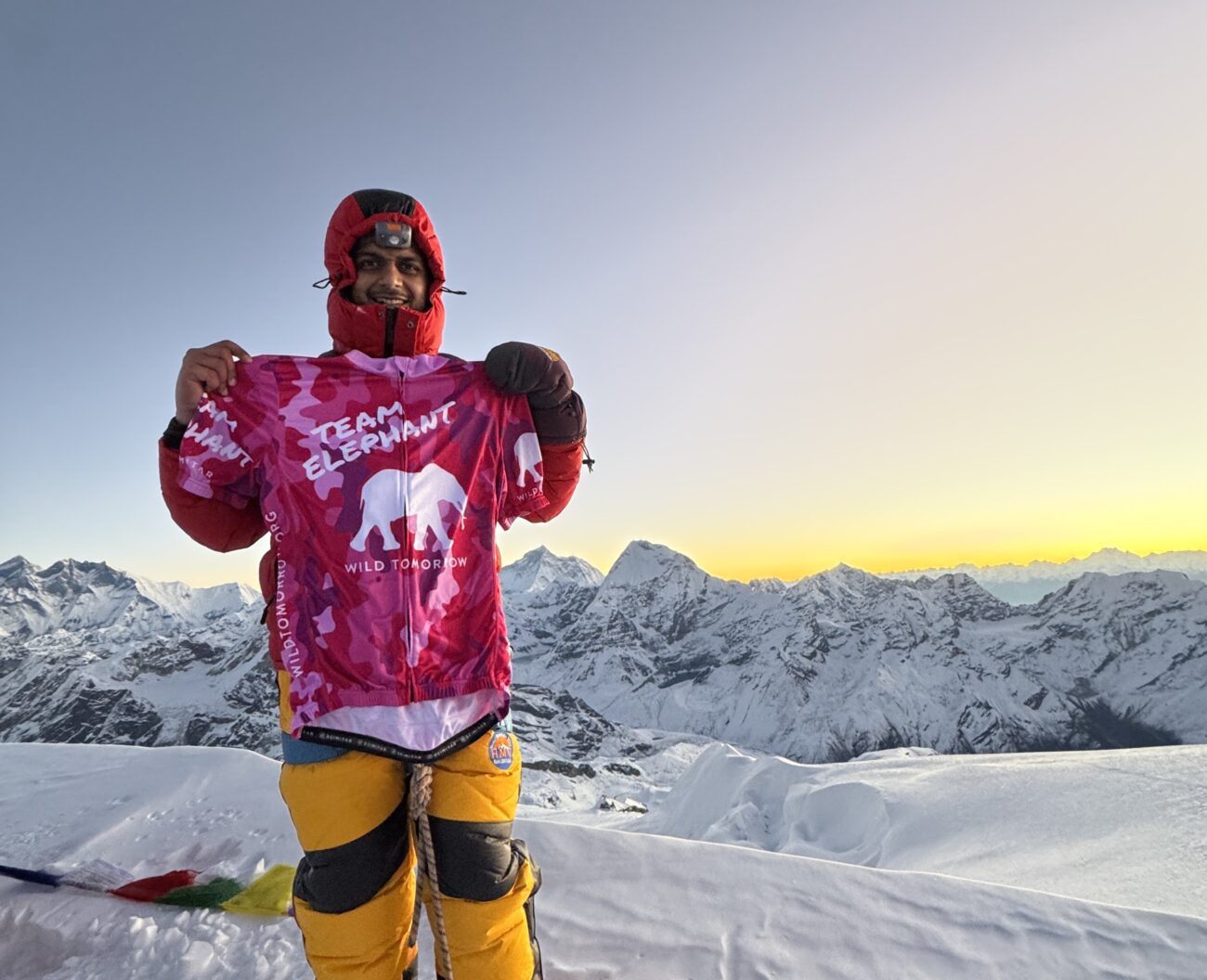
One year ago, I summited Mera Peak—21,250 feet above sea level—in the Himalayas to raise funds for Wild Tomorrow, a conservation organization working to restore endangered ecosystems and protect wildlife in South Africa. What began as a physical challenge quickly turned into a deeply personal reflection on identity, belonging and the freedom to be wild—in nature and in ourselves.
Climbing to raise funds for restoration, research on human-elephant coexistence and my queer journey had taught me the same lesson: when a landscape becomes fragmented, life adapts. But adaptation is not the same as freedom. If we want different outcomes, we have to change the conditions that shape them.
Breaking the spirit
Growing up queer in South India, surrounded by domesticated elephants, I developed a deep reverence for these magnificent yet gentle beings.
Over time, I began to see a painful parallel. Elephants, once wild and free, are often forced into lives that are not their own: giving joyrides, blessing devotees in temples, being used as props by people begging on streets for coins and prayers. The traditional process that makes this possible has a chillingly precise name: “breaking the spirit.” A young elephant is separated from its herd and conditioned, often through deprivation and pain, until obedience replaces instinct.
Queer children in conservative societies often undergo a quieter version of the same conditioning, taught to suppress their true selves to fit heteronormative expectations. Before I had words for my sexuality, I had learned to monitor myself: my mannerisms, my voice, what I said and what I left unsaid. No one had to tell me to become smaller. It takes no chains to break a spirit; silence works just as well.
Habitat loss and fragmentation
With grant support from Columbia Climate School and under the guidance of Ruth DeFries, a professor of ecology and sustainable development at Columbia University and co-founding dean of the Columbia Climate School, I researched human-elephant conflict in Asia. I entered this work with a familiar question: Why do elephants enter farms and come into conflict with people?
The field gave me a more complicated answer.
Across southern India, forests that once formed continuous elephant corridors have been fragmented by encroachment, plantations, roads and freight corridors. As habitats shrink and food In places such as Coorg, even coffee cherries can become part of their diet
A conversation with a coffee plantation owner stayed with me. He told me that some calves born within plantations no longer know the forest as home: “The forest no longer has enough for them.”
That response reframed human-wildlife coexistence for me. The issue is not simply animals entering “our” spaces. Human systems have transformed the landscapes they once depended on. What looks like a wildlife-management problem can actually be a land-use, infrastructure and development problem.
Fragmented social landscapes
Through this research, I came to see that fragmentation is not only an ecological condition but also a social one. Like elephants moving through a broken-up forest, many queer people grow up in communities where acceptance comes in patches: open with a few people, guarded with most.
Even where acceptance exists, it sits on a spectrum. At one end is tolerance: granting someone the right to be “wrong,” putting up with who they are without ever affirming it. At the other is true acceptance: recognizing another person’s truth as just as valid as your own. Many queer people spend years somewhere in between, with families and communities that tolerate in private but hesitate to embrace in public. The journey from one end to the other is rarely a straight line.
What keeps so many people stuck in the middle is that these patterns pass down through generations. A fear can outlive its originall norms. Parents who never saw queer lives represented struggle to imagine queer futures for their children. Children learn silence from adults who inherited it. Shame comes to feel normal simply because it is repeated
The result is social fragmentation: enough room to exist, but not enough support to flourish.
Restoration as a way forward
This is where the ecological lesson became personal. Conservation is not only about protecting isolated patches of habitat; it is also about reconnecting landscapes and creating the conditions for coexistence.
The same principle applies socially. We cannot place the entire burden on individuals to become more resilient to environments that constrain them. We also have to repair those environments—through representation, inclusive institutions, supportive families and communities where authenticity is not treated as a threat.
I climbed Mera Peak to raise funds for Wild Tomorrow’s work restoring endangered dry sand forests in South Africa. Restoration resonated with me because it is about repairing degraded systems so life can return.
I realized I had been doing something similar within myself: unlearning inherited shame, finding people who allowed me to be seen and reclaiming parts of myself I had once learned to suppress.
Finding my wild
At altitude, the performance falls away. There is only thin air, the mountain, your body and the next step.
When I reached the summit, I felt the freedom to occupy space without apology. I had spent much of my life learning to shrink. The mountain taught me I did not have to.
As we marked National Coming Out Day earlier this week, the lesson extends beyond individual courage. We should not only ask people to be brave enough to be themselves; we should build environments where they no longer have to negotiate their existence.
Build corridors of support. Just as ecological corridors reconnect fragmented habitat, supportive schools, workplaces, health care and communities can reconnect people to safety and possibility.
Challenge inherited narratives. Ask which fears and assumptions we have accepted simply because they were handed down to us.
Fix the system, not just the symptom. Whether the symptom is an elephant in a coffee estate or a young person learning to hide, individual behavior is a readout of the conditions around it. Change the conditions, and behavior follows.
A wild tomorrow is not a return to an untouched past. It is a future where ecosystems can regenerate, humans and wildlife can coexist and people can inhabit their identities without first asking whether they are allowed to do so.
A wild tomorrow is one in which nothing living has to be broken in order to be itself.
Jithamanyu Thoppey M is a graduate of the M.S. in Sustainability Management program and currently works in sustainability at EQT Real Estate.
Views and opinions expressed here are those of the authors, and do not necessarily reflect the official position of the Columbia Climate School, Earth Institute or Columbia University.

