

There is a question Africans must begin asking the West without apology: Do you really want democracy in Africa—or do you simply want African regimes that serve your interests?
Because increasingly, Western policy toward Africa presents a contradiction that has become very visible and impossible to ignore. In Washington and European capitals, the immigration debate has hardened. Africans who crossed oceans and deserts running from sit-tide dictatorships and searching for safety and opportunity are increasingly told: Go home. Fix your countries. Respect immigration laws.
Fair enough. But then there is a question within the immigration context or debate that nobody seems eager to answer: Who continues to sustain the entrenched political systems that drive Africans from their homelands? Who continues to shield and prop up the political elites whose corruption, mismanagement, and failed leadership have devastated their countries’ economies, leaving millions of Africans with little choice but to seek survival and opportunity elsewhere?
And perhaps the most uncomfortable question of all: Who keeps these failed political establishments in power while condemning the desperate migrants fleeing the very conditions those establishments have created?
Consider Cameroon for a moment
Paul Biya has ruled the country since 1982. He is now 93 years old. After the bitterly disputed Oct. 2025 presidential election, described by observers as fraudulent and rigged, U.S. Secretary of State Marco Rubio conspicuously called Biya and congratulated him on his inauguration. And while the people who had been disenfranchised were still fuming, Rubio and Biya discussed deepening the U.S.–Cameroon partnership, security issues, regional peace, and prosperity.
So think about the symbolism. You question the democratic process—but instantaneously step in to continue business with the perpetrator and beneficiary of that process. And now the economic relationship is moving forward.
In August, the first so-called U.S.–Cameroon Bilateral Economic and Commercial Dialogue identified nearly $7 billion in potential American trade and investment opportunities in energy, mining, infrastructure, technology, forestry and logistics.
Let me note here that nothing is inherently wrong with American businesses investing in Cameroon. But the question is: Where is the US equivalence in energetic investment in democratic accountability? In good governance and human rights? Because Washington terminated Temporary Protected Status for Cameroon in 2025, removing an important protection previously available to thousands of Cameroonians who had escaped the brutal regime into the United States.
So America can pursue billions of dollars in opportunities with Cameroon while Cameroonians escaping insecurity and repression face an increasingly unforgiving immigration system. That contradiction deserves scrutiny. And Cameroon is not alone.
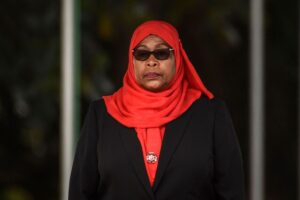
Look at Tanzania. President Samia Suluhu Hassan officially won the 2025 election with about 98 percent of the vote. Yet the African Union’s own observers concluded that the election failed to comply with AU democratic standards. They documented ballot stuffing, restrictions on observers, an internet shutdown, and an environment poisoned by repression and political exclusion.
How about Côte d’Ivoire. Alassane Ouattara secured a fourth term with nearly 90 percent of the vote after two of his strongest potential opponents—Laurent Gbagbo and Tidjane Thiam—were ruled ineligible. And guess what the West does afterwards? International diplomacy continues. Trade continues. Strategic partnerships continue. The photographs continue. The handshakes continue. No sanctions, nothing! And Africans are then lectured about democracy. This is where the West’s credibility problem begins.
Europe and America cannot repeatedly tell Africans to change their governments democratically while treating democratic accountability as secondary whenever the government in question is strategically useful to them. You cannot preach constitutionalism in speeches and practice geopolitical convenience behind closed doors. And you cannot keep treating the consequences of African political crises as immigration problems while refusing to confront their causes as governance problems.
Cameroon’s Ambazonia conflict is now a decade. Thousands have been killed. Hundreds of thousands have been displaced. Communities have been devastated. The United States has certainly spoken about the conflict. Washington has condemned violence, imposed some visa restrictions, and repeatedly called for dialogue. But where is the diplomatic urgency proportionate to a conflict that has lasted for ten years?
Ambazonians are sometimes told that they must first become sufficiently united before meaningful international engagement can occur. But since when did perfect political unity become a prerequisite for international diplomacy? Which conflict zone possesses perfect unity? Not even in the case of America. America’s independence movement did not wait for perfect unity. Its leaders disagreed profoundly over separation, reconciliation, timing, and strategy—and nevertheless built the political coalition necessary to achieve independence.

But if sufficient unity is the yardstick here, why not consider Somaliland.
Here is a territory that has effectively governed itself since 1991, that is, thirty-five years. Somaliland has built institutions, maintained considerably greater stability than much of Somalia and conducted competitive elections, including a peaceful transfer of presidential power following its 2024 election. But for decades, virtually the entire international community still refused recognition.
Israel finally broke that wall in December 2025 by becoming the first country to formally recognize Somaliland. Yet the United States, the UK, and Europe continue to recognize Somalia’s territorial integrity, with Somaliland as part of it. So if unity among independence movements is the magic requirement, what exactly is Somaliland missing?
How many more elections? How many more peaceful transfers of power? How many more decades of self-government? Does anyone seriously imagine that after more than three decades Somaliland will simply wake up tomorrow and say, ‘Forget all this; let us return to Mogadishu?’
This exposes the deeper problem. Western foreign policy is not governed by democracy alone. It is governed by interests. Security interests. Commercial interests. Military interests. Mineral interests. And Geopolitical interests. They can talk about human rights and good governance, but they really don’t mean it. It doesn’t matter. It’s a CAMOUFLASH. And that is why nationalists who challenge the established international order quickly become international problems, while governments and rulers with terrible democratic records like those in Yaounde, Arusha, Yamoussoukro, among others, can remain valued partners.
Look at the controversy surrounding Burkina Faso’s Ibrahim Traoré. Whatever one thinks about military rule, and coups should never automatically be romanticized—however, his popularity among his own people, and many young Africans, tells us something important.

Many Africans increasingly believe the international system rewards obedience more reliably than democracy. That perception is dangerous. Because when people stop believing ballots can change their governments, they begin searching for other instruments of change. And when peaceful political reform becomes impossible, instability becomes predictable.
Then the instability produces refugees/migrants. The migrants reach Europe and America. And suddenly the conversation begins at the border or the shore—as though history started when the migrant arrived there. No. The conversation must begin much earlier. It should begin with governance. It begins with elections. It begins with dictatorships. It begins with international powers deciding whether African democracy matters even when democracy threatens their preferred political arrangements.

You cannot help preserve the conditions that push people out and then express outrage when those people arrive at your doorstep. You cannot embrace the government that pushed out the people and criminalize the immigrant. You cannot celebrate the ruler and deport the ruled.
And you cannot demand that Africans “fix Africa” while international diplomacy repeatedly cushions political systems that Africans themselves are struggling to change.

