

Author
Meredith Moran
Upcoming Events
Transforming Public Defense Operations for the Digital Evidence Era
2026 Fall Board of Directors Meeting and Building Better Futures: A County Leaders’ Symposium on Youth Outcomes
Related News
Counties reassess license plate surveillance amid privacy concerns
U.S. House introduces the Nonprofit Security Grant Program Funding Improvement Act to provide upfront security funds to nonprofits
Federal agency partnership creates new emergency alert for missing persons with autism
Key Takeaways
Jenny Singer-Rupp, a Boulder County, Colo., resident who lost her home in the 2021 Marshall Fire, stood in front of the U.S. Supreme Court Oct. 5, surrounded by environmental advocates and fellow Coloradans.
She traveled more than 1,500 miles to share her experience in the aftermath of the fire at a rally and press conference held before the Supreme Court heard Suncor Energy (U.S.A.) Inc. v. County Commissioners of Boulder County. She described the difficulty of navigating insurance claims and the years it has taken to recover and rebuild.
The Supreme Court opened its October 2026 term with the case. In it, Boulder County and the City of Boulder contend that oil companies should be held financially responsible, under state law, for local harms caused by climate change.
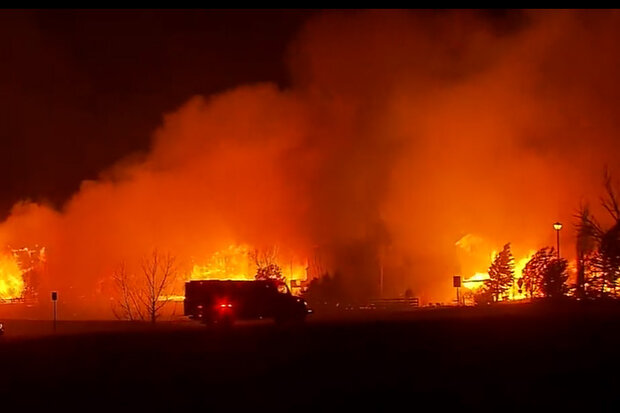
The Marshall Fire, which swept through parts of Boulder County, mainly the towns of Louisville and Superior, was the most destructive wildfire in county history. It led to roughly 37,000 evacuations, destroyed 1,109 homes and killed two people.
“I want my children to grow up in a world where they don’t have to wonder whether the place they call home will still be there tomorrow,” Singer-Rupp said. “I also want them to know that when something is wrong, we do not simply accept it. We stand up, we ask questions, we seek accountability and then we fix the problems.”
The county and city’s brief to the Supreme Court contends that ExxonMobil and Suncor Energy “intentionally misled the public” about the impacts of climate change and should pay for damage they say is caused by fossil fuels’ contribution to it.
All three Boulder County commissioners were in the courtroom for the argument. Afterward, on the steps outside the Supreme Court, they read a joint statement that alleges the community is already seeing current and future climate impacts, such as worsening air quality, wildfires, dangerous heat, historic flooding and drought.
“Roads and bridges washed away. Homes and communities burned down,” the joint statement reads. “And the impacts go beyond physical. They leave social and emotional scars — for the families forced to evacuate with only minutes’ notice, for workers whose livelihoods are interrupted, for the parents compelled to reassure worried children and for the public servants working around the clock to restore essential services.
“The costs are projected to climb higher for our families and our taxpayers. Faced with these rising costs, we ask, is it fair for communities to shoulder these costs alone? We believe it is not.”
The Supreme Court is not deciding whether Boulder’s allegations are true. It is considering two narrower questions.
First, does the court have jurisdiction to hear the case? Second, if it does, does federal law preclude Boulder’s state-law claims seeking relief for injuries allegedly caused by interstate and international greenhouse-gas emissions?
In 2018, Boulder County, the City of Boulder and San Miguel County sued ExxonMobil and Suncor Energy in state court. San Miguel County’s claims were later split off and are proceeding separately. The companies moved the case to federal court, but a federal judge sent it back to state court in 2019, and the 10th U.S. Circuit Court of Appeals agreed. The U.S. Supreme Court declined to review that decision in 2023.
In 2024, Boulder County District Court refused the companies’ request to dismiss the case. In 2025, the Colorado Supreme Court ruled 5–2 that federal law, including the Clean Air Act, does not preempt Boulder’s state-law claims. ExxonMobil and Suncor then asked the U.S. Supreme Court to overturn that ruling, with support from the Trump administration, which also argued on the companies’ side Oct. 5.
The companies argue that greenhouse-gas emissions are governed mainly by federal law, including the Clean Air Act. Allowing state tort claims, they say, would improperly intrude on that federal regulatory framework.
“If Boulder’s claims are allowed to go forward, some 90,000 municipalities across the country will have the ability to make national and international energy policy by asking juries to impose catastrophic damages on selected fossil fuel producers,” Kannon K. Shanmugam, a lawyer representing the companies, said in his opening statement before the Supreme Court.
Kevin Russell, the attorney representing the county and city, answered questions about the Clean Air Act. He said Boulder did not sue over emissions, which the Clean Air Act regulates. Instead, it sued over the companies’ alleged deceptive marketing, their production, promotion, refining and sale of fossil fuels, and their alleged concealment and misrepresentation of climate risks, none of which that law regulates.
“Since the founding, states have had the power to provide tort remedies for injuries occurring within their borders, even when the conduct causing those injuries occurred elsewhere,” Russell told the justices Oct. 5.
After the argument, it wasn’t clear whether a majority of justices would side with the oil companies or with Boulder. Justice Samuel Alito recused himself from the case without explanation. He has stepped aside from earlier oil and gas cases because of stock holdings. With only eight justices hearing the case, the vote could split evenly.
If the justices split 4–4, the Colorado Supreme Court’s decision would stand, allowing Boulder’s case to proceed. A decision is expected by summer 2027.
A win for Boulder would likely pave the way for dozens of similar lawsuits filed by local and state governments against major oil companies. A loss would set a precedent that federal law preempts state tort claims over climate change, handing a major legal victory to the fossil fuel industry.
“We believe we should have a fair opportunity to present the facts and allow a local court to determine whether the defendants have harmed Boulder County,” Boulder County Commissioner Claire Levy read on behalf of the commission, in front of the Supreme Court after the Oct. 5 hearing.
“And if so, whether they should be required to pay their fair share of the damage. We urge the Supreme Court to allow our case to continue.
“No matter the outcome, the City of Boulder and Boulder County will continue to do our part. We will continue to prepare, to adapt, to reduce our emissions and to invest in a safer and more resilient future. Because that’s our job as local government — to create safe and livable communities for our taxpayers.”
- Justice & Public Safety
Related News
Counties across the country are grappling with how to address mass public backlash against local governments’ use of Flock cameras and other automated license plate readers.
The U.S. House of Representatives introduced the Nonprofit Security Grant Program Funding Improvement Act to provide advance funding to nonprofits receiving federal awards for security improvements.
Health Secretary Robert F Kennedy Jr. announced the development of the National Autism and Endangered Person Alert Initiative.

