Back to News/Environment & Climate Change
Environment & Climate Change
NASA Spotlights the Bijagós Archipelago as a Tide-Fueled Trove of Global Biodiversity
NASA satellite data reveals how extreme 7-meter tides in Guinea-Bissau’s Bijagós Archipelago sustain a globally critical sanctuary for 870,000 migratory birds and sea turtles.
SFStreamline Feed OfficialVerified
Jul 17, 2026
Updated Jul 17, 2026
Reading
Follow on Google News
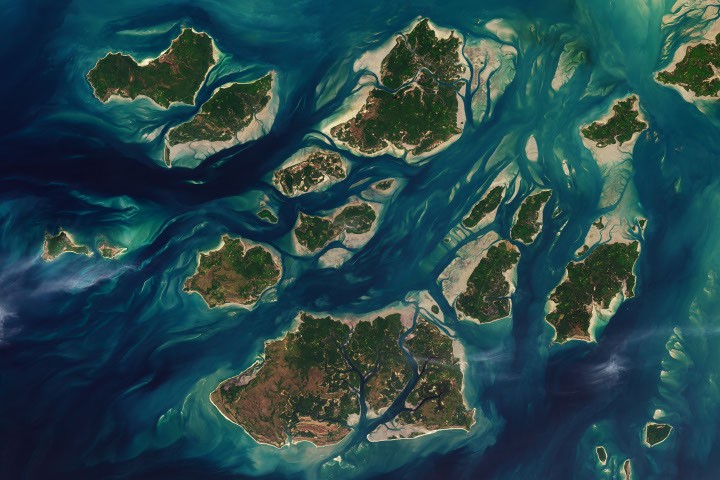
Twice every twenty-four hours, the coastline of the Bijagós Archipelago undergoes a dramatic and violently beautiful geographic transformation. The Atlantic Ocean retreats for kilometers, exposing a sprawling maze of sandy channels and nutrient-rich mudflats, before surging back to reclaim the land.
The National Aeronautics and Space Administration (NASA) has recently spotlighted this dynamic ecosystem off the coast of Guinea-Bissau, utilizing advanced satellite altimetry data to explain the mechanics behind one of the most biodiverse tidal zones on the planet. Recognized as a <a href="https://absafricatv.com/the-first-unesco-corner-was-opened-in-turkmenistan/” title=”The first UNESCO Corner was opened in Turkmenistan”>UNESCO World Heritage site, the archipelago is a critical sanctuary that demonstrates the fragile equilibrium between oceanic forces and terrestrial life.
The Mechanics of a 7-Meter Tide
The Bijagós Archipelago—comprising 88 islands and islets—is the only active deltaic archipelago on Africa’s Atlantic coast. What sets it apart is the sheer magnitude of its tidal fluctuations. A 2025 analysis of the region’s hydrology revealed that the archipelago experiences a staggering tidal range of up to 7 meters (23 feet).
To put this into perspective, the average tidal range along most of the West African coast is roughly 1 meter (3 feet). Researchers utilizing data from the NASA/CNES TOPEX/Poseidon, Jason-1, and Jason-2 satellites determined that the region’s exceptionally wide, shallow continental shelf, combined with the unique geometric funnel of the estuary, amplifies the tidal wave. This perpetual rhythm forces the islands to expand massively during low tide and shrink hours later, creating a highly specialized intertidal zone.
The extreme tidal shifts act as a biological engine, churning up river sediments, fostering coastal upwelling, and sustaining an outpouring of marine life. During low tide, the exposed mudflats offer a smorgasbord of marine worms, crustaceans, mollusks, and small fish.
This immense foodgrounds along the East Atlantic Flyway. UNESCO estimates that the ecosystem supports approximately 870,000 migratory shorebirds annually
- Tidal Range: Up to 7 meters (23 feet)
- Avian Population: 870,000 migratory shorebirds
- Geography: 88 islands forming an active deltaic archipelago
- Global Status: Inscribed as a UNESCO World Heritage site in 2025
As the high tide returns, the ecosystem transitions to serve a different cast of megafauna. Manatees, dolphins, and large schools of predatory fish push deep into the flooded mangrove forests. Simultaneously, tens of thousands of green sea turtles navigate inland toward the sandy beaches to establish nesting sites, particularly on the tiny island of Poilão, part of the João Vieira and Poilão Marine National Park.
The East African Coastal Parallel
For environmental policymakers and marine biologists in Mombasa, Kenya, or Dar es Salaam, Tanzania, the Bijagós Archipelago serves as a crucial comparative baseline. East Africa’s Indian Ocean coastline features its own fragile mangrove ecosystems and turtle nesting grounds, such as the Watamu Marine National Park.
Understanding how the extreme tidal mechanics of West Africa sustain such dense biodiversity provides invaluable insights into managing East Africa’s coastal resources. As global climate change accelerates sea-level rise and alters oceanic currents, the preservation of natural coastal buffers—such as the mudflats and mangroves detailed in the NASA report—has never been more urgent for the African continent. Both regions face the shared challenge of balancing localized economic development with the preservation of globally significant ecological heritage.
Space-Based Observation and Conservation
The integration of space-based observation tools has revolutionized marine conservation. The ability of NASA’s satellite infrastructure to precisely measure sea surface heights and map intertidal zones allows researchers to track minute changes in the ecosystem over decades. This data is critical for anticipating how the archipelago will respond to encroaching climate threats.
The survival rate of the archipelago’s green sea turtle hatchlings is exceptionally low—estimated at less than 1 percent reaching adulthood due to predation by crabs, birds, and large fish like barracudas and sharks. Preserving the exact environmental conditions that allow even this fraction to survive requires uncompromising data accuracy.
As the tides continue their relentless ebb and flow, the Bijagós Archipelago stands as a testament to the raw power of nature. Through the lens of orbiting satellites, the world is granted a clearer understanding of why this remote corner of Guinea-Bissau remains a vital organ in the Earth’s ecological circulatory system.
The documents, data and reporting consulted for this article. Links open the original material so readers can inspect the evidence directly.
- 01NASA Earth ObservatoryPrimary document
Primary
A Tide-Fueled Trove of Biodiversity in Guinea-BissauBy Adam VoilandPublished 17 Jul 2026Accessed 17 Jul 2026- • Bijagos archipelago features a tidal range of up to 7 meters.
- • Supports 870,000 migratory shorebirds.
- • Uses altimetry data from TOPEX/Poseidon and Jason satellites.
Hot discussions around this story
Keep the conversation in one place—threads here stay linked to the story and in the forums.
Fresh thread
No linked discussion yet. Start one without leaving this page.
Start a conversation about this story and keep it linked here.
E-sports and Gaming Community in Kenya
The Role of Technology in Modern Agriculture (AgriTech)
1030122Agriculture & Food Security
Popular Recreational Activities Across Counties
Investing in Youth Sports Development Programs
You Might Also Like
Naivasha’s Next Crisis: Will AI Cooling Drain Local Water Supplies?
Toxic Wildfire Smoke Paralyzes US Midwest and East Coast Cities