

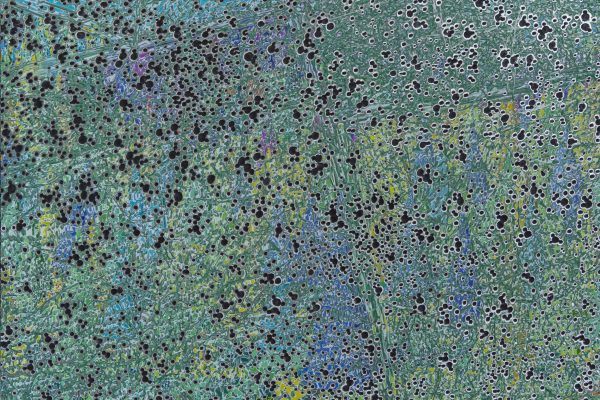
From the ‘Bombed’ series, 2023, by Oleksiy Sai. Image courtesy of the artist. The image shows an artillery-scarred landscape in eastern Ukraine resulting from Russian attacks. As a visual record of these marks, it could be read as a form of evidence in a tribunal addressing the crime of aggression.
- Symposium
- Special Tribunal for Ukraine
Realities of War, Ideals of Law
Introducing the Symposium on the Special Tribunal for the Crime of Aggression against Ukraine
Following Russia’s full-scale invasion of Ukraine in February 2022, international legal experts and policymakers have faced a critical accountability gap. While the International Criminal Court (ICC) has jurisdiction over war crimes, crimes against humanity and genocide committed on Ukrainian territory, structural limitations prevent it from prosecuting Russia’s leadership for the crime of aggression (Art. 8 bis of the Rome Statute), as Russia is not a party to the Rome Statute (Art. 15 bis (5)). Russia also holds veto power in the UN Security Council, therefore, traditional pathways to prosecute the Kremlin’s top officials have been blocked.
To close this accountability gap, Ukraine and the Council of <a href="https://absafricatv.com/europe-launches-e95m-semi/” title=”Europe launches €95m semi”>Europe established the Special Tribunal for the Crime of Aggression against Ukraine (the Tribunal) through a bilateral agreement in 2025, which includes its Statute in the annex. It is expected to be complemented by a multilateral framework for governance and financing, enabling the Tribunal to become operational. As such, the Tribunal’s character is unique and complex: it does not fit within the confines of a purely international nor a purely domestic court, nor a hybrid tribunal. As the crime of aggression is considered a “leadership crime”, the Tribunal is specifically designed to prosecute only the highest-ranking politicians and military decision-makers who orchestrated the invasion in violation of the UN Charter.
Looking at the cost of life and heritage in Ukraine, the distance between the ideals of law and the realities of war reveal a troubling scene. Against this background, the establishment of the Tribunal marks a significant development in international criminal law. However, the Tribunal’s establishment has sparked intense legal, political, and philosophical debate among practitioners and academics, and not everyone has welcomed it. The discussions surrounding the establishment of the Tribunal highlight the need to adapt international legal mechanisms and the structural limitations of the existing framework to address the crime of aggression.
The Symposium contributions invite us to reconsider what international law can offer in the face of aggression, and whether new approaches might narrow the distance between law and war. One dimension the Symposium takes up is the criminal responsibility of those who lead the war. Several contributors observe that the effective prosecution of high-level perpetrators faces a considerable obstacle in the form of personal immunities. Obstacles that have stood in the way of full accountability before international courts and tribunals, such as immunity and jurisdiction, are here re-imagined by the authors both within and beyond the existing framework of international law.
At the same time, another dimension reflected in the Symposium’s contributions is the tension between the universalist claim of international law and its selective application in practice. The selectivity inherent in creating a Tribunal with jurisdiction limited to Ukraine – which has itself raised significant criticism regarding “double standards” – is accompanied by more subtle forms of selectivity that are incorporated in the design and structure of the Tribunal itself. For instance, despite international recognition of the crime of aggression as a serious breach ofius cogensnorms, personal immunities continue to apply within the framework of the Tribunal, highlighting the apparent contradiction between the alleged universality of certain fundamental norms and their selective application. Additionally, is the Tribunal best understood as a manifestation of international law’s universal condemnation of aggression, or merely a limited exercise of Ukrainian state jurisdiction, delegated to an internationalised body? These questions are among those addressed by contributors, who recognise the establishment of the Tribunal as an achievement in its own right, even as they consider the implications of its limitations.
Furthermore, the narrow focus of the Tribunal, namely, the prosecution of “persons who bear the greatest responsibility for the crime of aggression against Ukraine”, raises questions as to the Tribunal’s legitimacy in an international legal order increasingly shaped by victim-cantered justice. Yet beyond questions of doctrine lies the very affective and physical human aspects of international justice. The contributions also address how the Tribunal might give expression to this aspect, whether through victim participation, or the application of community-interest norms and human rights.
Over the coming week, the Symposium contributions will shape a new, distinct, and hopefully inspiring view on what the Tribunal will be able to achieve and how it will situate within the broader international criminal justice framework. The Symposium progresses thematically, starting today with two contributions on core legal concepts: jurisdiction and applicable law.Julian Schophausargues in favour of reading Article 1 of the Statute as expression of the delegation theory and situates the Tribunal vis-à-vis theMonetary Goldprinciple.Meraj Ahmadinquires further into how and to what extent human rights considerations penetrate the criminal realm through Article 3 of the Statute, comparing this provision with Article 21(3) of the Rome Statute.
On day two, we move on to the topic of immunities withDiego Uribe Bustamanteexemplifying their effects through a thought-provoking piece on the interface of community interests and the crime of aggression asius cogens.Yasin Deregives us a doctrinal and historical account of personal and functional immunities and analyses the somewhat opaque two provisions of the Tribunal’s Statute on this subject, arguing that they relate to different moments in time.
Day three sees us entering the realm of comparative analysis, with a piece byChuka Arinze-Onyiaon the Extraordinary African Chambers’ institutional structure.Miraz ChowdhuryandMahamodul Hasantake us to the world of asylum law. We also shift here from doctrinal analysis of procedural questions to an account of the effects a judgment of the Tribunal may have, specifically for the case of Russia’s military draft evaders.
Day four is reserved for a topic which has, rightfully, become inescapable since the drafters of the Rome Statute included it in 1998: victim participation and representation.Garima TiwariandHimani Jhaspell out the difficulties of aligning a leadership crime with the considerations necessary for meaningful victim and civil society engagement. This is complemented byEric Belgorodski’spiece which dives deeper into the question of victim representation as foreseen in Article 22 of the Statute.
On the final day of our Symposium, we take a step back. Two very different pieces will end the week: Firstly,Thore Kohltakes us on a journey of critical legal theory, asking the reader to engage with the conflict between indeterminacy and universality, notions observable throughout both genesis and structure of international criminal law. We end the Symposium with a piece by a Ukrainian voice, judgeNataliia Iakusha, who through her frank account allows us to understand the Tribunal in its larger context, for what it is: A piece of an answer to a war which has been ongoing since long before 2022, waged by people capable of escaping accountability with ease. This final contribution reminds us not to look only to The Hague for answers, but to build resilience for the upcoming institution which will surely be under attack as of the moment of its inception.
We invite you to join us on this intellectual trip during the next few days, and we hope that you will find inspiration, as did we throughout the process of curating this Symposium.

Marie-ChristinManke
Tags
International Criminal Court, Russia, Ukraine

