

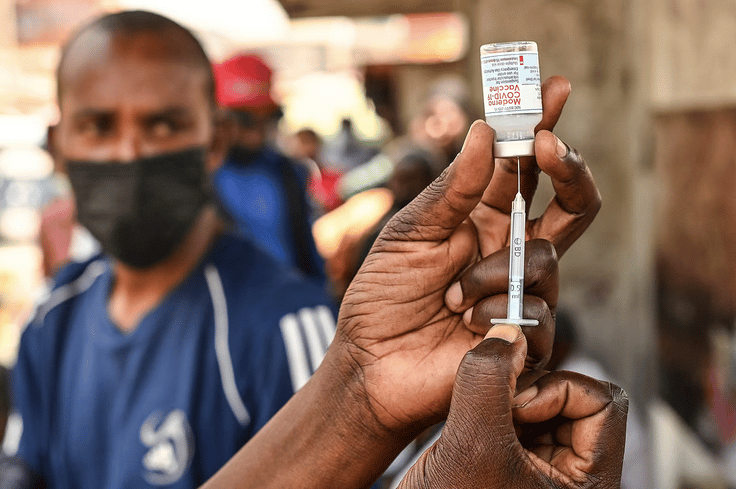
Africa has too few vaccines but too many vaccine factories.
The continent still accounts for about 1% of the vaccines it uses, the same share as when Covid-19 left it waiting months for doses hoarded by richer countries. Yet the plants built since are running at 30% to 40% of capacity, and more are on the way.
“When you look at the vaccine space, you talk about 38 vaccine projects on the continent,” Skumbuzo Ngozwana, director of local manufacturing at the Africa Centres for Disease Control and Prevention (Africa CDC), said in an interview. “There’s clearly overcapacity for some of these vaccines.”
That paradox is why Africa is missing its targets. Projects crowd into the same few products, and few earn the quality approval needed to sell to major buyers. The African Union agency responsible for coordinating the sector has no authority to say no. With health funding at a 14-year low, the goal of producing 30% of the continent’s vaccines by 2030 seems out of reach.
READ MOREHow Trump is leveraging aid to access Africa’s pathogen data
The issue was taken up at the International Conference on Public Health in Africa, which opened in Addis Ababa on 23 November under the banner of health sovereignty. “We have not done a lot,” said Nyasha Masuka, a Zimbabwean public health physician. “Our progress is too little.” Abel Bizmantak, a researcher at Makerere University’s School of Public Health, sees at least a foundation: “What we have achieved so far is systems establishment.”
Advice, not authority
After the pandemic, the AU set a goal to produce 60% of Africa’s vaccines on the continent by 2040, with interim targets of 10% by 2025 and 30% by 2030. Africa CDC leads the strategy but lacks enforcement powers.
“Ultimately, the decision about who invests what where is made by private enterprise,” Ngozwana said. “We cannot tell countries not to invest. We can guide, we can advise.”
Governments compound the problem because several want national capacity rather than relying on a neighbour’s. A 2023 analysis by Boston Consulting Group found that if every announced project became fully operational, Africa’s fill-and-finish capacity – the final step of putting vaccine into
A plant is not a product
Gavi, the global vaccine alliance, and Unicef purchase most of the doses used in Africa’s public immunisation programmes. Both require prequalification by the World Health Organisation, a process that can take years. Gavi projects that only three African vaccine makers will receive it within five years.
READ MOREHow China uses health diplomacy to expand its influence in Africa
Gavi’s $1.2bn African Vaccine Manufacturing Accelerator (AVMA) pays manufacturers when a priority vaccine is prequalified and tops up each dose sold through a UNICEF tender. That rewards the few that reach the market, not the many still building. AVMA has helped broker 13 technology-transfer deals, leading to commercial-scale plants in six countries. But papers for Gavi’s July board meeting say milestone payments have been delayed by regulatory constraints and technical setbacks.
Idle plants, higher prices
Operating below capacity spreads fixed costs over fewer doses. African firms still import their active pharmaceutical ingredients, equipment, and excipients, mostly from India, China, and Europe. Ngozwana estimates that African-made products start 15% to 20% more expensive than imports.
And money is shrinking. The Institute for Health Metrics and Evaluation estimates that global health funding will fall to $42.6bn this year, the lowest level since 2012. The US cut its health development assistance by about 45% between 2024 and 2026. Most African governments still fail to meet the 2001 Abuja Declaration pledge to allocate 15% of their budgets to health.
“Most of the time, ministries of finance see money put in health as a waste,” Masuka said. “Funding is a political choice.”
Buyers before builders
For new money, Africa CDC steers investors and technology partners towards products where competition is thin. That includes medicines and diagnostics, which the target now also covers. Ngozwana said Africa produces about 30% of the essential medicines it needs, and the figures for diagnostics are equally low.
For already-built plants, the answer is volume. The African Pooled Procurement Mechanism (APPM) pools orders from AU member states, enabling manufacturers to bid for continental contracts. Heads of state endorsed it as a “Buy African” tool in February. In May, it concluded its first tender for 10 medicines for maternal and newborn health.
We are being complacent because there’s no outbreak right now. Have this conversation again when there’s another outbreak
Firms that added capacity during Covid lost orders once Covid passed. “African manufacturers were encouraged to invest, and after the need disappeared, people just ignored them,” Mariatou Tala Jallow, the APPM’s director, said in September.
READ MOREWhy COVID-19 vaccines pose ‘equity and social justice concerns’
Bigger orders would let companies buy inputs in bulk and run larger batches, Ngozwana said. “It starts with giving them the volumes that they need, and the price will naturally follow.” He points to India’s generic drug makers, whose antiretroviral prices fell as they scaled up. Until then, he wants governments to pay more. “The cost of not doing that is another exposure when the next pandemic comes, and again we find ourselves at the back of the queue.”
What’s next
Gavi’s board meets in December to consider changes to AVMA’s payment terms. The first African-made vaccines it supports could be deployed as early as 2027.
Whether governments act before the next emergency is another matter. “We are being complacent because there’s no outbreak right now,” Masuka said. “Have this conversation again when there’s another outbreak.”

