

The News
African countries must open up their power markets in order to court the private investors needed to supply the electricity that AI will demand, a data center executive told Semafor, as a new report warned the continent risks seeing little economic benefit from the technology.
Africa’s economy is barely expanding on a per capita basis, and household living standards are stagnant across the continent. With the labor force projected to almost double by 2050, many African governments fear growing unemployment in the next few years. AI, as in other parts of the world, offers an opportunity to drive economic growth. But Africa only hosts about 160 data centers — around 5.5% of the global total — and aging grids in many African countries mean access to power, the key driver of AI infrastructure expansion, is limited.
In Africa, independent power producers typically sell electricity to state utilities under long‑term power purchase agreements. But private‑to‑private supply — in which a private generator sells directly to an industrial or commercial buyer using the grid, a practice that is commonplace across the West — remains rare on the continent.
In an interview, Robert Skjødt, CEO of Raxio, a data center company that operates in six African countries, said that in many nations, regulatory reform was needed to “allow a private supplier of electricity to supply to a private buyer” while using the grid.
The potential upside is significant: The International Monetary Fund, in a paper published on Tuesday, said AI could make sub-Saharan Africa’s economy around 4% bigger over the next decade than its baseline projection — but that requires better electricity supply, internet access, and digital skills. Policymakers and business leaders have long warned that Africa’s power shortfall in particular, if left unaddressed, would starve energy-hungry data centers of the electricity needed to digitize economies.
Alexis’s view
Power is inextricably linked to Africa’s digital evolution. The infrastructure needed to drive everything from online payments and logistics platforms, to tax systems and health services requires continuous operation of data centers to ensure uninterrupted service.
Yet around 600 million people across sub-Saharan Africa — roughly half the region’s population — lack access to power. Unreliable electricity provision stands out as the main reason the IMF ranks sub-Saharan Africa lowest on its global AI Preparedness Index. The lender’s models suggest the economic impact of AI over the next decade will be negligible in sub-Saharan Africa if power provision remains sclerotic.
The importance of electricity is no secret, but less is said about the policies that could ease bottlenecks in providing the power needed for the continent to reap the rewards of the AI revolution. The lengthy process of constructing power plants, for example, involves planning permission, commissioning, and construction, and the same goes for building data centers. For that reason, policies that unlock access to energy are crucial.
As Raxio’s CEO suggested, South Africa shows the potential impact of energy reforms. The country launched its Energy Action Plan policy in 2022 to resolve a crisis that forced authorities to ration power in planned blackouts, known as loadshedding. South Africa has in recent years seen a surge in private energy generation since the wide roll out of power purchase agreements. The policy shift is widely credited with improved power generation, including a sharp rise in renewable energy, that has reduced the pressure on state power utility Eskom and helped end loadshedding.
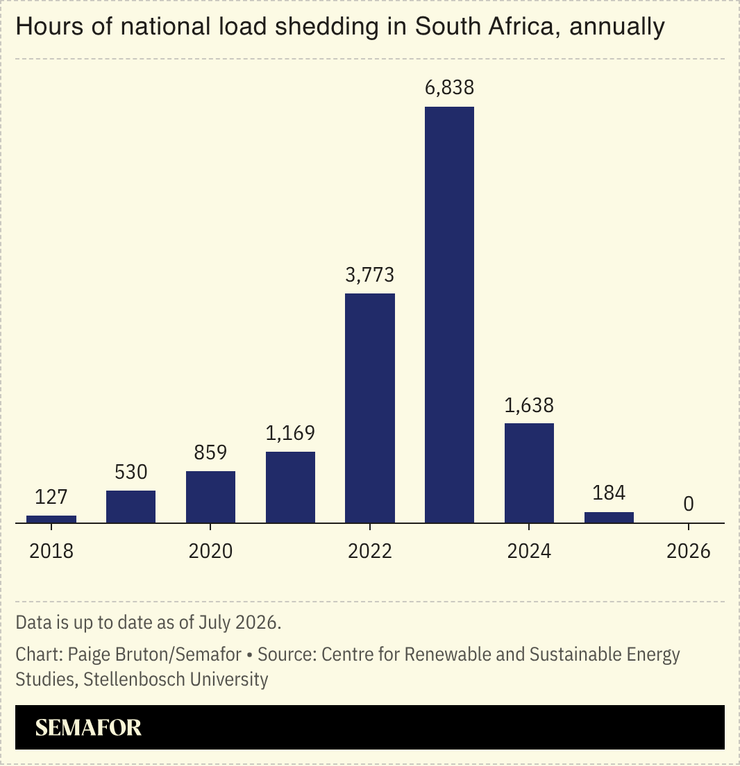
Both Kenya and Nigeria — two of the continent’s largest economies — are now carrying out similar reforms.
But, Skjødt said, such policy changes “take time” to make an impact. “It’s a necessary discussion now to prepare for the future, if you want to have, as a nation, large-scale digitalization,” said Skjødt, whose company last year secured a $100 million investment from the International Finance Corporation to expand its network of data centers in Africa.
And just as mobile phone use evolved in Africa in different ways from other parts of the world, spawning earlier and more prolific adoption of digital payments, AI use and deployment will differ. And it will also vary across an entire continent.
But power is a common constraint that cuts across the continent’s borders. Overcoming that challenge will require a mix of solutions and an understanding that one size really doesn’t fit all.
Know More
The issue of a lack of energy required to power data centers was highlighted in May when Kenyan President William Ruto, confirming a story first blamed inadequate power capacity when explaining why a $1 billion geothermal energy-powered data center project by Microsoft and UAE’s G42 was unlikely to go ahead
Hardy Pemhiwa, the CEO of Cassava Technologies, separately told an event in London that improved energy provision would drive increased competition. “At its very base, the cost of AI is going to be the cost of energy,” said Pemhiwa, whose company last year announced a $700 million partnership with chipmaker Nvidia to build and upgrade data centers across the continent. “Whatever, we do with energy, so goes the cost of tokens.”
Martin Schindler, the lead author on the IMF report, concurred. “Broad access to reliable electricity has always been an important policy recommendation. And it just is doubly so now — without electricity, nothing happens,” he told Semafor.
Room for Disagreement
Investment related to digital infrastructure is a high-risk gamble that could divert scarce public re local employment and creating long-term fiscal problems, Kyle Volpi Hiebert, visiting fellow in the Digital Policy Hub at the Centre for International Governance Innovation research body in Canada, argued recently
“Simply locating data infrastructure on the continent does not signify progress toward greater digital sovereignty,” he wrote, adding: “Political unrest could emerge if citizens feel their leaders are prioritising costly vanity projects over improving healthcare, education, security and basic services.”
Notable
- Chinese leader Xi Jinping has cast Beijing as the leader of a new AI global order, warning that “new historical injustices” were emerging from unequal access to the technology.
