

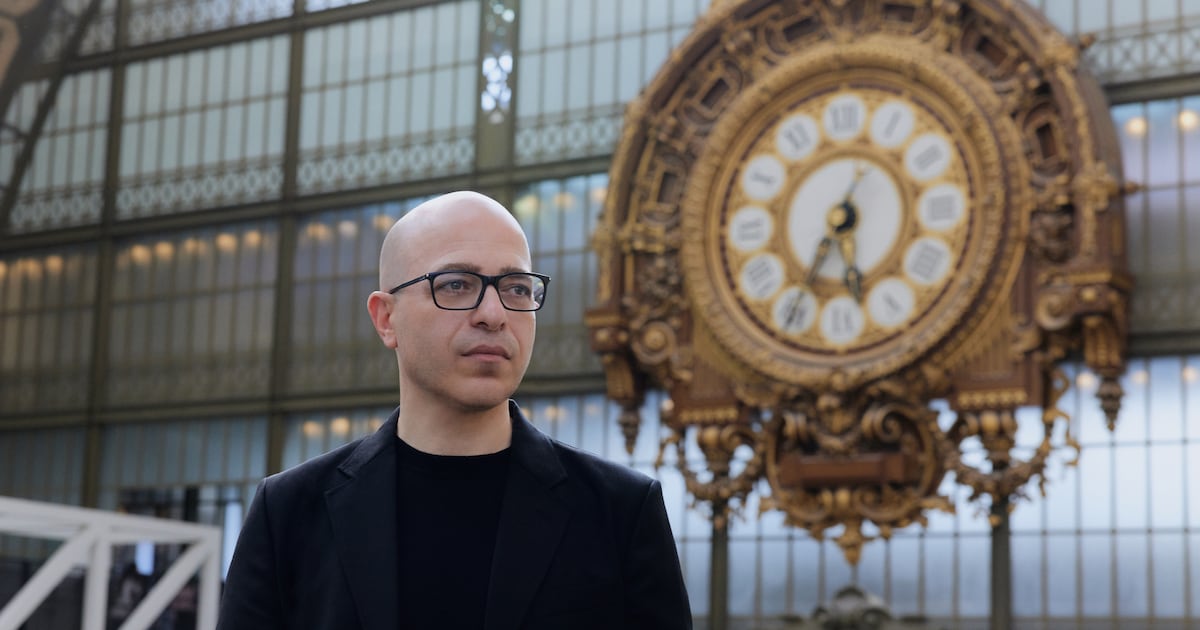
In the Musee d’Orsay’s Orientalist galleries, Youssef Nabil’s photographs at first appear almost modest. They are smaller than many of the paintings around them, their colours softer and their subjects often caught alone, asleep or gazing beyond the frame.
Yet they are not overwhelmed by the grand canvases surrounding them. Their intimacy gives them a different kind of force. If the Orientalist paintings offer a third-person vision of the Middle East and North Africa – assembled through foreign observation, imagination and fantasy – Nabil answers with a first-person gaze shaped by his own complicated relationship with his homeland.
De Rever Encore, or To Dream Again, is the first exhibition by a contemporary artist within the museum’s Orientalist galleries. The choice of Nabil is particularly meaningful. The Franco-Egyptian photographer and filmmaker first visited the Musee d’Orsay in 1992, when he was 19 and had never previously left Egypt.
Pierre Puvis de Chavannes’s 1883 painting The Dream made the deepest impression. A sleeping man lies beneath a tree as three figures representing love, glory and wealth appear above him. Nabil later recreated the composition in his 2021 work The Dream, Self-Portrait, inserting his own sleeping figure into the scene.
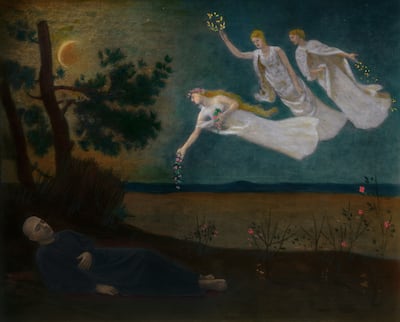
Its inclusion here completes an unusually satisfying circle. A young Egyptian who once stood before the painting imagining an artistic future now hangs beside it, claiming a place in the institution that helped shape his visual language.
In the Mena region, the word “orientalism” has come to have a mostly pejorative connotation. But, notably, the exhibition does not present that journey as a rejection of the museum’s collection. Nabil clearly understands the problems of Orientalism, particularly the unequal relationship between the artists from the West producing the images, and the people and cultures being represented. Yet he is also deeply drawn to the emotional and visual world they created.
There is affection in his work for the Orientalists’ melodrama and sensuality, their warm colours, elaborate fabrics and dreamlike stillness. Discussing artists such as Jean Lecomte du Nouy and Alexandre Cabanel, Nabil has described their paintings as depicting “a beautifully documented Orient, maybe fantasised, but which exists for me”.
That distinction is central to the exhibition. Nabil does not argue that the Orientalist fantasy was accurate, or that its history can be detached from colonial power. Edward Said’s landmark 1978 book Orientalism demonstrated how western depictions of the East helped construct an imagined, inferior “other”, allowing European powers to speak on behalf of the cultures they dominated.
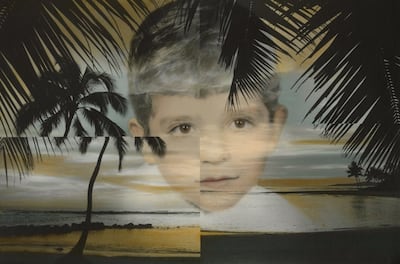
Nabil enters that fantasy from the other side of the spectrum. He uses many of the same visual codes, but his Egypt is personal rather than ethnographic. The figures are friends, artists, actors or versions of himself. Their theatrical settings come from the Egyptian cinema he watched as a child rather than a European traveller’s search for the exotic.
The resulting images can be kitsch, but deliberately and often movingly so. Nabil shoots in black and white before colouring every print by hand, using a technique he learnt from some of Egypt’s last studio portrait retouchers. The skin tones, bright reds and deep blues recall the publicity photographs and hand-tinted images associated with the golden age of Egyptian cinema.
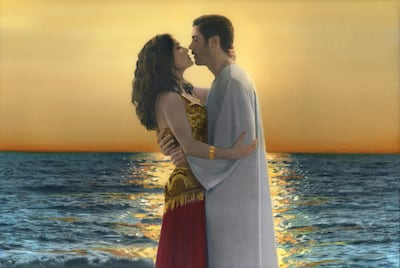
In person, that colouring gives the photographs an otherworldly quality. They appear as memories already altered by time. Even when the surfaces are glamorous, there is often something funereal underneath.
Nabil has said that he “discovered death through cinema”. As a child, he says films showed him that images could preserve actors long after their lives had ended. His photography performs a similar act, holding on to people and places even as it acknowledges that they will disappear.
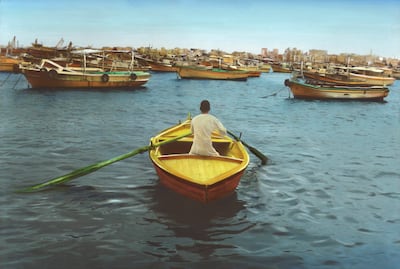
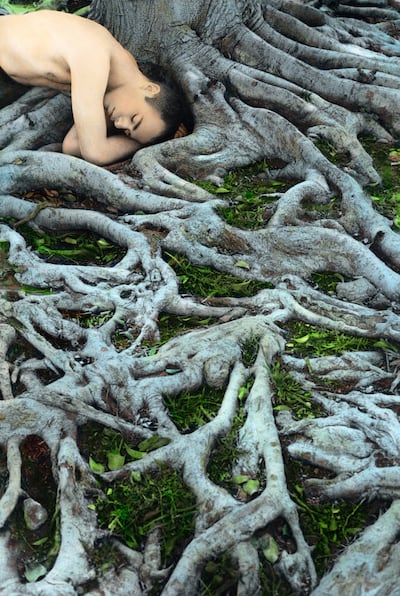
That is why his works hold their own so effectively beside the larger paintings. In Say Goodbye, Self-Portrait, Alexandria, Nabil faces the sea with his back towards the camera. In I Will Go to Paradise, Self-Portrait, Hyeres, his body appears suspended between departure and disappearance. Self-Portrait with Roots, Los Angeles places him asleep against the exposed roots of a tree, close to Odilon Redon’s similarly dream-bound Sleep of Caliban.
These are images of exile, although Nabil has resisted describing his departure from Egypt in 2003 as forced. He has said he left by choice after struggling to find room to develop photography as a fine art, obtain materials and work freely amid censorship involving the body. The emotional condition of exile remains present even if the biographical label is imperfect.
The museum prefers a gentler formulation. Its texts describe Nabil’s work as creating an idealised Mediterranean without borders, where eastern and western identities meet through dreams, sensuality and shared symbols. At its best, the exhibition supports that reading. His photographs move naturally between Cairo, Alexandria, Paris, Los Angeles and New York, carrying the same visual world with them.
There is also some curatorial wishful thinking. The idea of a borderless Mediterranean is easier to sustain within Nabil’s images than in the history surrounding them. The museum acknowledges cultural appropriation and the outsider gaze, but rarely allows those subjects to disturb the exhibition’s peaceful atmosphere for long.
Nabil’s inclusion also makes the Orientalist collection easier for the Musee d’Orsay to present. A regional voice has finally entered rooms that historically allowed Europeans to define North Africa almost entirely on their own terms. That change is worthwhile, but it cannot correct the broader absence of Arab artists from the western institutions and art histories of the period.
The exhibition instead adds context to the paintings while reinforcing their artistic value. That is not an insignificant achievement. Orientalist artists are often discussed as though the historical charge against the movement settles every question about the individual works within it. Their paintings remain entangled with empire and unequal power, but they can also show technical brilliance, serious curiosity and, at times, genuine affection for the cultures their creators encountered.
Nabil allows those positions to coexist. His response is unlikely to satisfy anyone seeking a furious rebuke of the galleries around him. At times, his fondness for Orientalist fantasy comes close to reproducing it, particularly in images of liberated femininity and in the 2015 short film I Saved My Belly Dancer.
Starring actors Salma Hayek and Tahar Rahim, the film imagines belly dancing as a disappearing art form that Nabil must preserve through dreams. Its strongest quality is its fantasy rather than any documentary account of the tradition. Yet preserving that fantasy is precisely the point. Nabil is trying to save the Egypt that cinema created inside him, whether or not it ever existed in that form.
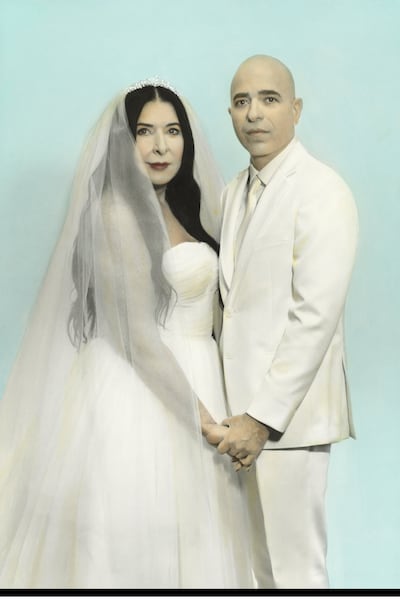
His more recent film, The Room, makes the themes of death and rebirth explicit. Serbian artist Marina Abramovic appears as an angelic figure who guides the artist from this life towards another world. The films state openly what the photographs often communicate more powerfully through suggestion: beauty is Nabil’s defence against disappearance.
The museum may have absorbed Nabil into its own mythology as readily as he has transformed it. Both readings hold. His photographs give the galleries a voice they previously lacked, while their presence allows the institution to frame its difficult inheritance through reconciliation rather than confrontation.
That ambiguity is the most honest part of To Dream Again. The exhibition recognises that art of lasting value often comes with a complicated history, made by people whose curiosity, talent and affection existed alongside their prejudices and blind spots.
Nabil does not clear away the Orientalist fantasy. He steps inside it, makes it personal and changes who is allowed to speak.
Youssef Nabil: To Dream Again runs at the Musee d’Orsay, Paris, until September 13
