

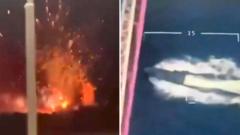
BENGHAZI, Libya — (ABS NEWS) Officials and satellite imagery show an explosion and fire at Benghazi port on 22 November that damaged a Russian-linked vessel moored for supplies, an incident Ukraine’s leaders publicly said was caused by naval drones.
Local eastern Libyan authorities reported an explosion at the naval base in the early hours while the ship was docking for fuel and supplies, and social media footage geolocated by BBC Verify showed a vessel engulfed in flames, according to BBC News reporting.
President Volodymyr Zelensky of Ukraine and the Security Service of Ukraine (SBU) said Kyiv had carried out the operation, with Zelensky saying seven naval drones struck and sank the corvette Merkury and hit a second ship he named MV ANGARA. Those assertions were reported by multiple outlets, including the Associated Press, but have not been independently confirmed by Russian defence authorities in public statements cited in available coverage.
Commercial satellite imagery cited by news organisations provides visual evidence of a burning vessel at the Benghazi berth early on 22 November and later images showing a partly submerged or capsized ship. BBC coverage attributed initial imagery to Planet Labs and higher-resolution images to a U.S. intelligence firm credited as Vantor, which analysts said showed a Project 20380 corvette moored on Saturday and largely capsized or sunk on Sunday.
BBC and other outlets also reported that Libyan local health officials said they had received people injured from a commercial ship that was targeted off the coast, but they cautioned that it was unclear whether that vessel was the same one named by Kyiv. Casualty numbers and nationalities remain unsettled in open reporting; news organisations treating official counts as provisional.
The UN Support Mission in Libya (UNSMIL) issued a statement expressing “serious concern” over the attacks and called for an immediate, independent and transparent investigation, warning against Libya becoming a battleground, the UN mission said.
Libya remains divided between a UN-recognised government in Tripoli and an eastern administration allied with military commander Khalifa Haftar. Both Tripoli and eastern authorities condemned the incident, with Tripoli’s foreign ministry saying Libya would not accept being drawn into foreign conflicts and forbidding foreign forces from using Libyan ports for military activities, BBC and Associated Press reporting said.
The incident follows a separate reported drone strike on a Russian-linked cargo vessel, Sparta II, in the Gulf of Finland on 21 November. Finnish authorities and Reuters reporting said Ukraine was “likely” behind that strike; Kyiv had not commented on the Baltic incident at the time of those reports.
Commercial imagery and open-source verification underpin much of the visual evidence cited by reporting, but experts and newsrooms note limits to conclusive attribution without on-site forensic inspections or admissions from the Russian Defence Ministry. Russian officials initially took a guarded public posture: Kremlin spokesman Dmitry Peskov said further details would come from Russia’s Defence Ministry but declined to comment directly on the Libya strikes, according to reporting.
Analysts quoted in BBC and other coverage described the strikes as part of a pattern of maritime attacks that Kyiv has used to target Russian logistics and a so-called “shadow fleet” since 2022, affecting Russian economic and military supply lines.
Reporting from BBC News compiled social media verification and satellite imagery; Associated Press and Al Jazeera also provided contemporaneous corroboration of officials’ statements and imagery attributions. Open reporting continues to treat Kyiv’s claims that the corvette Merkury and the MV ANGARA were hit and that the Angara carried weapons as assertions pending independent confirmation.
Subscribe to our breaking news bulletin

