

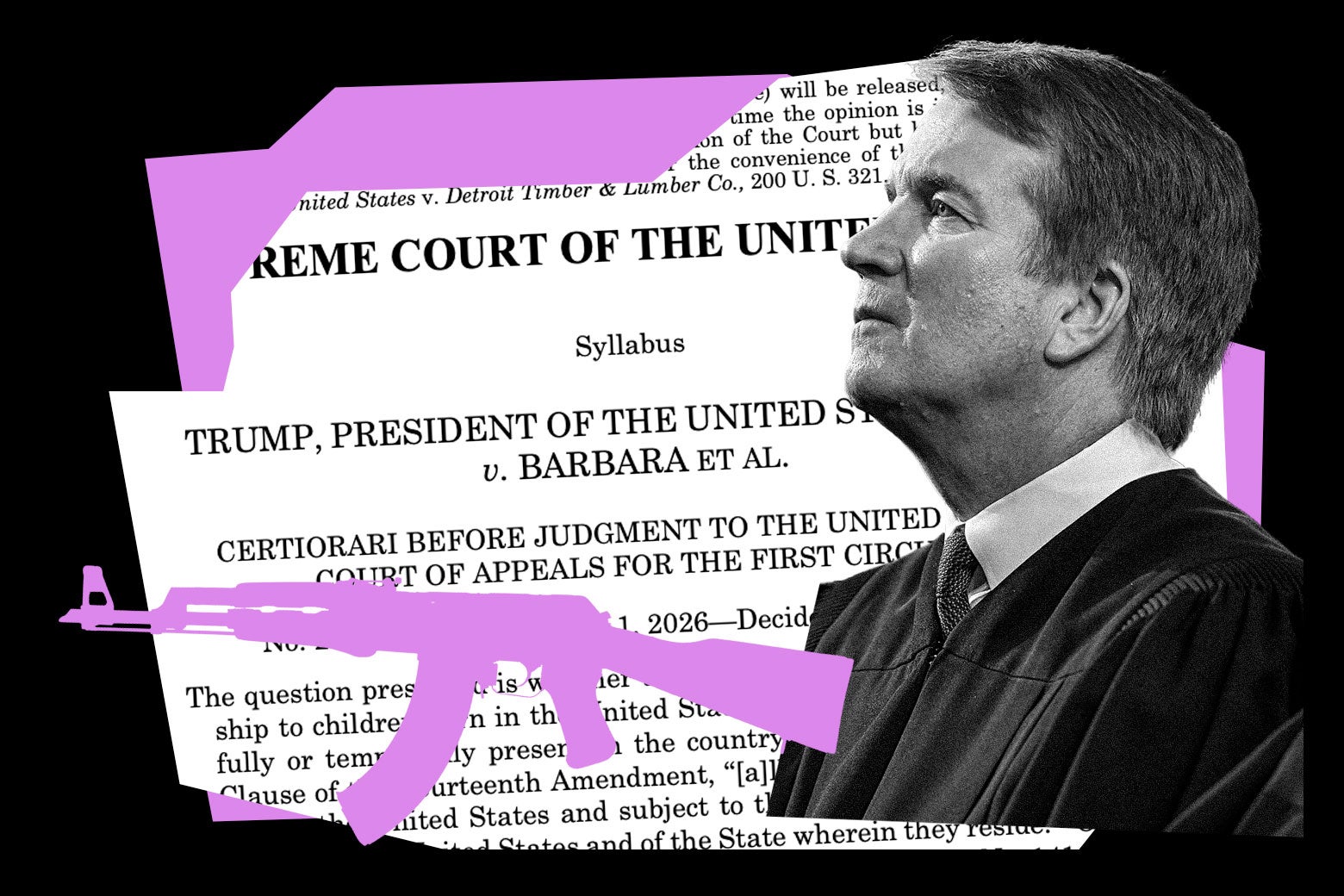
Of the six separate opinions the Supreme Court generated last month in Trump v. Barbara, the birthright citizenship case, Justice Brett Kavanaugh’s solo contribution was the quirkiest, and perhaps the most revealing. Aside from its grim implications for the court and potentially for birthright citizenship itself, Kavanaugh’s opinion did another big thing that has not really been discussed. Whether intentionally or not, he may have shown how the court can approve greater restrictions on firearms.
The outcome of Barbara turned on the word “jurisdiction” in the 14th Amendment, ratified in 1868, which provides that “All persons born … in the United States, and subject to the jurisdiction thereof, are citizens of the United States.”
Chief Justice John Roberts’ majority opinion was succinct and direct. Holding that “jurisdiction” plainly means “the power of the United States to govern those within its territory,” Roberts upheld the citizenship of nearly all children born in the U.S.
Justice Clarence’s Thomas’ principal dissent meandered through 91 pages of selective history before agreeing with President Donald Trump’s executive order that only the child of a legally “domiciled” parent qualifies for birthright citizenship. This is despite the fact that “domicile” does not appear in the 14th Amendment or the subsequent statutes.
In his opinion, “concurring in the judgment and dissenting in part,” Kavanaugh first agreed with the majority that the executive order’s limitations on birthright citizenship are invalid. But he premised his conclusion only on statutory grounds; specifically, the Nationality Act of 1940. He went on to agree with Thomas’ dissent that the Constitution itself does not grant birthright citizenship to “children born to foreign citizens unlawfully or temporarily in the country.”
Kavanaugh’s reasoning was intricate at best.
He conceded that the 1898 Supreme Court opinion in U.S. v. Wong Kim Ark granted citizenship to all children born in the U.S, with four narrow exceptions, comprising a “closed set” for constitutional purposes: the children of foreign diplomats or enemy invaders, those born on foreign ships in U.S. harbors, and certain Native Americans (all of whom were later granted citizenship by Congress).
Because the 1940 statute was enacted in light of Wong Kim Ark, said Kavanaugh, it codified the same closed set of exceptions, which Trump’s executive order could not change.
Now comes the revealing.
According to Kavanaugh, even Wong Kim Ark’s closed set of constitutional exceptions can be expanded to apply “to new circumstances” based on subsequent developments “largely unknown or unanticipated” by the Framers of the 14th Amendment.
One such circumstance, per Kavanaugh, is the advent of “significant illegal immigration,” which he believes the Framers of the 14th Amendment could not have anticipated and would not have approved. Another is the phenomenon of children born to temporary visitors, given “changes in immigration laws and travel.”
The implication of Kavanaugh’s approach to changed circumstances is undeniable. It stands in distinct contrast to the Supreme Court’s recent rulings on gun control, which have discounted changed circumstances as sufficient to justify restrictions on the right to bear arms.
If developments in lawbreaking (unauthorized immigration) and technology (air travel) are sufficient to create new exceptions to the 14th Amendment, why can’t the same hold true for the Second Amendment?
Recent times have certainly seen developments in the scale of possible lawbreaking, with recurring mass shootings in schools, at shopping centers, and houses of worship that would have been unimaginable in 1868.
Likewise, the invention of semiautomatic firearms, capable of firing faster than Civil War–era weapons by an order of magnitude or more, has had a far greater impact on shooting victims (about 15,000 homicides and 85,000 nonfatal shootings annually) than air travel has had on what Thomas dubs “birth tourism” (estimates range from 9,000 to 20,000 births per year).
The majority opinion in New York State Rifle & Pistol Association, Inc. v. Bruen nodded slightly toward the relevance to gun control regulation of “unprecedented” societal concerns or dramatic technological changes, while specifically rejecting conventional “means-ends tests” or “interest balancing.”
Instead, firearms restrictions can only be upheld if “historical inquiry” identifies a “proper analogue” or “relevantly similar” regulation close in time to ratification, which turned out to be a challenging test indeed for gun laws. The court’s conservative supermajority has found few analogues that justify exceptions to the Second Amendment.
Kavanaugh, however, may have broken analytical, if not political, ranks with his Republican colleagues. His separate opinion in Barbara applied an exceptionally loose test for exclusions to birthright citizenship. He found Trump’s “exceptions for children born to foreign citizens unlawfully or temporarily in the country” to be supported by the new circumstances of immigration and travel, based on an extremely tenuous analogy to the closed set declared in Wong Kim Ark.
It remains to be seen whether Kavanaugh’s newfound flexibility on constitutional exceptions will apply exclusively to the denial of citizenship to innocent children.
We will soon have a chance to find out.
The Supreme Court recently accepted two cases involving bans on AR-15-style semiautomatic rifles. Will Kavanaugh vote to uphold the restrictions, perhaps bringing other justices along, based on recognition of new circumstances “unknown or unanticipated” by the Framers of the Second Amendment? Or will he revert to form, privileging gun ownership more than he values citizenship?
