

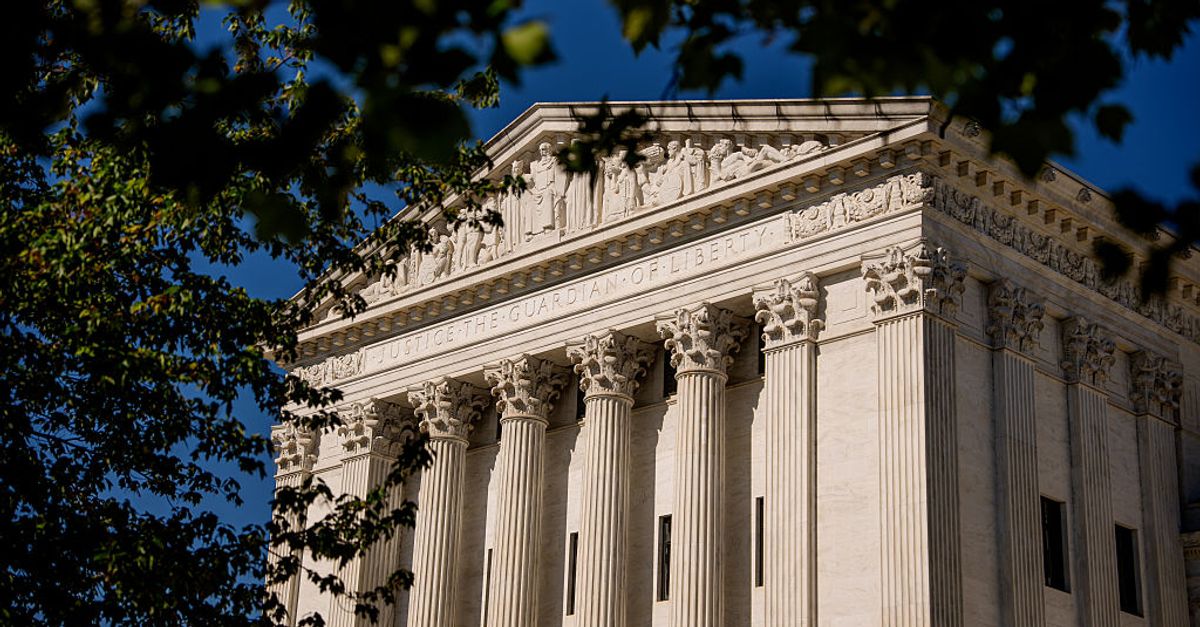

The Supreme Court on Friday evening turned down a request by Virginia’s attorney general and other Virginia Democrats to allow the state to use a new congressional map, which would have been expected to strongly favor Democrats, in the 2026 elections.
The denial came in a brief, unsigned order sent to reporters at 6:30 p.m. EDT on Friday – just 15 minutes after the court’s Public Information Office distributed the reply filed by Jay Jones, the Virginia attorney general, and Democratic legislators.
There were no public dissents from the order. The effects of the court’s order are likely relatively minimal, because Virginia Gov. Abigail Spanberger had already indicated earlier this week that the state would not use the 2026 map in the upcoming elections.
Jones and the other Virginia Democrats came to the Supreme Court on Monday, asking the justices to block a May 8 ruling by the Virginia Supreme Court that invalidated an amendment to the Virginia Constitution allowing the state’s Legislature to enact a new congressional map.
The Virginia General Assembly had adopted the new map in February. But before the state could actually use the map, it needed the state’s voters to approve an amendment to the Virginia constitution that would give the General Assembly the power to draw a new congressional map outside of the normal cycle following the decennial census. In April, voters approved an amendment to the state’s constitution that gave the General Assembly the power to do so. Nevertheless, a divided Virginia Supreme Court struck that amendment down on the ground that the Legislature had not followed the correct procedures when it put the new amendment on the ballot. The majority explained that under the state constitution, the Legislature must approve a proposed amendment to the constitution during two different legislative sessions, which must be separated by an election to the General Assembly’s House of Delegates. Although the Legislature had voted on the proposed amendment for the first time on Oct. 31, 2025, the majority said, more than 1.3 million votes had already been cast by then – and, therefore, “the General Assembly passed the proposed constitutional amendment for the first time well after voters had begun casting ballots during the 2025 general election.”
In their filing on Monday asking the justices to step in, Jay and the Virginia Democrats argued that the Virginia Supreme Court’s ruling “overthrows [a] democratic outcome just days before the Commonwealth must begin its preparations to administer the 2026 midterm election.” Moreover, they contended, the dispute implicates “two critical issues of federal law” – the meaning of the term “election” under federal law, and the idea that the state court so “impermissibly transgressed the ordinary bounds of judicial review” that its ruling should be reversed.
The Republican legislators (along with an election official and two individual voters) who challenged the new map countered that the request to block the state supreme court’s ruling was “extraordinary.” They emphasized that the case involved “state courts applying state law to hold state actors accountable” – and is thus not one in which the U.S. Supreme Court should intervene. To the extent that Jones and the Democrats now argue that the case involves federal issues, they added, the U.S. Supreme Court should not consider them because they did not raise those issues until they reached the Supreme Court.
In a filing on Friday afternoon, Jones and the Democrats pushed back, telling the justices (among other things) that “Spanberger’s candid acknowledgment of where things presently stand, which is not part of the record, does not foreclose this Court from acting.” Instead, they argued, her comments merely indicated that “the Commonwealth will conduct its elections in the manner the law requires, and this Court’s intervention will inform that conduct.”
Soon after the filing was submitted on Friday, the court denied the request by Jones and the Virginia Democrats without comment.

