

In the high seas off west Africa, a fisherman on a Chinese longline tuna vessel cuts the fins off a live shark before throwing it back in the water to suffocate and drown
Its lucrative appendages will be landed at the port of Dakar before being shipped onward to Asia for use in shark fin soup, a delicacy in certain countries, or traditional medicine.
Finning, the practice of removing fins and casting the rest of the shark overboard, often alive, is largely prohibited across a variety of regulatory zones, countries and international conventions, even if fishing certain shark species is generally allowed.
Yet in recent years, illegal shark fins have been repeatedly landed in Dakar, one of Africa’s busiest fishing ports, by dozens of Chinese and Taiwanese longline tuna vessels, according to a report released Thursday by the London-based Environmental Justice Foundation NGO.
Rapid population decline
Finning increases vessels’ profitability, but also incentivizes catching sharks, whether directly or as bycatch.
The practice is inherently cruel and wasteful, conservationists say, likening it to killing a rhinoceros for its horn. But brutality is not the only problem.
Global shark populations have been in rapid decline due to industrial fishing, with a study published in the journal Nature showing their population has plummeted, alongside that of their close relatives rays, 71% since 1970.
Not only does finning further deplete shark populations, but it often occurs in tandem with other types of illegal, unreported and unregulated fishing and human rights abuses.
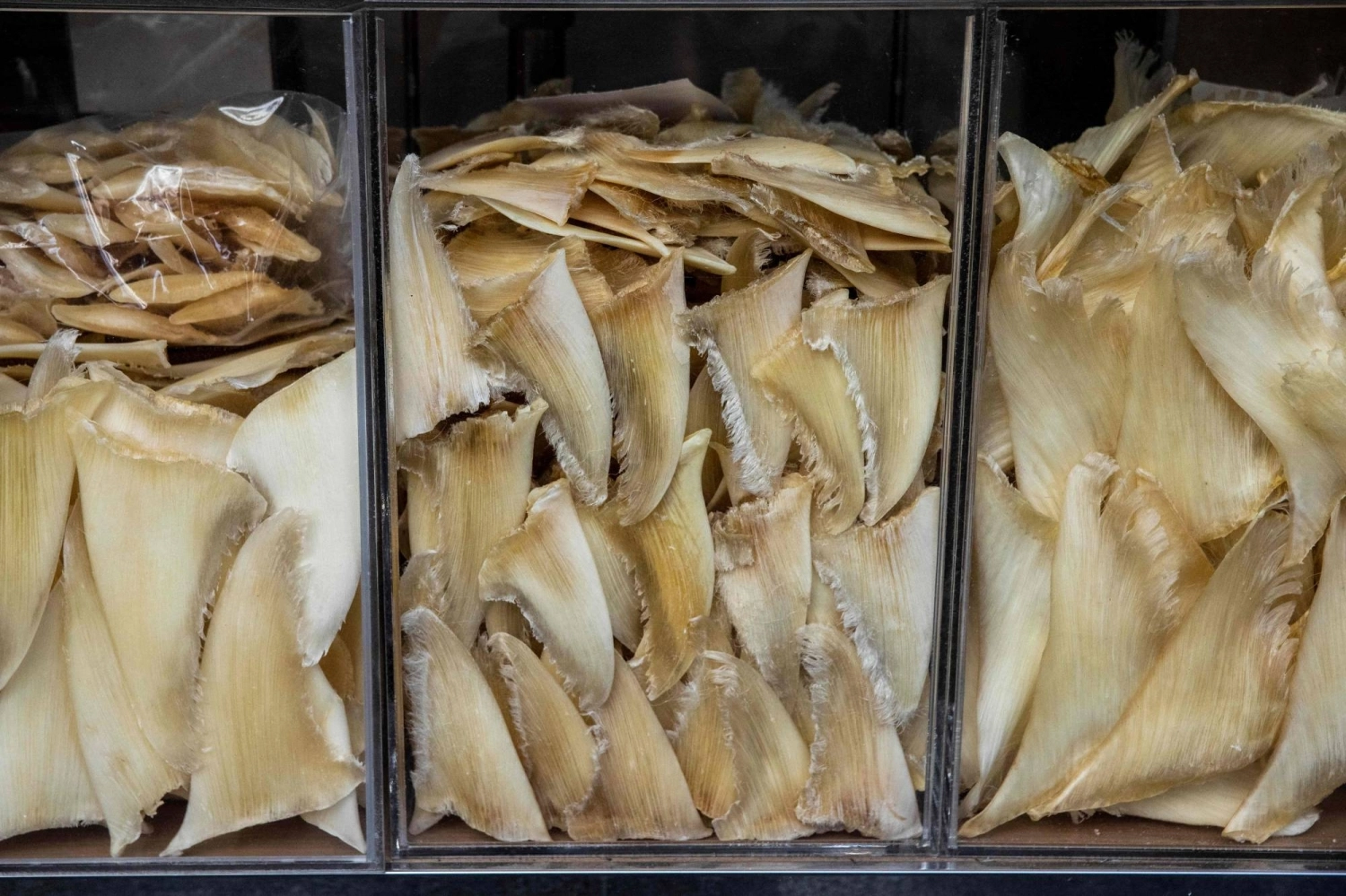
Shark fins on display at a shopfront in Hong Kong in 2022.
| AFP-JIJI
The EJF study focused on Chinese and Taiwanese distant water longline tuna vessels authorized to fish in the Atlantic, two of the largest fleets of their kind and traditional shark finning culprits.
Reverse engineering the situation, researchers spoke with 124 Indonesian and Filipino fishers who worked on the boats between 2020 and 2025.
A total of 71 of the two Atlantic fleets’ 130 vessels visited Dakar during that time. According to fisher testimony, 41 of the vessels participated in shark finning.
Of those 41 vessels, 24 had landed fins in Dakar, they said.
That number, EJF’s head of ocean research Callum Nolan said, is likely even “higher” given that the data set includes only explicit mentions from wide-ranging interviews.
Like ’theft’
Senegal is a party to the International Commission for the Conservation of Atlantic Tunas (ICCAT), which regulates fishing operations related to tuna and tuna-like species in the Atlantic Ocean.
Not only does ICCAT ban the retention of certain species of sharks, but it also specifies that fins cannot total more than 5% of the overall weight of sharks onboard. The rule is meant to prevent finning, but makes things difficult to quantify.
AFP spoke with one of the Indonesian fishermen from EJF’s report, Jamaludin, at a village outside the coastal city of Cirebon on Java island.
Jamaludin, a former crew member of a Chinese fishing vessel, shows a photo on his phone screen displaying shark fins at the traditional port of Bungko Lor hamlet in Cirebon, West Java, Indonesia, on June 10.
| AFP-JIJI
The 29-year-old, who goes by only one name, worked aboard a Chinese-flagged tuna vessel between 2018 and 2020, which he said took far more fins aboard than bodies with fins.
After cutting sharks “daily,“ he said the crew unloaded fins at Dakar separately and “discreetly.”
“If there were police, the unloading was delayed,“ he said.
Other fisherman recounted similar scenarios to EJF, including that fins were often disembarked after dark.
“The catch was unloaded first, whereas the fins were (unloaded) secretly … at night” one Indonesian fisher, who worked on a Chinese-owned longliner from 2024 to 2025, told the NGO, describing the operation as like “theft.”
Cheikh Ndiaye, an inspector with Senegal’s Directorate of Fisheries Protection and Surveillance, said malfeasance was more possible at night when “sometimes there are not many people at the port” and recommended that international observers monitor fishing on such boats.
Extinction possible
As apex predators, sharks regulate the sea and are “fundamentally important for the ecological integrity of our oceans,“ EJF CEO Steve Trent said.
According to the International Union for Conservation of Nature (IUCN) Red List, 70% of pelagic sharks are threatened with extinction.
Meanwhile an estimated 80-101 million sharks are killed as a result of fishing activities each year.
Longline tuna vessels release a line of hooks that can stretch kilometers, catching far more than just tuna.
Greenpeace observers off West Africa in March watched one longline tuna vessel catch eight sharks in 12 hours and another catch 32 sharks in 11 hours, the NGO said, including apparent finning on the second vessel, which was Spanish-flagged.
’Literally impossible’
Disparate and difficult-to-enforce rules across fish management zones, countries and treaties, make finning “literally impossible” to police effectively, Iris Ziegler, head of fisheries policies and ocean advocacy at German marine NGO DSM, said.
She advocates for a “fins naturally attached” global policy to target the “specifically cruel, wasteful way” of fishing.
The method, also advocated by EJF, would dictate fins remain on a shark’s body upon landing, effectively preventing finning.
It would additionally make it easier for port states to conduct inspections and would keep the number of shark deaths down.
Afterall, Ziegler said, “if we lose the sharks, we lose our oceans.”
