

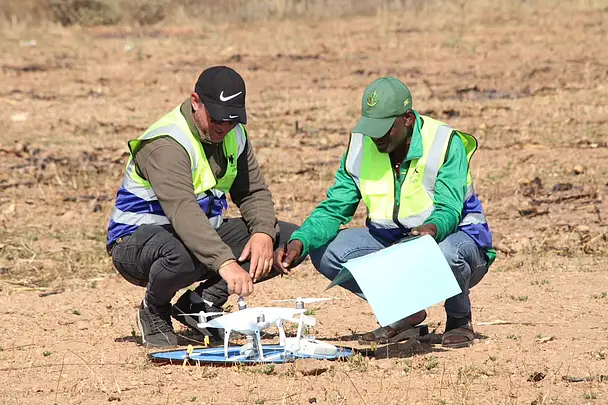
In the rugged northern section of Hwange National Park, protecting wildlife requires more than boots on the ground. As conservation teams work across large and sometimes difficult-to-access areas, technology is becoming an increasingly important tool for monitoring wildlife, strengthening anti-poaching operations, and supporting faster responses to threats.
Recognising the importance of this technology, WWF Zimbabwe supported the Zimbabwe Parks and Wildlife Management Authority (ZimParks) and Bhejane Trust with specialised drone training for conservation personnel working in Sinamatella, an Intensive Protection Zone (IPZ).
Sinamatella holds particular importance for Zimbabwe’s rhino conservation efforts. The area was designated as an Intensive Rhino Protection Zone in 1990’s as part of Zimbabwe’s emergency response to the severe decline in black rhino populations and the need to concentrate protection and monitoring efforts in key areas.
The training provided conservation practitioners – Nicholas Long, Operations Manager at Bhejane Trust, and Elias Muzvondiwa, a Senior Ranger in the Scientific Service Department at Sinamatella Camp with practical knowledge and skills to safely and effectively use drones in conservation operations.
Supporting this training forms part of WWF Zimbabwe’s broader commitment to strengthening protected-area management through partnerships, capacity building, and appropriate conservation technology.
For Muzvondiwa, the value of the training goes beyond simply learning how to fly a drone. It is about developing a practical conservation skill that can support the day-to-day work of rangers and scientific teams.
“This training is pivotal because it gives us another way of seeing and understanding what is happening in the field. We can use the skills gained to support wildlife monitoring, surveillance, mapping and data collection, helping us make better-informed decisions for conservation,” said Muzvondiwa.
“The ability to collect aerial information can be particularly valuable in a landscape such as Sinamatella, where large areas of rugged terrain can make conventional ground-based monitoring time-consuming and difficult. Drone-based information can complement ranger patrols and other monitoring approaches by providing an additional perspective of the landscape,” he said.
For Long, the training is directly linked to strengthening work on the ground.
“I am getting a drone licence that we can use in the field for anti-poaching,” he said.
He explained that having trained personnel who can operate drones provides conservation teams with an additional tool to support field operations, monitor large areas, and respond to potential threats more effectively.
The drone training covered areas including drone and remotely piloted aircraft System (RPAS) fundamentals, technical knowledge, principles of flight, meteorology, navigation, air law, as
Participants acquired practical flight training, covering aircraft familiarisation, pre-flight procedures, basic flight manoeuvres, manual flight exercises, circuit flying, emergency procedures, advanced flight exercises, and operational scenarios
The final stage focused on applying these skills to conservation-related activities. Participants were introduced to flight planning, mission planning, risk assessment, data collection, image acquisition, data processing, analysis, and project presentation.
For Zimbabwe, protecting rhinos requires continued investment in effective monitoring, strengthened law enforcement, skilled conservation personnel, and appropriate technology. In areas such as Sinamatella, where rhino protection remains a key conservation priority, building the capacity of teams on the ground is an important part of these efforts.
‘’The use of drones can complement existing conservation approaches by providing aerial information that supports wildlife monitoring, surveillance, mapping, habitat assessment, and rapid response. When combined with the knowledge and experience of rangers, scientists, and conservation partners, this technology can strengthen decision-making and improve the efficiency of field operations,’’said Long.
Drone training strengthens wildlife protection in Sinamatella
© Kumbirai Comfort Mhandu

