

Emerging threats
Cross-postsEbolaOutbreaks
Ebola response highlights value of African science
- 25 June 2026
- 6
min read - bySciDev.Net
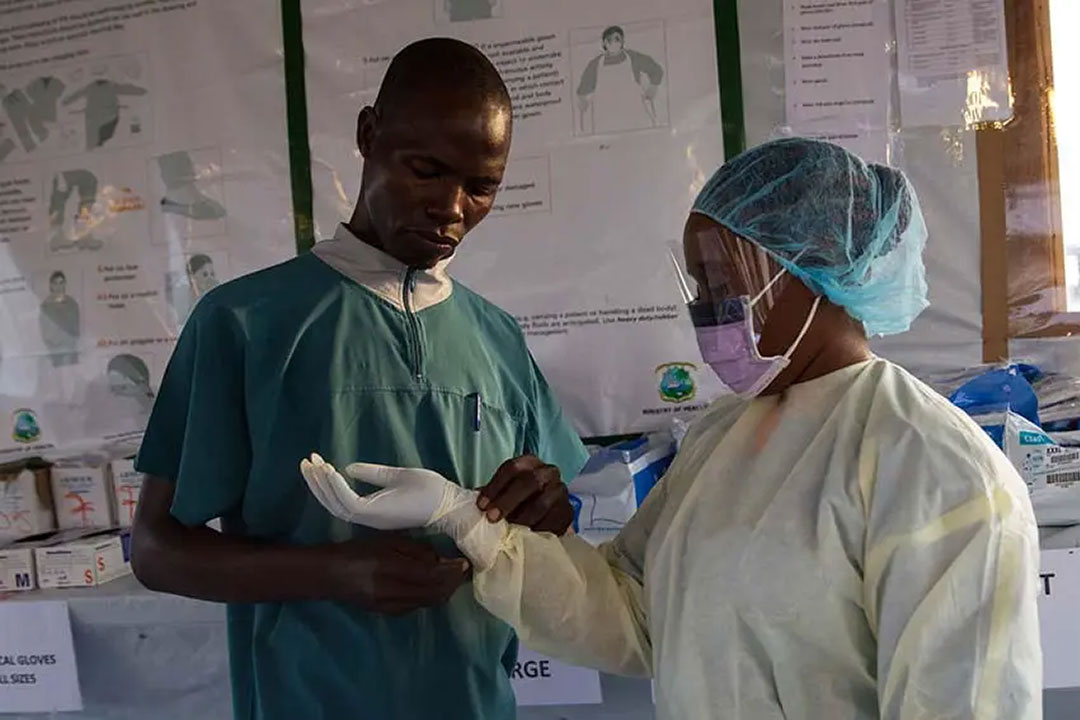
Health personnel dressing up in personal protective equipment (PPE) during a 2015 Ebola outbreak in Liberia. The 2014-16 West Africa Ebola epidemic catalysed a wave of investment in Africa’s response capacity. Copyright: UNMEER (CC BY-ND 2.0)
At a glance
- African scientists confirmed new Ebola strain in days and led the response.
- Response now needs lasting funding
- World must invest in preparedness, not just react to crises
Every part of the global response to the latest Ebola outbreak in the Democratic Republic of Congo (DRC) rests on an early act of African science
When reports of a severe illness cluster reached health authorities from Ituri Province in early May 2026, researchers at the Institut National de Recherche Biomédicale (INRB) in Kinshasa analysed blood samples, confirmed the pathogen and within days delivered a diagnosis: Bundibugyo ebolavirus, a rare strain behind only two previous outbreaks, in Uganda in 2007 and the Isiro area of DRC in 2012.
The identification was fast, rigorous and decisive. It is the kind of work that rarely makes headlines, yet on which every other part of the response depends
A decade ago, the story of Ebola in Africa was told through the lens of what the continent lacked: laboratories, genomic capacity and the infrastructure to run clinical trials in the middle of an outbreak
The 2014–2016 West Africa epidemic was a turning point. It exposed real gaps, but it also catalysed a wave of investment in Africa’s response capacity that has fundamentally changed what the continent’s researchers can do
The Africa Centres for Disease Control and Prevention (Africa CDC) was established in 2016, directly out of that crisis, as a regional institution designed to detect, respond to and prevent disease threats under African leadership and on African evidence
Africa CDC now sits at the centre of the continent’s disease detection, preparedness and response architecture, strengthening national laboratory systems, training epidemiologists and operationalising genomic sequencing networks across multiple countries. This is the infrastructure African scientists are using today
The current outbreak shows what those investments can deliver. When the World Health Organization (WHO) declared the Bundibugyo outbreak a Public Health Emergency of International Concern on 17 May, Africa CDC declared it a Public Health Emergency of Continental Security the following day, mobilising its rapid response architecture and coordinating across borders in real time. Researchers from Stellenbosch University and other African institutions have since joined the scientific response.
At the 11th CelebrateLAB West Africa Conference in Monropurposing initiative, a continental effort to accelerate African-led research into diagnostics, treatments and drug discovery for future outbreaks
African scientists are not responding to this crisis from the outside; they are at its centre, driving the response and the innovation the continent needs. But leadership cannot be sustained on urgency alone
It requires predictable, long-term investments in the systems that make fast, African-led response possible in practice. This means well-equipped laboratories, genomic sequencing capabilities, bioinformatics, clinical trial platforms, regulatory systems, data infrastructure, emergency operations, and the people who run them. Such investments are critical to detect outbreaks before they materialise and to respond quickly when they do.
We have seen the impact of catalytic support from philanthropies such as the Gates Foundation, alongside development partners including WHO, Africa CDC, the European Union, and bilateral partners, in strengthening outbreak preparedness and response
When well aligned with national and regional priorities, such investments can help absorb early risk, strengthen local institutions, and accelerate the tools and systems needed before outbreaks spiral
It can support the unglamorous but essential work of preparedness that requires trained scientists, functional laboratories in-between emergencies, data systems, surveillance networks, and ensuring that diagnostics, vaccines, and treatments can move faster from evidence to access
The value of preparedness is often invisible until a crisis arrives, and that is precisely why it is neglected. Yet outbreaks are not contained by country borders. A pathogen that emerges in one community can quickly become a national, regional or global threat
The current response illustrates this. By mid- June, donors had pledged US$ 910 million, far exceeding the US$ 518 million sought in the joint Africa CDC and WHO continental response plan launched on 5 June. However, investment in the underlying preparedness infrastructure continues to lag
An outbreak stopped early costs far less in lives, illness, social disruption and economic loss. Investing in African scientific capacity and outbreak preparedness is therefore not only an African priority but a global responsibility. When Africa can detect, respond to and contain outbreaks faster, the whole world is safer
At the 79th World Health Assembly, member states reaffirmed their commitment to reforming the global health architecture and recognised Kenya, Algeria, Burundi, Egypt, Libya, Senegal, and Tunisia for notable public health achievements. Member states also agreed to continue negotiations on the Pathogen Access and Benefit-Sharingannex to the WHO Pandemic Agreement, a mechanism through which low- and middle-income countries are pushing for guaranteed access to vaccines and treatments in exchange for sharing pathogen data, with an outcome now expected in 2027.
For African leaders and institutions, this was not just another global convening; it was a platform to demand change and reimagine global health with Africa as a key contributor rather than a peripheral player
The African Medicines Agency used the Assembly to push for harmonisation of regulatory systems to accelerate local production and reduce Africa’s dependence on imported medicine
The work of the African Population and Health Research Center (APHRC) starts from a simple conviction—evidence is strongest when it is generated and used close to the people and realities it is meant to serve
Across more than 100 projects in 44 countries, APHRC work with African researchers to produce evidence that informs policy at national and regional levels, In the Countdown to 2030 initiative, APHRC works with teams in 34 countries to analyse health data and inform strategies and investments in national programmes for women, children and adolescents
The Consortium for Africa Cross-Border Evidence and Policy Sovereignty is building frameworks for African nations to define and own their research agendas on cross-border health security matters. That proximity to context, culture, and lived experience matters. It shapes the questions we ask, the methods we use, and the recommendations we make. It is also what makes African-led research irreplaceable.
We still have a long way to go, but Africa’s response to the latest Ebola outbreak and the many more public health events that are effectively managed each year, indicates that progress is real, but it is not yet secure
This is the moment, coming out of Geneva, to match the ambition of the WHA resolutions with concrete commitments to the scientific infrastructure that makes them achievable
That means core institutional funding for African academic and research centres, African researchers leading clinical trials (not serving as secondary participants in studies designed elsewhere), and knowledge translation mechanisms that fast-track evidence into policies, strategies and programmes. This approach is also strongly aligned with consensus around African sovereignty within the reformed global health architecture.
The Ebola outbreak will be contained. African scientists, coordinating with their governments and regional and global institutions, will see to that. The question the global health community, which includes African countries themselves, must now answer is whether it will invest in those scientists and institutions with the consistency they deserve

