

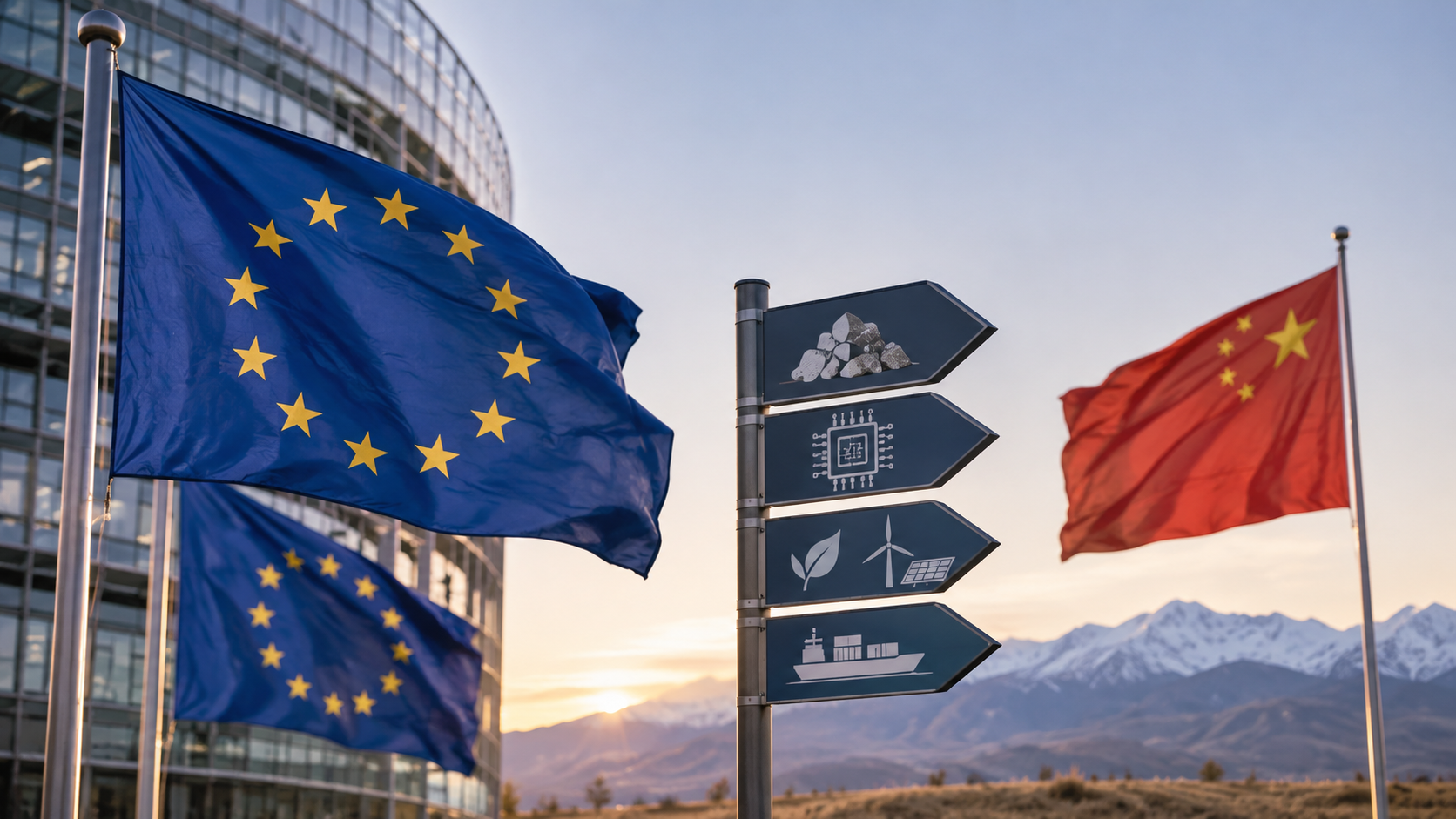
For years, Europe has been talking about reducing its strategic dependence on China, whether in critical raw materials, industrial supply chains or technologies needed for the green and digital transitions. But there is a question that seems particularly relevant for Kazakhstan: if Europe wants to diversify away from China, what exactly is it prepared to offer the countries that could help it do so?
Central Asia has become increasingly important in this discussion, and for understandable reasons. Kazakhstan and its neighbors have natural re ambitions to develop transport links, industrial capacity and new technologies. Yet the region is also deeply connected to China, whose economic presence is unlikely to diminish simply because Brussels wants to reduce certain dependencies
For Central Asia, this creates an opportunity, but not an automatic win. Europe’s search for alternatives to China could bring new investment, technology and industrial partnerships to the region, but whether these translate into lasting economic gains will depend on what Europe is prepared to offer and what Central Asian governments can negotiate in return.
Europe cannot simply walk away from China
The European Union’s (EU) position on China is complicated. Beijing is simultaneously an economic partner, a global competitor and a systemic rival, said Paweł Gałecki, an expert on EU-China relations at the International Institute for Middle Eastern and Balkan Studies.

Paweł Gałecki, an expert on EU-China relations at the International Institute for Middle Eastern and Balkan Studies. Photo credit: Personal archive
“A complete or majority separation of the EU from Chinese-origin technology, products, and logistics is simply impossible and unrealistic,” he said.
European companies operate factories and research and development centers in China, while Chinese manufacturers have established strong positions in several industrial sectors. The more realistic prospect, Gałecki notes, is managed strategic rivalry, with cooperation continuing where interests overlap while restrictions tighten in areas considered important for Europe’s economic security.
Yet this approach is complicated by differences among EU member states, whose governments do not always share the same priorities toward Beijing. Individual countries continue to pursue relations with China according to their economic interests and domestic political circumstances, making a consistent European strategy difficult to maintain.
For Central Asia, the implications are significant. If Europe wants to diversify its supply chains and strengthen its economic security, it needs reliable partners beyond China. The region offers opportunities, but those opportunities will not automatically translate into a stronger European presence.
The EU’s ambitions in the region became particularly visible at the first EU-Central Asia summit in Samarkand in April 2025, when Brusselsannounceda 12 billion euros (US$ 13.4 billion) Global Gateway investment package covering transport, critical raw materials, digital connectivity, energy and other areas of cooperation. The summit elevated relations between the two sides to a strategic partnership.
The announcement was significant, but the real test will be implementation. For Europe, Kazakhstan is attractive not only for its rend build new industrial partnerships. The EU’s Critical Raw Materials Act sets a 2030 benchmark that no more than 65% of the EU’s annual consumption of any strategic raw material, at the relevant stage of processing, should come from a single third country
Yet there is an important distinction between finding an alternative supplier and building a more resilient supply chain. If Kazakhstan simply extracts raw materials and sends them abroad, the country may help Europe diversify its imports without necessarily gaining the industrial capabilities it needs for its own development.
That is why local processing, technology transfer and industrial cooperation matter so much. The EU and Kazakhstan have already outlined cooperation on raw materials, batteries and renewable hydrogen, including a2025-2026 partnership roadmap. Whether such initiatives can move beyond agreements to create competitive industries and skilled jobs will determine how valuable the partnership becomes for both sides.
Gałecki said that Europe needs to go further if it genuinely wants to compete with China’s Belt and Road Initiative.
“To genuinely compete with the Belt and Road Initiative, the European Union’s strategic cooperation with Kazakhstan and Central Asia will require significantly greater financial investment, the transfer of industrial and digital technologies, support for Asian partners in aligning legislation with EU cooperation, and simplified, more accessible capital for Central Asian partners,” he said.
In other words, Europe cannot expect to become a more attractive partner simply by explaining why diversification serves its own strategic interests. It needs to demonstrate what its partners stand to gain.
Europe’s strengths can also become its weaknesses
The EU has advantages that matter to Central Asian countries, including access to European markets, financing, industrial expertise and established standards for environmental and corporate governance. But these strengths do not always translate into speed or simplicity, particularly when projects require several layers of approval, regulatory compliance and coordination among institutions.
Gałecki emphasized that China’s approach is often more appealing to regional governments because it comes with fewer political conditions and less cumbersome regulation than cooperation with the EU. This does not necessarily mean Central Asian countries should prefer one model over the other. It does, however, suggest that Europe needs to understand how the region perceives its approach. A partnership can look attractive on paper but lose some of its appeal if financing is difficult to access, projects take years to advance or promised technology transfers fail to materialize.
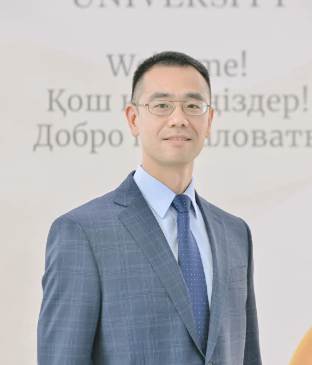
Jiyang Dong, assistant professor at Nazarbayev University’s Graduate School of Business. Photo credit: Personal archive
“The so-called ‘China’s model of influence,’ as it is often described, is not uniquely Chinese,” he said, pointing out that China’s own development benefited from trade, investment and technology transfers from Japan, the United States and Europe.
That observation matters because Europe does not necessarily need to reproduce China’s approach to remain relevant. It needs to build partnerships that offer tangible economic benefits while allowing local economies to develop their own capabilities.
For Kazakhstan, that could mean moving beyond the role of a supplier of raw materials or a transit country and becoming a more active participant in processing, manufacturing and technology-intensive industries. For Europe, it would mean that cooperation contributes not only to securing supplies but also to building a more capable and resilient economic partner.
The question is what Central Asia gains
The debate over reducing dependence on China risks becoming too focused on Europe’s strategic needs. From Brussels, critical raw materials and alternative transport routes are essential to economic security. From Astana, however, they are also opportunities to attract investment, diversify the economy and develop industries that can generate value locally.
Gulnar Shaimergenova, director of the China Studies Center in Kazakhstan, noted that Central Asian countries should not try to avoid economic interdependence altogether.
“The question for the countries of Central Asia is not to avoid such interdependence, but to preserve institutional control, diversify partnerships and independently determine national priorities,” she said.
That is a useful principle for relations with Europe as much as with China. Kazakhstan does not need to choose between the two simply because they are competing for economic influence. But it does need to assess what each partnership delivers, how much value remains in the country and whether cooperation strengthens its long-term economic position.
Europe’s ambition to diversify away from China could create opportunities for Central Asia, but the region should not confuse increased strategic attention with guaranteed economic benefits. Demand for raw materials does not automatically lead to local processing, and investment announcements do not necessarily produce technology transfer or competitive industries.
Ultimately, Europe faces a choice of its own. It can treat Central Asia primarily as an alternativein a relationship that helps the region develop its own industrial and technological capacity
The second approach would be more demanding and would take time. It would also offer something more durable than a series of deals tied to immediate European supply needs.
Get The Astana Times stories sent directly to you! Sign upgram, YouTube and Tiktok!

